|
|
| |
 |
|
| |
Click on image to buy from Amazon.com |
|
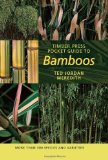
Timber Press Pocket Guide to Bamboos by Ted Jordan Meredith, 2009.
This book covers 35 genera of bamboos in cultivation and describes more than 300 species and cultivars. Each entry includes the plant's maximum height, maximum culm diameter, light requirements, and minimum temperature tolerated. Includes 300 color photographs for easy identification. Packed with all the authority of an encyclopedia in a pocket-size format, the Timber Press Pocket Guide to Bamboos is a perfect reference for taking to the nursery or garden center.
| |
 |
|
| |
Click on image to buy from Amazon.com |
|
Farming Bamboo by Daphne Lewis, Carol Miles, 2007.
Farming Bamboo describes how to grow bamboo as a farm crop for shoots and poles in the warm temperate zones of the United States. The second half of the book is an encyclopedia of the larger Phyllostachys bamboos that are suitable for producing a sellable crop. Chapters cover topics such as the botany of bamboo, selecting a site, how to source plants, how to design the planting area, soil and nutrition, irrigation, pests, control of rhizomes, harvesting shoots, harvesting poles, livestock fodder, marketing shoots and using shoots. Daphne Lewis had been a bambusero for 30 years. Dr. Carol Miles is a crop scientist working for Washington State University.
| |
 |
|
| |
Click on image to buy from Amazon.com |
|
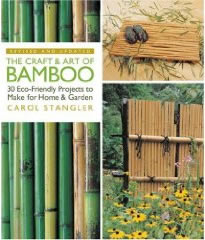
The Craft & Art of Bamboo, Revised & Updated: 30 Eco-Friendly Projects to Make for Home & Garden by Carol Stangler, 2009.
Beautiful, sustainable bamboo is one of the most popular materials around for gardens and home décor. This highly regarded introduction to the material is now back in print, revised and updated. It still offers rich history, fascinating background, and great projects, but with several new images-making this the most attractive source on the "it" plant of the green movement. From weathering the plant and preventing insect damage to attaching, bending, flattening, finishing, and preserving the bamboo, this photo-filled introduction covers it all. More than 30 how-to projects include a curved garden handrail, low trellis for climbing plants, porch swing, and even an outdoor shower stall. Lush photography and abundant illustrations make the book a visual treat.
| |
 |
|
| |
Click on image to buy from Amazon.com |
|
Bamboo: A Material for Landscape and Garden Design, by Harry van Trier, 2006. Of all the sustainable materials now available, none is more interesting than bamboo. Botanically classi?ed as a grass, bamboo is one of the fastest growing plants on the earth, easy to harvest, alternately ?exible or stiff (depending on the application) and extremely strong (stronger, in fact, than steel), and is in use in applications as diverse as ?ooring, building structures, furniture, aeronautics, and high-end racing bikes. Bamboo is a portrait of this dynamic and amazing material and a guide to its many uses across the design spectrum. Striking color illustrations convey exhaustive technical and botanical information while experts in ?elds such as biotechnology, wood technology, and horticulture explain technical properties such as the different varieties, their methods of propagation and habitat requirements, as well as information on the uses of bamboo in numerous design situations. A must-have volume for any designer interested in materials.
| |
 |
|
| |
Click on image to buy from Amazon.com |
|
Bamboo Style: Exteriors, Interiors, Detail, by Angelika Taschen, 2006. Besides feeding pandas and making a yummy addition to many Asian dishes, bamboo is also used as a building material, both functional and decorative. The dried stems are extremely sturdy and lend themselves to a multitude of uses. Shigeru Ban, for example, found a way to create lumber from laminated woven bamboo for a house he designed in Beijing. Other houses show off bamboo in more straightforward ways, lining the ceilings or floors with stems, or even forming walls. Bamboo is also used to construct furniture, lending a chair or a bed a warm, earthy feeling. This unique book captures the many uses of bamboo in houses throughout China, Japan, and Indonesia.
| |
 |
|
| |
Click on image to buy from Amazon.com |
|
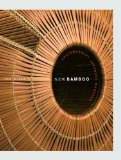
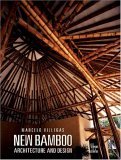
New Bamboo : Architecture and Design by Marcelo Villegas, 2003. Bambusa guadua, the tropical giant bamboo, is the most versatile, reliable architectural material of its native mountainous regions. Bamboo's delightful exterior and exotic reputation obscures its oaklike strength. New Bamboo is a color portfolio of contemporary structures and decorative designs demonstrating the appeal of building with natural materials for the modern eye. Properly treated, bamboo is as reliable as prime-grade hardwoods, beautiful in its own right, and suitable for commercial and residential structures in any climate. This is an anthology of bamboo construction by different experts: an agronomist, architects, a designer, and a builder, that showcases projects in Mexico, Brazil, Ecuador, Panama, and Colombia, where this product has been used as a traditional construction material for centuries. Also covered are France and Germany, where architects are discovering the delights of working with bamboo. Guadua is beautiful but not so delicate that it cannot be used in commercial structures like the auditorium-size pavilion built for the Hannover Expo 2000. Here are delightful details and rugged outbuildings that show bamboo as a most natural design element.
|
| |
 |
|
| |
Click on image to buy from Amazon.com |
|
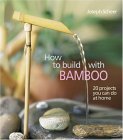
How to Build with Bamboo by Jo Scheer, 2005. How-To Build with Bamboo: 30 Projects includes step-by-step illustrations on building your own bamboo items, with 30 unique projects including a plant holder, picture frame, porch swing, candle holder, privacy panel, lampshade, chest of bins, luggage rack, and much more! With a section on the history, philosophy, and environmental advantages of bamboo, plus tips on finding bamboo locally and growing your own, How-To Build with Bamboo: 30 Projects is an incredible resource on a major modern renewable resource.
| |
|
|
| |
Click on image to buy from Amazon.com |
|
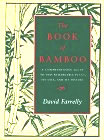
The Book of Bamboo: A Comprehensive Guide to This Remakable Plant, Its Uses, and Its History by David Farrelly, 1995. Now available once again with a new preface by the author, The Book of Bamboo introduces us to the oldest, most remarkable resource on the planet. Part catalog, part history, The Book of Bamboo shows us how this versatile wood, which is both sustainable and plentiful, has been used for thousands of years to make items ranging from things needed for survival like clothing and housing to more exotic and luxurious objects like phonograph needles and children's toys, as well as dozens of others. With information both practical and wistful, David Farrelly tells us about the plant's biology and life cycle, gives tips on harvesting and planting, and lore about the ancient wood. Farrelly conveys the rich and timeless message that bamboo -- strong, flexible, and beautiful in both its natural and its finished states is an abundant resource that could beneficially replace many of the less sustainable materials now commonly used in many aspects of our daily lives and transform our culture in the process.
| |
 |
|
| |
Click on image to buy from Amazon.com |
|
Bamboo World by Victor Cusack, Deirdre Stewart, 2000. The object of this book is to communicate a wealth of knowledge, both scientific and practical, to those with little knowledge of the fabulous clumping bamboos of the world. The Western world is not yet taking clumping bamboos seriously. Most Asian countries treat this fastest growing, annually renewable resource with great reverence. Bamboo feeds them, houses them, graces and shades their environment. It is used to make their musical instruments, cooking and eating utensils, furniture, hunting weapons, and ceremonial artifacts. It even provides the reinforcement for their concrete. Bamboo provides their carrying and storage baskets, lamps and lampshades, ropes and strings, roof tiles and hats, and has hundreds of other practical and spiritual uses. Bamboo World distills simple practical advice on using bamboo for a wealth of applications. It draws on both traditional village technology and modern scientific research, accumulated over the author's many years of travel, practice, research, growing, and association with village communities and scientists from many countries.
| |
 |
|
| |
Click on image to buy from Amazon.com |
|
Bamboo in Japan by Nancy Moore Bess, Bibi Wein, 2001. There have been other fine books that show and describe bamboo in Japan, both plants and craft, but no other book has so effectively shown how this remarkable plant has shaped a culture in all of its aspects, from the roots of its language, to its cuisine, its art, and its commerce---from the most mundane tools of daily life to the most sublime aspect of art and spirit. Beautifully designed, the book itself is a work of art, with text and photographs woven together in such a way that one finds that one has not simply read a book about a topic, but has become a part of that experience.
| |
 |
|
| |
Click on image to buy from Amazon.com |
|
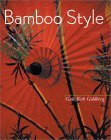
Bamboo Style by Gale Beth Goldberg, 2002. Bamboo isn't just for Asia anymore! Author Gale Goldberg shows us how to creatively bring bamboo home, teaching us how to live with it indoors and outdoors--even how to grow your own bamboo. Every room in your home can be decorated or accented with beautful, sensual bamboo furniture, flooring, wall covering, ceiling material and accessories. Bamboo is highly versatile, requiring little care yet having a visual appeal that can change a mundane setting into an exotic oasis. The resource directory includes connections to designers, manufacturers, artists, suppliers and bamboo organizations. For do-it-yourselfers, the bamboo projects in this book--from a simple ladle to a more complex pergola for the garden--will inspire you to create other designs of your own.
|
|
|
|
|
|
Bamboos by Christine Recht, Max F. Wetterwald, 2001
| |
 |
|
| |
Click on image to buy from Amazon.com |
|
|
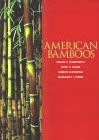
American Bamboos
by Lynn G. Clark, Ximena Londono, Margaret J. Stern, Emmet J. Judziewicz, 1999
| |
|
|
| |
Click on image to buy from Amazon.com |
|
|
|
|
|
|
|
|
|
|
|