Cool Pantries
 Kelly Hart is your host at greenhomebuilding.com. He and Rosana created a large pantry (about 150 Sqare feet) in their earthbag house. Kelly has produced a video, titled Building with Bags: How We Made Our Experimental Earthbag/Papercrete House, which chronicles the adventure of building this house, and shows some of the making of this pantry. Kelly is available to answer questions about what he has done, or consult about other pantry or root cellar projects.
Questions and Answers
Q: I'm interested in building a place that will remain cool and dry to store canned and sealed food without electricity. It seems a root cellar is too humid. Any suggestions?
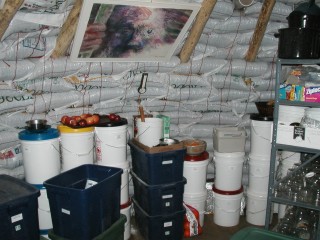 A: We have a large, naturally cool pantry just off from our kitchen, that remains dry all year round. You are right that a root cellar tends to be too humid for storing many foods. It depends on where you are located and the climate there, exactly how to design such a pantry, but in most places in the U.S. you can dig into the ground to attain very stable temperatures that are well below average highs and also well above the average lows. Our pantry (at 8,000' in Colorado) stays between 38 degrees F. and 65 degrees F. It is dug about 5' down into the ground, and then more earth is bermed up over it. There are fresh air inlet and outlet vents that remain open year round. This earthbag structure was sealed with plastic on the outside before being back-filled with soil, so that moisture does not enter the space and it stays quite dry.
Q: I have been at my present home about 18 months. There is a "cold storage' area off the basement and under the front concrete steps. We have had problems with freezing in the winter and too warm and humid conditions in the summer. I am at a loss and the previous owners (the house is 15 years old) had not used the space. It is about 6 feet square and 8 feet high. All the walls and ceiling are insulated with 1 1/2 inch rigid styrofoam insulation and the floor is covered with vinyl flooring. There is a vent at the very top of the room about 8" x 6". This steel vent has a slider in it for opening and closing the vent. The entrance to the room from the finished basement is a doorway with an insulated steel door that is very well weather -stripped. The room keeps things cool in fall and winter but, late spring and summer the room is more humid and warm than outside. I have searched and searched for some wisdom and have been led to this site. Might you be willing to help me? I would gladly pay for your time! I wish to learn that I may some time help another.
A: From your description of the room and the conditions that prevail, it is clearly not functioning as one would hope for cool storage. You say that it is under the front concrete steps; are these steps in a location where they receive much sunlight during the day? If they are, they could be storing a tremendous amount of warmth that is slowly being passed into the cool room, even with the rigid insulation. Ideally a cool room is on the north side of a house, where it receives little or no sunlight, in which case no insulation between it and the soil is needed if it is dug into the ground. It may be that you will need to add considerably more insulation against any area that is warmed by the sun.
The other problem you may be having is inadequate ventilation. If there is only one vent at the top of the room, it won't being doing much good without an inlet air vent at a lower area. This inlet would ideally draw in air that has been tempered by the temperature of the soil. If not, you can manually open it at night and close it during the day when it is warm.
Q: I need advice to make a commercial cold storage building. I want to make it in Bangladesh.
A: The only advice I can offer is to consider putting your cold storage facility underground, where the temperature is quite stable year-round. This will reduce the cost of refrigeration. You should probably consult with a local refrigeration expert for advice about just how to do this in your climate.
Q: I have been interested in Thermal Mass Refrigerators since reading about them in Earthship Vol. 3, but haven't found much practical information on them out there. If anyone has experience with them, is it worth the trouble of building one, or would it be more efficient to buy a SunFrost or a similar commercial model?
A: (David Knapp) If you live in a very snowy area where there is often 4 - 6 feet of snow on the ground in winter, a thermal mass refrigerator can work very well. The snow can be packed into a tank through a roof hatch that far surpasses any relying on chilled air to do the same trick. To the extent that you don't have much snow, one typically makes up the difference with electric refrigeration. After visiting several of them, some successful, some not, we are going to make our life simple by spending $495 (shipping included) for a 12 cu ft AC powered chest freezer that will in 2 minutes convert to a refrigerator that uses less than half the power of a $2000 Sunfrost RF-12 with the addition of an external thermostat control for $75. Then we will build a cold room pantry into the rear berm that typically varies from 40F - 60F winter to summer (fill in the two month appropriate time lag response of course). Having several working examples of thermal mass refrigerators made all of the difference for us in determining how much we wanted to "tinker" with it on a daily basis.
The most successful thermal mass refrigerator we've visited is in Steamboat Springs, CO where the snow averages 4 - 6 feet on the ground December to March. A 300 gallon tank is installed into the roof with a hatch that fills with snow. In summer a roof mounted compressor runs off PV power during the day to keep the room at 40 degrees F (+/-). I have photos of the roof configuration with snow hatch lid and vented/covered rooftop compressor. This system works pretty well, but it isn't set and forget it, the owner has put in hundreds of hours into tweaking it into operation, something great for those that like to tinker, not so great for those "Plug and play folks".
The best cool room pantry idea keeps things very simple such that there isn't anything to break down or continuously tweak ... and the space makes a great root cellar and cool room storage. The cool room pantry can be viewed in the photo link below located in the north berm of this earthbag/papercrete dome home in Crestone, CO. Crestone has 40 degree F daily temperature swings winter and summer, however snowfall isn't reliable enough to be used consistently as the primary source of cooling. The outside air can vary from -40 to 60 degrees F in the winter, making it tough to build a thermal mass refrigerator that can run unattended.
Q: I need instructions to build a food storage room above ground in an existing framed building. I want to frame up a corner of the room. I live in Utah. It can get to 100 degrees Fahrenheit and 15 below zero Fahrenheit.
A: Doing this above ground is never as effective as digging into the ground. Is it possible to berm soil around the room? You might read this article for some ideas.
Q: We're building a new house with a slab on grade foundation. I would like a root cellar but going below ground would be difficult. Due to the high water table I think it would flood in the spring.
A: Depending on the crops that you intend to store, some humidity is a good thing.
We are planning to do a cool pantry above ground but are wondering about some of the specifics in building it. We won't be able to berm it with earth very well either.
This is too bad, because either berming or digging into the ground is the best way to provide even temperatures above freezing in almost any climate.
We live in Canada and it can go as low as -25 Celsius. The usual winter temperatures are between -5 and -12 Celsius. If the cool pantry is well insulated from both the outside and the house are we liable to run into difficulty with freezing? Will we need to supply much heat in the winter?
Without the buffering effect of a lot of soil, or supplemental heat, the root cellar will almost certainly freeze.
Would it make sense to put our deep freezer in the cool pantry to reduce the cost of running the freezer and provide some heat to the pantry or would that result in overheating in the spring?
This might be a solution to keep the room from freezing, especially if it is very well insulated. It is hard to say if it would overheat things in the spring; it might. Perhaps you could partition the freezer from the rest of the cellar in such a way that it could be isolated in case it does tend to overheat the rest of the space.
We plan on using the pantry mostly to store vegetables and fruit over the winter and not use it much in the summer.
Then overheating in the summer may not be much of an issue.
Q: As I would like to build a basement, about 36' x 20', with two cool storage rooms, one for a root cellar and the other for dry storage, for a new 1 1/2 level cabin to be built on top of it. Which materials are recommended and which type of construction is best? There is no clay available here (on the Atlantic island of Madeira, Portugal), nor any strawbales, and the stones are either too hard or too soft. What would be available though with the shortest way of transportation and the least need of processing, would be logs. ( I wondered that you did not include the vernacular building with logs in this website, as they are renewable, if reforested, which is certainly the case here, as they self-seed sufficiently; amongst the most durable types of buildings as well, and when it comes to a healthy indoor climate, they are probably unequaled.)
A: The best material to use in building a basement cold storage room would be durable masonry, such as stone, cinder blocks or concrete, or even earthbags filled with local soil. You don't need to insulate such a cold storage wall since you want the natural cool from the surrounding soil to penetrate the room. I would definitely not recommend the use of wood or straw for what you have in mind. I can't imagine that stones could be "too hard" to use for building, as long as you don't have to cut them.
The reason why I don't include the use of logs as a recommended resource for sustainable building is that in most situations around the world the forests have been so badly decimated that further harvesting of trees would not be ecologically beneficial. It is true that in some localities, if the trees are harvested in a sustainable manner, then they are a good resource, but this is rare. Especially with global warming, we need to preserve the forests as much as we can to help absorb the CO2.
Q: I'm looking at creating a structure that is rectangular in shape inside for an outdoor pantry. I'm hoping to build it separate from the house. A few years ago we had a house fire that destroyed about 2 years of food storage, so want to have some food stored away from the house. My boss talked about using an old fridge or freezer for a root cellar. This is something I'm interested in.
A: Very simple cool storage facilities can be arranged with burying a garbage can (or perhaps an old fridge...)
Q: I have an old home and want to build a root cellar in the basement which is dirt. Could you please explain how this project should be done.
A: There are too many questions about your specific situation to answer in great detail. In general, you need to decide if what you need is a true "root cellar" or more of a cool pantry. Root cellars are damp and cool and are best used for keeping root crops; many other commodities are better off in a dryer atmosphere. It may or may not be appropriate to encourage moisture in your basement; often this is more appropriate away from the house. It is much easier to create dry, cool space in a basement, and for this you just need to partition off where you want the cellar, preferably on the north side of house (in the northern hemisphere), with insulated walls (if other areas of the basement are warmer. It is important to provide entry and exist ventilation in the room.
Q: I am thinking of building a cool pantry in my yard, away from the house. Would it be possible to use an underground storm shelter for a cool pantry? It is made of fiberglass, and measures 6'x6'x6'. The walls are 1/4" thick with a reinforced foam core construction. It has a battery-powered fan which provides a constant source of fresh air. Its not very deep though. There would only be 5 1/2" of Earth on on top. The actual specs call for a concrete slab 80"x80"x5 1/2", to hold the unit down in the event of a storm. Any ideas?
A: I would think that such a structure has some real potential to make a good cool pantry. It is designed to be buried, is made of materials that won't degrade, and even has built in ventilation. Just how cool it would be, depends on your location. It would help to locate the pantry in a shady area, so the summer sun won't try to heat it. You could also perhaps provide more light-weight insulation over the roof area somehow, such as straw, sawdust, perlite, pumice, etc.
Q: When we moved to our old farm, the root cellar was dry and free of mold. We decided to plant all kinds of bushes and plants around it and over the years, the root cellar has become wet and moldy. Did we cause this by introducing plants that sent their roots down and drew the water with them? How can we get our DRY cellar back?
A: Hmmm, obviously something has changed, and it could be your plantings, especially if you are watering them where before the area was not watered. Or it might just be some natural change in the migratory nature of your water table...hard to say. Plant roots will go where the water exists, not usually the reverse of this, although roots can eventually open up cracks that will allow water to enter a space. If the area above the cellar is being watered, you might stop this, or diminish it for awhile to see if this helps, depending on how dear your plantings are to you. Another thing to do is make sure that there is adequate ventilation in the cellar; there needs to be at least two vents: one as low as possible and one as high as possible. A true root cellar should actually be rather humid by definition, depending on what you want to store there. Keeping a storage room below ground absolutely dry is not easy. As a last resort you may need to uncover the entire room and seal it with a moisture barrier if you want it really dry.
Q: We are are redoing our kitchen and want to look at putting in a cool cupboard, we don't have the space for a root cellar but do have a large space under the floor of the house (approx 1 metre high). However we want the convenience of keeping most food produce in the kitchen rather than under the house. We have heard that all you have to do to keep a kitchen cupboard cool is to connect it to that under floor space or have some pipes into the earth under the house that go up to the cupboard. But we are not sure how to design this, insulate it etc. We have an area in the kitchen for a small walk in pantry and are wondering how we best make one end of this cool? Or should we just look at making a storage area under the southern end of the house space? (we are in Australia!)
A: I have no experience with ducting under-floor areas to pantries above them, but in principle I can see that this might work, although I am not sure how well. There would have to be a significant difference in temperatures to make this worth the trouble. I don't think that simply cutting a hole between the spaces will make a whole lot of difference, mainly because heat rises and cooler air stays below, so there would be no incentive for the the cold air to rise. You would need to use a small fan to mix the air, blowing the cold air from below up into the pantry for this to be effective; and probably recirculating the warmer air back down below to be cooled again. The pantry space would need to well insulated from the rest of your house in order for it to maintain a cooler temperature. Making just one area within the pantry cool would be very difficult.
We were thinking to have a pipe(s) in at the bottom and a pipe out at the top to encourage air flow, however perhaps a fan would be better. We also considered whether we could have the floor pipe going underground to further cool the air. We have designed the pantry with a cupboard at one end that we will insulate and with a fridge or cool room door on it. Do you think that would work? We have a veggie patch but live in an urban location and don't tend to have heaps of excess produce but I would love somewhere to keep fruit and veggies without using such a big fridge.
If you have a duct near the top that exhausts to the outside, this will definitely cause some air movement, with the hot air rising out of it, pulling in the cooler air from below. Having a pipe that enters the basement area and is ducted through the ground (the lower the better) is a great idea. This will provide cooler inlet air and promote circulation. In this case a fan may not be needed.
Q: My Pasadena, Ca house was built in 1949 and has a cooler pantry. It has a screen at bottom of the cabinet. House is on approx. 2' raised foundation. No basement. Screen at the top, which goes into the attic. Slat shelves. I am remodeling my kitchen and would like to keep it. However, it isn't insulated. Is there a way to improve this cooler so that it could be used to store fruits and vegetables? If so, what?
A: It would definitely perform better if it were insulated, so if you can incorporate some insulation to isolate the space from the rest of the interior of your house, that would be good. If the bottom screened vent accesses the foundation area and that area is also vented to the outside so air can come through this cooler space, that is good. Also, make sure that the attic also vents to the outside, so you get a positive flow of air upward and out. When it is really hot outside, you could close the lower vent during the day, and that might improve performance too. You could experiment with this to see what works best.
Q: I have a 4 1/2 foot to 5 foot crawl space under my house. Can that be used for a cool storage for canned goods (from store) and my owned canning goods in Jars? Sacks of potatoes and apples.
A: You might monitor the temperatures down there to see if the range is appropriate for what you want to store; you certainly wouldn't want these food items to freeze, or get warmer than they would in the house above. Chances are that it would work fine, especially if you have adequate access to the space.
Q: I have a portion of my property, North facing, that angles up hill fairly steep and I am thinking about building a cold storage area. I was thinking of two rooms, both approximately 6' x 10' for a total 12' x 10' structure. I'd like to pour concrete walls and roof, concrete division wall with an insulated door between the two rooms and an insulated door at the entry. Floor would be concrete pavers set onto a compacted sand/gravel bed. I plan to mortar stone to the inside walls. The entire structure with exception of the entry door will be buried in the earth with a minimum of 3' soils on the roof. I'm planning on a ceiling vent pipe (4" dia) in both rooms and a floor intake pipe (4" dia) in each room as well. I'll add a small solar lighting system to provide light. My goal is to use it to store canned goods, garden produce and to hang meat for aging. I'd also store wine and home brew. Any thoughts? I have over 20 years of construction experience, so I'm skilled and well equipped to build-out such a project. I just want to do it right the first time.
A: Everything that you say sounds fine to me regarding your planned construction. There are different preferred storage needs for various kinds of produce, etc. so you might study this some to come up with the right blend of temperature and humidity. In my article about cold storage, I mention a few general guidelines about this. It might be that your two rooms can have different temperature and humidity goals.
C: I built a log cabin (felled trees myself on the property, peeled the bark with a draw knife) and for my cabin floor I installed large stone slabs (3' x3') on a compacted gravel base. I removed 3' of earth and then added 3/4" crushed gravel for the floor base. I have been amazed at how it consistently stays about 15 degrees cooler in the summer and keeps the temperature at floor level slightly above freezing. There is no power in the cabin at all and I heat with a wood stove. Mother Earth is a good regulator of temperature!
Q: I think the earth bermed pantry is a brilliant idea. What is the temperature inside? I'm sure in the winter it is like a fridge, but I am wondering about summer. My summers would be a little warmer than yours. We get up in the mid to high 80s on occasion.
A: That earth bermed pantry never did freeze inside, but it got down to maybe 36 degrees F. on occasions in the winter, and up to maybe 60 in the summer when it was pushing 90 outside.
Q: I have been looking at what you say about your pantry. It sounds like you dug out several feet. Is that correct? So it is really like a root cellar?
A: Yes, our pantry was bermed into the hillside about 5' deep, and then covered with earthbags and two layers of 6 mil plastic sheeting and covered with more soil and gravel, similar to a root cellar, but without any added humidity.
The land I will be on is mesa land (flat). Do you think if I put a pantry right against the north side of my house and berm it with bags all around that I will get a similar effect to what you have?
The further down you go into the ground the more stable the temperature is, and also the more soil that is bermed around a structure the more stable it will be. One layer of bags on the north side, whether insulating or not, may freeze at times in the winter without some source of heat.
Q: My parents are constructing a garage onto their home in central West Virginia. A corner section of the concrete block garage walls are underground approximately four feet. The concrete floor has not been poured as of yet. They would like to be able to can/preserve some tomatoes, peaches, and beans annually. They are concerned about the proper temperature and humidity for storing these foods and need advice if there is proper way to enclose the underground area of their under construction garage.
A: Canned produce should be kept cool and fairly dry, but the exact humidity is not as crucial as it would be with raw produce. Obviously it should not freeze, so a temperature range of about 36 - 60 degrees would be acceptable. This temperature range is fairly easy to maintain in a completely underground pantry or cellar, but it sounds like this will not be the case in their garage. I would suggest that they try to isolate an area in the bermed corner of the garage (if this is toward the north it is ideal) with a well-insulated enclosure. This should tend to keep the temperature within the space fairly constant. The concrete blocks that are against the soil do not need to be insulated.
Q: I want to build a stacked 2-story cold pantry in our new addition. The ground temp is 44deg at this latitude. Winter temperatures are around 40-45deg F. Summer in the 70s by day, 60s at night. It would be on the N side of the house, completely insulated around the exterior aka. sides, ceiling, doors. It is less than 5x5’ on each floor. The contractor is suggesting poured concrete walls on the 1st floor only & super insulating on the 2nd floor with a solar panel powering a fan continually circulating the air between floors to cool both areas. My concern is that the thermal mass on 1 floor only will not be enough to cool both. His concern is that the cold from the ground would not be conducted 2 stories if we built the concrete walls 2 stories tall. Cost is also a factor. The duct work for the fan would pull the cool air from the lower level to the upper pantry with venting for natural convection downward. In the winter 2 exterior baffles can be opened so that exterior air can be brought in on the top floor & vented out the bottom floor. Advice on what to do please.
A: That is an interesting puzzle, and I'm not sure that I have the right answer. It sounds like you intend to only have the floor on the first level actually in contact with the earth. If there is any way to increase this contact by berming soil up around the concrete walls, this would probably help your situation. In this case you would not need to insulate those portions of the walls that are bermed.
I tend to agree with the contractor that two-story concrete walls will not conduct the cool sufficiently upward to be worth the trouble. Whether there will be enough cool mass in the lower level to also cool down the upper level is hard to say. It will certainly lower the temperature some...but the question is will it be enough? You might store things upstairs that are less critical as to temperature.
Q: I am from Canada. I am going to be building in the near future. I will have a ICF basement in my house. I plan to build a cold storage in the basement. I was planning to create a 6' by 8' ICF box within the basement and insulate the roof of the room with around R32 insulation. Conditions could get to around -35 degrees Celsius. Would I bring the cold air inlet to approx. 12 inches off the floor to introduce the cold air, and would I have to outlet air even with the roof line of the room. Would this room possibly balance a certain temperature or would I need to introduce a fan of some kind.
A: Basically your plan sounds good to me. A low air inlet and a high exhaust should create enough air circulation that no fan would be necessary. However, with winters that cold, I suggest that you provide insulated vent covers during the cold season.
Q: I live in Pa. and we have very cold winters. I do a lot of canning and have nowhere to store my jarred-up goodies. I got the idea of laying down a few strawbales on a cement floor in an outbuilding, putting in my jars and then encasing them in more bales. They would be totally surrounded by the bales. Do you think this would keep them from freezing?
A: Surrounding your canned food with strawbales would certainly help keep them warm for awhile, but if it is freezing in that outbuilding for very long the jars might also freeze. Burying them several feet underground is a better bet, but this does make them less accessible.
Q: We are building an above ground cellar to store fruits & veggies for the winter and wine storage year round. We live on the coast of SW Washington WET mild climate. Summer temps average 70, winter averages 50. We have a 4" vent coming in the cement floor and out going vents at the ceiling level and will insulate to R40. We will have a very small slow moving circulation fan. What is the optimum humidity level for storing fruits and veggies? Is the humidity going to be a problem in this climate? If so how can we increase the humidity? Humidifiers? I have heard you can't store apples and potatoes in the same space is that true?
A: From my study on optimal temperature and humidity for storing produce, it seems that this varies somewhat depending on what is being stored. Vegetables that like to be cold and very moist (32-40 degrees F., 90-95% humidity) include: carrots, beets, celery, Chinese cabbage, kohlrabi, Brussels sprouts, rutabagas, turnips, collards, broccoli and Jerusalem artichokes. Produce that likes to be kept cold and fairly moist (32-40 degrees F., 80-90% humidity) include: potatoes, cabbage, cauliflower, apples, grapes, oranges, pears and grapefruit. Produce that likes to be kept cool and fairly moist (40-45 degrees F., 85-90% humidity) include: cucumbers, sweet peppers, cantaloupe, watermelon, eggplant and ripe tomatoes. Vegetables that prefer cool and dry conditions (35-40 degrees F., 60-70% humidity) include garlic and onions. Produce that likes to be stored in fairly warm, dry conditions (50-60 degrees F., 60-70% humidity) include: dry hot peppers, pumpkins, winter squash, sweet potatoes and green tomatoes.
I suspect that the humidity in your area will actually be an advantage for storing most produce, but humidifiers or dehumidifiers can help adjust this if necessary, With average temperatures between 50 and 70 degrees F., the temperature underground will likely be around 60 degrees most of the time. You will notice that most of the produce listed above prefers lower temperatures for optimal storage. You might combine some earth-coupled inlet air vent system, with simply venting the space mainly at night to try to keep the temperatures down.
Apples will give off ethylene gas which can cause potatoes to sprout prematurely and make carrots go bitter, so store the apples near the outlet vent.
Q: I live in Fresno, CA. It gets as hot as 110 F during the summer and as cold as 28 F in winter time. I am interested in a cool pantry atmosphere. I live in a track home area but have a 9,500 sf lot. I am thinking of building away from the house. I thought something like an 8x12 foot area would be adequate. I want to store food for long term storage. I was thinking of an eleven foot hole, six inch concrete floor, cement block sides, some kind of roof, and some kind of access door. What do you think?
A: In that climate you should be able to create some storage space that maintains something like 60 degrees F. I'm guessing. You'll want to dig down or berm over the pantry with perhaps a yard of soil, and it would be a good idea to insulate the roof some. Obviously the roof needs to support a lot of weight so be sure to build it strong enough for this. It is also a good idea to provide some small air vents for ventilation (one entering at the bottom and one exiting at the top.)
Q: I live in Fresno, CA. It gets no hotter than 110 during summer. I'm looking for a cool pantry. I want to buy long term food storage with 25 year shelf life and want it to be safe and stored well. I thought about underground but that might be too aggressive.
A: I don't think that it is possible in that climate to create a very effective above-ground pantry that is completely passively cooled, without using mechanical refrigeration. Even going below ground will only yield perhaps a 60 degrees F. average temperature.
Q: We have just bought a 2-story vinyl-sided home with an unfinished basement and want to put a cool-storage room in the northwest corner of the basement which is mostly underground. In reading about requirements on your site, it sounds like we need to include a venting system. To put a vent at floor level seems like it would allow the warmer air from the rest of the basement (there is a wood stove that will be used for heating the house) enter the cool room.
A: The vents should be to the outside, not within the basement space. That way they won't be bringing in the warmer air.
Q: Our home in Northern Utah is 12 years old. We have a large cold storage room that sits under a large cement porch at the front of our home which faces north, therefore not much sun. It sits about 2/3-3/4 under ground. We have stored food successfully in this room for 11 years and until this past winter when we finished our basement and closed off the room with a solid core door, we have had no problem. But when we sealed off the room, we discovered how much freezing air was being let into our home! The cold pantry ceiling, particularly the farthest outside corner froze over, defrosted, and froze over again for a couple of months. Needless to say, I have mold growing in the farthest top part of the ceiling (and I rarely have mold living in the high desert!). I lost a lot of food as the room defrosted and dripped water every where and I have no idea what to do to prevent it this next year! I don't want to leave the door open to the basement that we now occupy - because the air is freezing and would cost us much more to heat the basement. Might you have any recommendations?
A: Obviously, the rest of that basement area helped keep the cold room from freezing, until you sealed it off. I think that what you need to do is put some good insulation up around the ceiling and the upper portions of the concrete walls that are exposed to the air outside. You could do this by attaching (possibly with glue) some rigid insulation panels (like blue board), several inches thick, to keep that from affecting the interior temperature so much. The part that is underground should tend to stay above freezing most of the time. Doing this will also help keep that space cooler in the summer.
Ideally there would also be some air circulation, with a low air vent and another up higher, to keep the air from getting stale and to help moderate possible problems with humidity. These vents can be closed off during extremely cold or hot weather to keep the temperature range right in the pantry.
Q: I'm renovating a wooden frame under my porch that is supported by 3 concrete pillars. The old frame was rotting and wasn't insulated (so it was very cold in winter) and I want to turn it into a well insulated (sealed) pantry. There is no concrete floor (just dirt/clay). While I will use pressure treated wood to rebuild, I am wondering if I should put down plastic on the ground before building to further protect the wood base?
A: Pressure treated wood is guaranteed for a very long time in contact with soil, so the plastic is likely not necessary. It might actually hold moisture up against the wood more, in which case it might even hasten decay.
Q: I live just outside Boise Idaho and our water table is 3'. I thought the neighbors were kidding but when we dug fence post holes we hit water. We want a cool "cellar" and think that an above ground earth bag building is probably the only way to go. We have 3 completely flat acres. Will an above ground structure stay cool enough to make it worth it? We can put it right behind but not touching the house on the north side. What other strategies will help with cooling-- covering it with earth vs. adobe, clay vs sand in the bags, etc.
A: According to my chart, the underground temperature in Boise is 47 degrees F., which is cooler than many localities, and would be a decent temperature for a cool pantry. With your issue of a high water table, you obviously can't dig into the ground very far, but you can mound up earth over a cellar and gain some of the same advantages of going underground. The more soil you surround the cellar with, the better, so you would need to have a plan that can withstand considerable weight and pressure, but this can be done. Many of the old potato pits in Idaho used this same strategy. Certainly earthbags filled with your local soil would be a good choice to build with because they will not rot when in contact with the earth. It is a good idea to cover whatever you build with perhaps two sheets of heavy plastic material for waterproofing.
Circular structures are stronger than rectangular ones, and they can have vertical walls with a substantial roof that can be buried. Or they can be more of a dome, such as that shown at http://earthbagbuilding.com/projects/mendome.htm. If you go with a dome, it is safest to fill the bags with stabilized earth, mostly likely sandy soil and some cement.
Q: I need to build something that will suffice for both a tornado shelter and food storage. You suggested that a cool room is more versatile than a root cellar. I was wondering... when you store vegetables like potatoes and carrots in your cool room, how long do they keep? I'll need something that will keep the vegetables good throughout the winter since I'll be growing and storing my own food. The other question is this... I just LOVE the idea of building the cool room from earth bags. However, I'm not sure papercrete would work well where I'm at... I'm concerned there may be too much moisture in the soil which could cause mold. If I were to use your earthbag building tactic, what substance would you suggest I cover the earthbags with? Papercrete or something else?
A: From your reading you probably noticed that various produce needs differing optimal conditions. So you have to make some choices about what conditions to try to maintain. In optimal conditions, you should be able to keep carrots and potatoes through the winter until spring time. I've heard that carrots do well if buried in a bucket of sand that is keep moist. Potatoes need to be kept as dark as possible so they don't sprout. You can store produce in a cool pantry, and will last a good long time, but perhaps not as long as if it were in a root cellar designed optimally for that produce. It is partly a matter of humidity, since a versatile pantry would generally be dryer than a root cellar.
You are right that papercrete is not a good material to use in a cool room or root cellar, as it is vulnerable to mold in humid conditions. If the earthbags are going to be completely out of the sunlight, they don't have to be plastered with anything; in the cool pantry that I built, we left the bags uncovered. But if you want to plaster them, you can use earthen plaster, lime plaster, or ordinary stucco.
How do build so that the weight of the surrounding earth doesn't affect the integrity of the cellar structure? How do you build a ceiling/roof for a structure that will have 1-3 feet of earth on top of it?
You can fairly easily build the walls with earthbags, especially if the structure is curved or circular, and they will be quite stable (just cover the outside with plastic before you backfill to keep moisture out.) It is the roof that gets tricky to build with earthbags.
Unfortunately we have little knowledge about burying earthbag domes, because there are very few examples of people doing this. I know of several small (about 3 m) domes that have been covered with earth, but not entirely buried underground. Theoretically it should work, especially if the fill material is stabilized with cement, but doing this would be experimental. Covering the dome with plastic is an excellent idea, and backfill in a uniform, symmetrical pattern, so that the forces are always evenly balanced. With a conical roof, it is possible to use some radial support poles as I did with the earthbag pantry that I made (see the photos in this article) Another approach to roofing an underground pantry is to use heavy duty poles to support a roof platform, as is shown in the first photo in that article. Or you can pour a reinforced concrete roof that is engineered to withstand the weight.
Q: What size vents would be best for a 6' x 12' cold cellar?
A: I think that 5" or 6" vents should suffice, and you should be able to find them at a building supply center.
Q: My wife and I are building a passive solar home on Vancouver Island and our designer has penciled in a cool room at my request but has no instruction on how to vent or insulate it. The house is buried into a steep slope, the north wall is about 15 feet under grade and is 10" thick concrete. The room is on the NE corner. We plan on framing and insulating the room with EPS board and isolating the concrete floor slab. I asked my builder to can off two vent holes upper and lower - he forgot or ignored me. Ought I run a lower vent pipe (cool air) internally and then vent it out over the top of the foundation wall (north), or is it really that much better if it is taken right through the concrete down low? I can always insulate the intake pipe, right? What diameter of pipe is best, and would PVC be ok? Should the upper vent be located far away from from the cold air intake? If I were to install a humidistat triggered fan, would I put it on the intake or outlet vent? I am insulating the both exterior and interior of the foundation/retaining wall with 3" EPS board. Should I do the same for the pantry, or leave it so the earth keeps the concrete cool?
A: I checked the underground temperature in Vancouver and it appears to be around 53 F., which is warmer than ideal for storing most foods, but still not bad as a cool room for storing many things. To maintain that temperature you would ideally keep both the floors and the concrete walls uninsulated and coupled with the earth. If the roof is exposed to the atmosphere it should be heavily insulated, but this would likely not be necessary if there are several feet of soil covering it.
As for the vents, it is best if the inlet pipe were also buried in the berm outside the wall and enter down low, so that the incoming air is also cooled by passing through the soil. It sounds like this would be difficult to accomplish at this point, although you might be able to do this to some extent by burying an extension of the inlet pipe some distance in the soil before it enters the room. And you can run that pipe down low in the room to get better circulation with the outlet vent. I try to make these vents at least 6" in diameter, and PVC is fine. On opposite sides of the room is best for the air flow. Any fan should go on the outlet vent.
Q: We live in Northwest Montana and want to build a cool pantry to store canned foods and emergency survival foods. We absolutely cannot dig down or surround or cover the building with earth. The building needs to be on skids so it is not a permanent structure. We don't need to worry about building codes. Would a wood framed structure "building within a building" using certified 18 inch wide strawbales for wall and ceiling insulation maintain temps between 36 and 70 degrees F? Would we need fans, vents or anything else to help maintain these temps? We could use a portable air conditioner in summer and a small heater in winter, if either is necessary.
A: A room within your house that was insulated with straw bales should be able to maintain a temperature that is different from the rest of the house, especially if you were prepared to use the heater or air conditioner on occasion. In fact, you might be able to locate a small heater/AC unit intended for use in a motel room that you could just rely on the thermostat to keep the temperature range that you want.
A less energy intensive approach would be to provide a large inlet and outlet vent to the exterior of the house, with the inlet low near the floor and the outlet vent up near the ceiling (it could have a small fan to force air out). Then you could open the vents when you wanted to take advantage of the ambient temperature outside.
In general, that pantry would likely stay well above 36 degrees F. and stabilize at the temperature that you maintain the rest of the house. If this all you want, then practically any unheated room, with strawbale walls or not, might suffice.
What do you think about a free standing building using the parameters I asked about?
Most of what I wrote is still true of an isolated building. But to get it through a long winter you might design some passive solar heat into it, with a south-facing window that has good shading from the roof during the summer, and plenty of thermal mass on the inside.