Stone Walls
 Jose Garcia has been a landscape contractor for 24 years and has gravitated to doing a lot of rock work. He has built innumerable retaining walls of timbers, boulders, drystacked and mortared stone. He has built foundations out of stone and mortar and put rock veneer around the base of a straw bale building to raise the level of waterproofing. He lays about 20 tons of flagstone a year in patios and walkways. Over the last couple of years he has built a half dozen mortared flagstone staircases. In Colorado we are blessed with a wonderful red flagstone with great tensile strength that he uses to make benches. He tries to work with the stone's shape as it comes, and can generally lay out a patio with a minimal amount of cutting or chipping, and the benches are free form and distinctly shaped. Mostly he's out rolling boulders and flipping flagstone on a daily basis.
Questions and Answers
Q: I want to know how to attach river rock to a fairly small lower part of my house facade. Right now it has just the wrap on it (The part that wasn't sided with cedar siding) I have many nice river rocks that I have gathered, but need to know the best way to attach them.
A: Your wrap should be waterproof then attach an expanded metal lath to the wall to give your mortar a tooth to grab. Use a type N masonry cement and try and cap it clean so as not to trap water at the top of the veneer. River rock can be heavy in a veneer application so beef up the bottom of the rock work, or better yet, bear on the foundation of the house.
Q: I want to make the rock go down to the ground, so extend the rock over the foundation, and use the larger heavier pieces at the bottom(I guess I can extend the metal lath almost to the ground over the foundation?I am not quite sure how to attach the lath to the foundation though, it isn't a very big area. The foundation has that foam block painted black with a waterproof stuff.
A: I have used some of the many varieties of foam block for foundation work. Most have metal or plastic tabs that you can screw the lathing to.
Q: I am planning to build my house with granite blocks using the slipform method. I am concerned with the thermal efficiency of the stone walls since the house will be built in Northern Mozambique, which has a tropical climate with temperatures routinely above 90 degrees Fahrenheit. My preference would be to add insulation on one side of the walls as you suggest in your 'thermal mass' section. What natural insulating materials would you suggest and how thick should the insulation be?
A (Kelly): It is generally best to insulate the thermal mass walls on the outside to obtain the best performance. This can be done with at least 2 inches of rigid insulation board, which is then plastered to protect it. Another option would be to imbed the same insulation in the middle of the slipform wall as it is built, which might provide a more aesthetically pleasing appearance on both sides of the wall. Or you can make a double wall, with a hollow space in the middle with either air or wool or cellulose insulation, if you want to use more natural materials.
Q: Three little pigs problem here. I have five acres of lava stones. I need to build a construction shed. First I made stone pillars with the intent to connect them with fencing and put on a metal roof. I reinforced them with rebar, but did not make deep footings and I used some volcanic sand that was free mixed with cement. The only person in a mile is mentally ill and doesn't want me to build. He managed to knock down the pillars, the columns falling apart in large chunks and falling over. Next we built with wood. Post and beam, had the wood side walls on and sheathed for the roofing, came back the next weekend with the metal roofing and he had knocked this 10x20 shed down with a sledge, splintering the roof supports and even dislodging the strapped block beam support footings.
I have had it with him. This time I want two foot stone walls, built with as much wire and rebar as I can incorporate with deep footings. I will use my salvaged OSB and 3/4" plywood with long bolts to make a form that I can move up as it dries. I have to haul all the water up there, so re-wetting is not practical, but neither is building a fourth time.
I want a wall so strong his sledge will bounce back and would hurt his arms before he could make it fall. While the lava is porous and soft on the outside, its got a really solid core and with the forming, it should be quite imbedded in the mortar. Would three feet thick be better? I worry about the evenness of that drying without fatal cracks. What is the very, very hardest and strongest mortar in the world? The police said shoot him. I would rather just discourage him with a structure that tells him that this is not his choice so I can continue with my build.
A: Quite the problem you have, and maybe one that a stone mason can solve better than a hired gun. My solution would be to build a mortared stone foundation approximately two foot by two foot for your shed. Use the stone you have and a type S masonry cement with the sand you have on site. Dig a trench about 8" deep for the foundation if the shed isn't going to be heated and cob from the rock to the roof line, tapering as you build to a finished width of about 14'. A round structure will be stronger and give you the most interior area for the least amount of wall. This is important as this will be a time consuming project. Way too much work for a weekend warrior. Put the commitment into the project on a daily basis and you will be around when your tormentor comes by with a sledge hammer. Talk to him like a neighbor if you intend to be one. He is only doing what the squirrels would do if they could wield a wrecking bar. My guess is that both he and the squirrels would tolerate you if you ask permission for this intrusion and make the commitment to the place. Any structure that you build affects the entire ecosystem on which you place it. There is a price to be paid for the disturbance. Pay a fair price and no one will begrudge your presence.
Q: I am building a 45 foot wall and 3 feet high and want to know how wide the wall should be and do I build strait up or gradually set rock little farther back?
A: A short wall like yours shouldn't need to be more that 18 to 24 inches wide at the base tapering to 14 inches or less at the top. A wall that has a little batter, each rock set back a little from the one below, will be stronger for sure. Make sure the base has a good toe, set the base stones underground about 6".
Q: I am building a small house in Napa CA. The house will be made of local stone 16 inch thick walls. For seismic reasons, it will be necessary to have a monolithic concrete core. Effectively we will build two 6 inch stone walls side by side with a 4 inch void in between. The two stone walls will have metal ties every 16 inched in both directions and steel rebar in the core/void. Every 4-5 ft in height we will pour concrete into the void to form the monolithic wall. I like the idea of using light weight concrete (LWC) for the void, but wonder about its suitability. What do you think? Do you have the engineering stats on LWC I could show to the engineer? Part of the value of the thick wall is to create a thermal mass and have the "thermal fly-wheel" effect (where it heats up during the day, but takes hours to penetrate the wall and then is released at night when it is cool). I am not sure how beneficial LWC would be energy wise. Any info on its R factor, etc would be appreciated.
A: (Kelly) 1) LWC would not be quite as structurally solid as ordinary concrete would be for the monolithic aspect of the wall, although I'm sure it would be plenty strong...the local building inspectors may not approve of it.
2) If you really wanted the thermal fly-wheel affect, you would want the wall to be a solid, concentrated mass, to pass the heat and cold all the way through, so regular concrete would be better than LWC.
3) I question whether thermal fly-wheel is really the best option in Napa. I lived for many years in Sonoma County, and I know it can get pretty warm in Napa in the summer. This means that a solid mass wall could produce uncomfortably warm interior temperatures in the summer and fall.
4) If I were doing this, I would probably put an insulative block in the void some how. This might mean using a layer of blue board in there, since the LWC might not satisfy the inspectors. If they would go for it, the LWC would be the best solution.
5) I don't really have engineering data on the material...there are so many variables according to the exact material used as aggregate, etc.
Q: My wife and I recently acquired a 4 year old manufactured home in an area where medium sized river rock is plentiful (3-7lb smooth rounded rocks) and we are considering slowly building rock walls all around the house such that we end up living in a rock house. There are many resources for techniques for building rock walls but in this instance we are concerned about sealing the original wall behind the new, rock structure--the outside of the house is currently painted wood siding--so that we don't get water, small animals, or insects living in the space and to avoid any rot. Do you have any suggestions? Will it seal sufficiently if you paint and then apply concrete directly to the wood siding as you build the wall? Is there a better way? We are open to any suggestions or cautions about anything concerned with this plan, not just this sealing issue. (For instance, should the rock be kept off of the original wall to avoid any weight stress?)
A: (Kelly) The main concern doing what you propose is to protect the wood siding from potential rot, which means keeping it sufficiently dry. I would suggest following the procedures that are employed for putting a cement stucco over a wood exterior; usually this is done by first applying layers of tar paper as a moisture barrier, then stucco netting (1 inch chicken wire will do), and then applying the stucco. This treatment seems to hold up pretty well over time. Rather than the tar paper, you might consider something like Tyvek wrap that breaths a bit to help avoid the possibility of condensation forming from the inside. Also, since you will be building the wall over time, there is the danger of moisture entering while you are in progress, so the more breathable it is the better. If the stones are as small as you indicate, the chicken wire might help hold the wall in place. You will also need to pay attention to the details of window sills, etc., to make sure these areas are sealed.
Q: I have a rock wall basement that leaks through the mortar joints. There is obviously mold build up (black). The floor is dirt with a wood structured floor over it. Is there a way to waterproof the problem without excavating the outside of the house?
A: (Kelly) I would expect any attempt to correct this problem from the inside would eventually fail. From the outside you have a better chance of mitigating the situation. Without knowing more specifically what your circumstances are, it is hard to recommend the best thing to do. It might be that installing a French drain around the periphery of the foundation to divert any water that approaches it to some other part of the property would suffice. More drastic measures would involve excavating all soil away from the foundation and applying a substantial moisture barrier there. Possibly both of these measures will be necessary.
Q: I'm thinking of building a stone foundation for our new home, 18'x35'. I love vaults, domes and arches and I'm wondering if you have any suggestions on using either a barrel vault running the length, or three domes. Oh half the house would be 2 stories. I'd like the vault to be able to function as the first floor floor. should the foundation wall be thicker at the bottom on the outside AND inside? I'd rather use as little rebar a possible, but still don't want to compromise strength. mmmm what else...are small mortared stones weaker than large?
A: I can't give you any advise about vaults or arches but can tell you that well constructed walls using large stone shouldn't need rebar in a normal setting. Set the stone to interlock and lap and keep your mortar joints small. Taper from inside and outside if you can. It sounds like your walls will be massive so you may need all the help you can get from the taper. It's the stone itself that will be providing the structure so definitely go with a large rectangular stone.
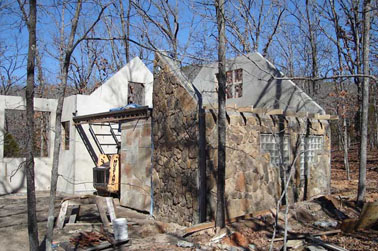 C: We are building a new home using tilt-up concrete walls. We cast on a sand bed placing native rock gathered from our site on the said bed, sweeping sand between rock spaces, pour a layer of concrete over the rock, place a layer of 2" extruded styrofoam with plastic pin connectors into fresh concrete, then place 4" of reinforced concrete over the insulation and connector pins, and finish the interior side of now a 10" wall. 100 ton crane comes in, lifts and sets.
Q: We live in the desert in southern CA and have an abundant supply of granite boulders of all sizes. I want to build a rock wall about 30" tall. I want it to have mass and taper from the base. I will insert pipe at 6' - 8' intervals to later slip in fence posts and then take fence up to 6'. It never freezes here. I am thinking 24" at base and 18" at top. Do those dimensions seem sensible?
A: (Kelly) Yes, this seems good to me.
1. Do I need a concrete footer, or can I just dig out 6" or so?
Giving the wall a 6" toe-hold should suffice.
2. I would like to make a slip form. These rocks are very irregular in shape, but mostly round. I would like to have the appearance of almost no mortar sticking out of the outside rocks. Any suggestions?
A slip form will not give you the appearance you seek. If you don't want mortar to show, you will need to individually set each rock.
3. This wall will bear no real weight, but should I integrate rebar?
A well-built stone wall, with overlapping stone, requires no rebar.
4. Can you suggest a book or WEB site to help me with mixing details, and building slip forms?
There are various books listed here, including one about building with slip forms.
Q: I am trying to put up river rock but it is just falling off after about one minute. What am I doing wrong? I am putting the mortar on a half to three quarter inch thick but why is it falling off ? I hold each rock for about 25 seconds. I am using a sticking agent and going by the directions. I am about to give up and I don't want to.
A: (Kelly) It is hard for me to know the scale of what you are attempting, whether a small mosaic or a large wall project...but in general you can't expect the mortar to hold the stones in place until it sets up in several hours. If the stones will not stay where you want them without mortar, then you need to find other stones that will. You need to arrange the stones so that they support each other without mortar, and then mortar them in place for a permanent arrangement. River stones are especially difficult to work with because they tend to be so smooth and rounded, so that they don't want to stay put; you just have to keep working with them until they will stay by themselves.
Q: I have 36 acres south of Patagonia, Arizona. It is mountainside facing southeast. It has some large tailing in certain areas, unworked crushed rock out of the shafts. I am thinking of a stone house, slip form with foam board, perhaps 4 inch, sandwiched between. I have a lot of stone rubble of every size from the mines. I have both flat and sloped land at about every angle. Any suggestions would be appreciated.
A: (Kelly) A southeast exposure is almost perfect for passive solar orientation, so that you get the early morning sun on the cold winter days. I would consider berming into the hillside, so that a large part of the house is actually earth-sheltered.
I like the slip-form stone with sandwiched insulation option; it should make a very comfortable and relatively inexpensive home.
Q: I'm planning to have built a granite block house - NOT veneered - actual granite walls - and I would be hiring craftsmen to build it. This is not do-it-yourself. My question is: are there even any craftsmen or building outfits out there who do this type of work anymore? Internet searches have brought me nothing, except this excellent site of yours. How might I find skilled, reputable people who still do this type of work? This house will be built (if I can find anyone) in northeastern CT.
A: (John Connell) Yes, there certainly are people who still do this sort of work. They're known as "stone cutters" and their trade/guild goes all the way back to the middle ages when they were the master craftsmen who build cathedrals. So, naturally, you must inquire at a cathedral that's still in the process of being built. Lucky for you, there's just such a cathedral in NYC. The Cathedral of St. John The Divine (110 th or so, I believe) actually has a stone cutters guild on their property. They train people from all over the world who come there to learn from some of the last truly gifted masters. So give them a call. I'm sure many of their faculty and graduates would LOVE to look at a nice project like yours.
Q: My wife has an old stone house in the north of France. She would like to convert the garage to a sun room. This would require putting a door way through an existing stone wall to access the new room. This exterior wall is a double thickness of 16 inch sand stone. My thinking is that it would be possible to cut out the top threshold on one layer at time and insert a concrete and steel piece before proceeding to the next layer. Then to do the same with the vertical sections of each layer of the wall before removing the core. These pieces would be tied together with rebar and concrete.
A: (Kelly) Your plan sounds like it would probably work to me, although advising someone from a distance on a project of this sort is difficult. The most critical area of concern would be the top of the doorway where the vertical loads above it could cause failure. If there is enough height in that wall, it might even be possible to make the cut as an arch, which would be inherently more self-supporting and require less reinforced concrete to be stable.
Q: We have an older ranch house and are trying to "beautify" it. We have an ugly outside wall made of stucco that we would like to apply mosaics to but since it is an outside wall and subject to the elements, we do not know what materials to use. Can you please tell us? We live in PA so we get snow and cold temps.
A: What you are proposing is similar to tiling a shower stall, which is common practice. You should be able to attach and grout most forms of tile, or possibly even glass to the stucco facade using either the common adhesives or setting mortar that is used for tile work. The existing stucco would need to be clean and rough enough to "hold." I suggest that you ask a local tile professional his opinion.
Q: I am putting stonework columns to increase curb appeal on top of my T100 (wood siding). How should it be done to make sure moisture does not get and remain behind the stone face and rot and destroy the original wood siding under it?
A: I would put a waterproof membrane between the mortar and your siding. Tar paper would work as well as any number of other treatments. Over the waterproof membrane screw in an expanded metal lath to give your mortar some tooth. You may have to pour a small foundation for the rock you are adding depending on the weight.
Q: Can I build a rock wall on plywood, its going behind wood stove, will it stick to plywood?
A: I installed wood stoves for a living in the 80's and though I haven't kept up on codes I remember that you need some distance from the stove to a fireproof surface and an airspace of an inch or so to a flammable surface. In my house I put a piece of flagstone about 6 inches behind my stove with an inch air space between it and the plaster wall. That inch of air space needs to be vented top and bottom. I'm thinking a good 12 inches between stove and flammable surface so the backing has to be bigger than the stove and up off of the floor to some extent to allow air flow behind the backing. A rock wall will transmit heat directly to the surface behind it so that plywood will be compromised without an airspace. If you put a rock wall as a backing to the stove consider the weight of the wall on the floor that supports it. I have seen a functional backing of a wood stove of a piece of sheet metal with an inch spacer to a flammable wall, not too pretty but no fire danger.
Q: We are building a home in western Montana. We have an ICF foundation with a 4" ledge for stone work. The plans call for a 4" battered stone veneer. Height ranges from 6' in one section but mostly 1-2'. The mason suggests that we have to add a angle iron to the ledge to accomplish this. My concern is freezing of the metal. I have been told that because the ground is decomposed granite there is not too much of an issue with water and freezing. So My question is should I worry? Is there an alternative? Or maybe just go with a straight wall and not worry.
A: The mason is in a position to know if you need an angle iron to stabilize the bottom of the veneer. Decomposed granite is a good medium to drain any water down below the frost line but you should still get some freezing of the soil in the winter. This has no effect on your veneer or the angle iron. I'm sure that the foundation is below the frost line for your area and the mortared stone should be set up before winters freezing temps give you any problems. So no worries.
Q: I have sand stone on my property that I want to use on the back wall of the fireplace. I have gathered flat sand stone rock to try and keep the weight as light as possible as well as easier to apply to drywall. What do I put it up with so it will stay. I thought about doing spacers to either cement in between or grout. I need an Adhesive that will glue it to the back of the wall immediately. I'm not dealing with a normal home. I am in a double wide mobile home. this is all I have to work with and would like to know how to do it right. Any suggestions?
A: I assume that you are going to build a backing for a wood stove as a fireplace in a trailer would be problematic. I installed backings for wood stoves a long time ago for a while and it is something that you can probably do yourself. Every stove is different and the requirements to keep it safe are likewise different. You should consult the manufacturer on the size of the backing and if you need a fireproof base. Generally you can build a backing for the thin sandstone you have with 5/8 drywall and cement backer board. I would lay the drywall horizontally and glue and screw the backer board vertically to the front of it creating an inch thick wall that should be attached to your existing wall with long screws and spacers of an inch or so. I used to use metal conduit cut to an inch length for the spacers. You also need to allow air to come in from the bottom so cut a couple of 2 by 6 inch slots at the bottom of the backer. You can apply the sandstone to the cement backer board with a thinset mortar. I also seem to remember that trailers had special requirements for wood stoves as to venting. I have no idea what these are myself but it may be as simple as leaving a window cracked open when you are burning the stove. Good luck and be safe.
Q: I would like to build a stone house without any kind of mortar in the San Gabriel mountains of California. I may be interested in finishing the house with a natural, perhaps adobe plaster, but I only want to use what I find within 100 yards of the site. I want it to be located on a mountain ridge. I would like the house to exist within a slice of the ridge. For a roof, I want to use only what materials, again, that I can find in the area. There may be some large trees I can fell. The structure will only be about 12x12 or 15'. Any comments on the feasibility?
A: (Kelly) Sure, you could do this; it is what our ancestors used to do for shelter. I wrote about what the ancient Hopi did in the Southwest in this article.
Q: I am trying to lay stone on a wood wall the way I saw my contractor do when he stoned the wall above my fireplace. He applied the wire mesh, then screed mortar, let it dry, mortared the back of the stone with type s mortar, pressed the stone in place and it stuck. Mine won't stick--just falls off 8 out of 10 times. I may have screed too much mortar on the wire mesh--I covered it completely. Any help would be greatly appreciated.
A: Try a type N mortar and some masonry glue. You may also have too much sand in your mix. Stay away from the premixed bags of mortar. Mix your own and experiment with the proportions to get a sticky mortar. Clean sand and clean water are important. The masonry glue applied to the old mortar and into the wet mix should help too. I don't think your mortar on the mesh is the problem if it is solid and clean.
Q: I'm trying to adhere lava rock to concrete block, (exterior), I tried thinset but the rock is coming off, what do I need to do or use to make the rock stick. It is just in some areas where the dry stack won't work.
A: First make sure that the concrete block is clean, then wet the block before you mortar the rock to it. Try a masonry cement, type R, and use a masonry glue in the mix. Stacking the stone in a manner that more or less supports itself till the mortar dries will help. I will sometimes use small stones or chips as shims till the mortar sets up. I have also used brick ties, if the stone is heavy, to hold the mortar to a smooth wall.
Q: We are purchasing land by Grants, New Mexico. We were planning an adobe structure with a fiber glass roof to catch the rain water, to fill cisterns. I have been to the land once and discovered the abundance of volcanic rock. I grew up in Kansas where lime stone was used to build with. I am looking for information on using the volcanic rock motored together with the adobe. Is this even possible?
A: (Kelly) Yes, you can combine volcanic stone with adobe, either in adjacent walls, or using the adobe to mortar the stones together. This is the old fashioned way to lay up stone walls. It is not as durable as cement-based mortar, but it will last a long time none the less.
Q: What do you think if I use cellulose for external stone wall insulation? The wall is about 15 inches wide.
A: I think cellulose is fine for insulation if it is readily available. It will have to stay dry of course which puts the thermal mass outside of the house. Depending on your climate, consider no insulation and letting the stone wall (if it faces the sun) absorb heat during the day and will transmit into the house later. Keeping heat from leaving the house is only one consideration. Maybe the prime consideration but maybe not.
Q: I have a 16th Century stone (limestone?) barn in SW France and one section of the barn is showing severe decay (weather damage?) of the stone. Is there anything I can spray on the stone to bind this and give me some improved structural integrity? I may build a greenhouse against this south-facing wall so would be willing to look at using a lime plaster as well.
A: Limestone can be notoriously weak in an exposed setting. I like the idea of coating it with a lime plaster. I imagine a good sealer would help in the short term but I think you would have to coat it a couple of times a year. Limestone will absorb water and degrade over time, even worse if you are subject to freezing. The greenhouse and lime plaster would help protect the wall from these pressures. Just keep your watering can away from the wall.
Q: I am in the planning phase to build a garage / shelter on my property. The property is in Shelton, WA in the Olympic Peninsula and it is crossed by a pretty mighty River. I would like to use the river rocks to cover the garage exterior walls because I love the look at the rock walls and because I think it is greener and can save me some money. What are the PRO and CONS? What size of rocks to you recommend? What rocks should I stay away from? What treatment should I give to the rocks? How should I install them? How can I find local expertise? Do you think I will save money?
A: The pros are that it would fit in to the natural landscape and would be an impervious surface to the elements in that wet climate. The cons have to do with the complex technique to do it right and the fact that your design does not fit the materials, think load of the stone over the garage door. I would recommend the largest rocks that you can find locally, think gravity and friction with a consideration to small mortar joints. Stay away from rocks that send you even the most subtle message that they don't want to participate in your endeavor. It takes some time to learn what a rock wants to say to you but the time is well spent. No treatment should be applied to the rocks. You should not install them. To find local expertise meet your neighbors. Trust the guy in the beat up pick up and scraggly beard who can mix his cement. You will not save money unless you become the guy in the beat up pick up and take the time to learn the art of talking to stone. If you do, reinforce the foundation to carry the weight of the stone and only take it up four or five feet and put siding on the upper part.
Q: I am building an earth bermed house into the side of a hill. I have plenty of field stone to build with, but I do not know how thick to make the walls? Do you think 18" walls would be thick enough?
A: (Kelly) In general, 18" stone walls should be plenty wide, but it partly depends on the shape of the wall, whether the wall might also be buttressed with partitions from within, the height and pressure of the berm, whether you also intend to insulate the wall. Walls that curve against the berm can support more.
Q: My husband and I are wanting to construct a solid stone home in the Utah mountains. We are planning on using Oolite limestone and want the stone visible on both the exterior and if possible, interior walls. What do you think the best way to insulate the home would be while preserving the exposed rock on the outside and inside?
A: (Kelly) The only way to do that that I can think of is to construct a double stone wall with a hollow space in between where insulation can be inserted. This sort of thing has been done with rammed earth successfully.
Q: I was wondering about the affects on staying cool and retaining heat if insulation was applied on the interior of a stone wall. My 1st floor is about 18" stone with cement floors in southwest Connecticut. It stays nice and cool in the summer, but is cold and really hard to keep warm in the winter. Insulating the exterior isn't an option, so I'm wondering about the seasonal pros & cons of adding an insulating layer to the interior - there's room for insulating between 4" studs with drywall applied.
A: (Kelly) It is generally better to insulate stone walls on the outside because then the stone will serve as thermal mass. But since that is not an option then insulating on the inside as you propose should help keep the space warmer in the winter. The cement floors will act as thermal mass as well, so this is probably your best option.
Q: Which is the best insulating material to use between two stone walls?
A: (Kelly) I can think of several options for this. Loose, crushed scoria or volcanic pumice could work. Perlite it another option. Cordwood masonry often uses a mix of sawdust and lime to good effect. I would stay away from straw or fiberglass.
Q: I have a small farm in Blue Ridge mountains of North Carolina. I have a large amount of rocks for when the fields were cleared 100+ years ago. I would like to build a small cabin using the rock. I would like to use the slip form process with an insulated board in the center... it gets very cold in winter. I was thinking a 24' x 24' and the walls 2' thick. Does this make since? I need some books and information on this process, can you help!
A: (Kelly) This sounds like a good plan to me. There isn't much information available about slip forming stones. The only book I am aware of that addresses this is www.amazon.com/Good-Life-Nearings-Self-Sufficient-Living which reportedly has a lot of detailed information.
Q: I have a question regarding double stone walls. My biggest question is about the insulation. If I were to leave a 12" gap between the walls and if it were filled with some sort of a blown in insulation, would I still have any sort of condensation issues? I'm planning on having the walls on the same wide footing...In regards to thermal bridging, is there any need to insulate between the two walls in the footing, or should I just wrap the underground foam insulation on the inside wall, under the footing and up the side of the exterior underground portion?
A: Condensation is always a possibility when dealing with stones, so using some form of insulation that would not be adversely affected would be good. Loose, crushed scoria or volcanic pumice could work. Perlite is another option. Cordwood masonry often uses a mix of sawdust and lime to good effect. I would stay away from straw, fiberglass, or blown in insulation. For the foundation, wrapping it with foam as you suggest sounds good. This is often done with Floating concrete foundations.