|
Save
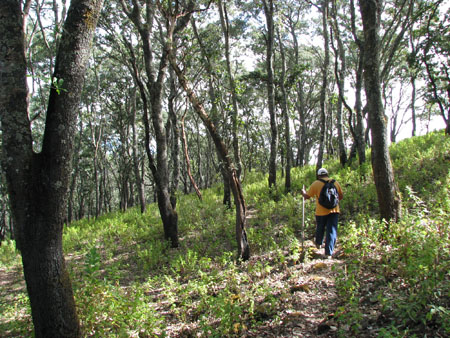
Our Forests
Having lived for many years in the Pacific Northwest,
I can attest to the appalling degradation of national and private forests.
While wood is ostensibly a renewable resource, we have gone way beyond
sustainable harvesting and have ruined enormous ecosystems.
Use wood as
decoration. Cull dead trees for structural supports. Use masonry, straw
bales, papercrete, cob, adobe, rocks, bags of volcanic rock, etc., instead
of wood. Unfortunately it is difficult to get away from lumber in making
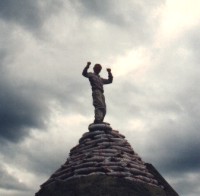
a roof, so consider making a dome from materials that can be stacked.
Domes are also more energy efficient and use less materials for the same
space as a box. A conventional straw bale house only diminishes the amount
of wood used by about 15%!
Homes can be made with certified sustainably harvested trees. This
means that the forests where the trees are harvested are carefully monitored
to make sure that the health and character of the forest is maintained.
Only certain trees are culled periodically, leaving the remaining trees
to grow and contribute to a healthy ecosystem.
Unfortunately, the American
Forest and Paper Industries has begun to mislead the public with their
own SFI (Sustainable Forestry Initiative) label, which would better be
considered the "Same-old Forest Industry" label. The Forest
Stewardship Council (FSC) legitmately certifies forest products, so look
for the FSC label. |
|
|
|
| |
 |
|
| |
Click on image to buy from Amazon.com |
|
The Last Ancient Forests (VHS video) starring James Redfield, 1999. A message from James Redfield: I grew up in the Alabama countryside, a region blessed with wonderful forests as far as the eye could see. Sadly, many of the forests I loved have been destroyed by clearcut logging and development. Alabama is not alone in losing its precious virgin forests. 500 years ago, America was covered with one billion acres of towering forests-forests with giant trees one thousand years old, and a vast array of plants and animals living in natural harmony that has existed for millions of years. Tragically, 95% of America's original forests from Alabama to Alaska have been cut down.
Most of the last, untouched wild forests left in America are found in our National Forests. Almost unbelievably, the U.S. Forest Service allows international timber corporations to clearcut our last wild and Ancient forests on millions of acres of our publicly owned National Forests! Recently, I walked amidst some of these sacred, Ancient groves in public forests in Oregon. Then, nearby, I walked amidst the devastation of an Ancient Forest that had just been clearcut and destroyed by a logging company. The experience moved me so deeply that I decided to join the national movement to save America's Ancient Forests, and restore our wonderful National Forest system. The group leading this campaign is Save America's Forests. Their campaign is succeeding because it is based on people like you and me, people from all walks of life who have joined together because they care about wildlife and forests, and want to save our public lands for our children.
The leaders of Save America's Forests traveled with me to the Ancient Forests in Oregon, and made a short documentary of my dramatic visit in the forest. You can share my journey, see what I saw, and learn how you too can help Save America's Forests by obtaining a copy of this documentary video. |
| |
 |
|
| |
Click on image to buy from Amazon.com |
|
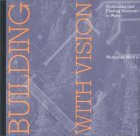
Building with Vision: Optimizing and Finding Alternatives to Wood by Dan Imhoff, 2001. The United States has both the rare fortune and the dubious distinction of being among the only industrialized nations to use wood as its primary material for residential buildings. While other developed countries have evolved masonry and other building systems not reliant on wood, on average, a full acre of trees is consumed to build just one house in the United States. And, for every twenty houses built, enough waste is typically left over to frame another house. Combining environmental philosophy, practical information, and dynamic visuals, Building with Vision makes accessible many solutions to wasteful tree-dependent construction and design. In addition to identifying the benefits, challenges, and applications of the recommended alternatives to contemporary American construction, this book details building methods to minimize wood waste, maximize efficiency, and emphasize the unique aesthetic properties of non-wood materials. Case studies highlight successful building projects that utilize innovative and effective framing, siding, insulation, roofing, and finishing materials and techniques.
|
| |
 |
|
| |
Click on image to buy from Amazon.com |
|
Finding the Forest: The Initiation by Peter P. Bundy, 1999, is a series of vignettes that offer a different vision of the forest. This vision challenges many of today's assumptions about trees, preservation and forestry practices. Peter Bundy is a certified forester who works with private landowners on stewardship plans, reforestation, harvesting, and habitat restoration projects.
| |
 |
|
| |
Click on image to buy from Amazon.com |
|
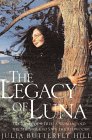
The Legacy of Luna: The Story of a Tree, a Woman, and the Struggle to Save the Redwoods by Julia Butterfly Hill, 2000. On December 18, 1999, Julia Butterfly Hill's feet touched the ground for the first time in over two years, as she descended from "Luna," a thousandyear-old redwood in Humboldt County, California. Hill had climbed 180 feet up into the tree high on a mountain on December 10, 1997, for what she thought would be a two- to three-week-long "tree-sit." The action was intended to stop Pacific Lumber, a division of the Maxxam Corporation, from the environmentally destructive process of clear-cutting the ancient redwood and the trees around it. Hill endured El Nino storms, helicopter harassment, a ten-day siege by company security guards, and the tremendous sorrow brought about by an old-growth forest's destruction. This story--written while she lived on a tiny platform eighteen stories off the ground--is one that only she can tell.
|
| |
 |
|
| |
Click on image to buy from Amazon.com |
|
| |
 |
|
| |
Click on image to buy from Amazon.com |
|
From the Redwood Forest: Ancient Trees and the Bottom Line: A Headwaters Journey by Joan Dunning, 1998. A passionate account of the struggle to save an area of northern California from logging. Describes how it was logged sustainably for decades by a family-owned business, but was subjected to liquidation logging by the Texas corporation that took over the company in 1985. Augmenting the narrative are 57 color photographs by Doug Thron of the forest before and after logging and of protest
|
| |
 |
|
| |
Click on image to buy from Amazon.com |
|
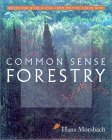
Common Sense Forestry by Hans W. Morsbach, 2002. Twenty-five years ago, when Hans Morsbach became interested in cultivating trees and managing small woodlands, he searched for a good how-to manual. He never found one, so he decided to write his own someday. Based on his subsequent experience, combining deep research into the academic literature on forestry with his successes and failures as a small-scale commercial tree farmer, the result is Common Sense Forestry, an indispensable reference for anyone who owns or wants to own wooded property. Morsbach is an unabashed nature lover as well as a businessman, and well understands the essential importance of a long-term approach to sustainable forest management. In this highly readable and entertaining text, the author offers a comprehensive look at managing existing woodlands by creating, and later maintaining, forests that promote biodiversity while providing harvestable timber.
| |
 |
|
| |
Click on image to buy from Amazon.com |
|
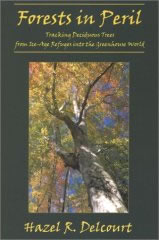
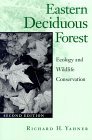
Forests in Peril: Tracking Deciduous Trees from Ice-Age Refuges into the Greenhouse World by Hazel R. Delcourt, 2002. In Forests in Peril, Hazel Delcourt takes the reader on her personal journey to document the history of the great deciduous forest that covers much of eastern North America from its elusive and nebulous presence at the peak of the last ice age through its development as a magnificent natural resource to its uncertainty in today's, and tomorrow's, greenhouse world. Along this journey, the reader is introduced to methods of studying vegetation, collecting and interpreting data, and applying the insights of forest ecology and history to project future needs of the forest in a world that is increasingly dominated by human activities. The philosophical, intellectual, and methodological perspectives contained in Forests in Peril will appeal to readers interested in understanding how the natural history of North America has been studied and how that study can contribute to the protection and preservation of America's important biological resources.
| |
 |
|
| |
Click on image to buy from Amazon.com |
|
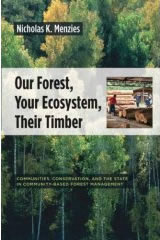
Our Forest, Your Ecosystem, Their Timber: Communities, Conservation, and the State in Community-Based Forest Management by Nicholas K. Menzies, 2007. Community-based forest management (CBFM) is a model of forest management in which a community takes part in decision making and implementation, and monitoring of activities affecting the natural resources around them. CBFM provides a framework for a community members to secure access to the products and services that flow from the landscape in which they live and has become an essential component of any comprehensive approach to forest management. In this volume, Nicholas K. Menzies looks at communities in China, Zanzibar, Brazil, and India where, despite differences in landscape, climate, politics, and culture, common challenges and themes arise in making a transition from forest management by government agencies to CBFM. The stories of these four distinct places highlight the difficulties communities face when trying to manage their forests and negotiate partnerships with others interested in forest management, such as the commercial forest sector or conservation and environmental organizations. These issues are then considered against a growing body of research concerning what constitutes successful CBFM.
|
|
|
|
|
|
|
|
|
|
In a Dark Wood: The Fight Over Forests & the Myths of Nature
by Alston Chase, 2001
| |
 |
|
| |
Click on image to buy from Amazon.com |
|
|
|
|
|
|
|
|
|
|
|
|
|
|
|
|
|
|
|
|
|
|
|
|
BAMBOO KIT HOME
Bamboo Octa Hale 20 House
Available as a complete Kit Home, delivered to your site by Bamboo Technologies
The plans for this are not for sale.


Octa Hale 20 is 320 sf interior with an extended porch roof with columns and railings which cover a 6ft wrap around deck area adding 510 sf. The deck can be used for lounging, storage, an outdoor bathroom or extra living area if screened in. The interior has warm tropical décor studio home with a living area, bed, kitchen, closet and bath. A peak cupola or skylight will brighten the interior with natural light. A premier vacation rental, guest cottage and primary residence. Modular Octa Hales can be attached to each other with an interior courtyard. They can be attached with the kitchen and living area in one octagon and the bedroom and bath in the other. Three can be attached with kitchen and bath in one, living area in the second, and master bedroom and bath in the third. Octagons can the same size or different sizes: 20, 16 or 12. It is also possible to attach a 10 ft square Pod Hale to an Octa Hale. 
To order this complete kit home from Bamboo Technologies or for more information about Bamboo Living Modular Homes, fill out their one page Customer Questionaire and they will respond by email within 24 hours. Please mention that you found them through GreenHomeBuilding.com!
For more information about this plan, and many others, visit our sister site www.dreamgreenhomes.com, where you will find a wide range of plans for sustainable homes, greenhouses, small buildings, garages, and food storage space for sale. Dream Green Homes is a consortium of outstanding architects and designers, who have pooled their talent and expertise for your benefit. |