Use Local Materials
In almost all localities, nature has provided us with some wonderful materials to build with. Because these materials require little processing or transporting, the environmental and economic costs are low. Some are renewable resources (like trees and straw), and some may be so abundant that their supply seems almost inexhaustible (like rocks and sand). One of the beauties of building with local materials is that they seem to fit well with the feeling of the place, naturally.
 |
|
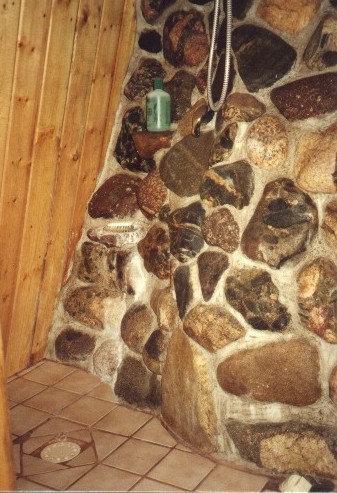
This rock wall made with our local stones lends a grotto-like feeling to our shower |
For me, the most prized local gems are the rocks. What can you do with these rocks, besides admire them? You can stack them to make retaining walls for landscaping, or make other decorative outdoor projects. They can also be mortared together to make walls for a house. My feeling is that such walls are best suited to special interior places where their thermal mass for heat storage can be taken advantage of. If they are used for an exterior wall, it should be insulated from the interior space. I built a rock wall in our shower stall that lends a wonderful grotto-like feeling to the space. I coated these stones with a thin layer of linseed oil mixed with mineral spirits to bring out the natural colors. If you go out to gather rocks, please respect people's private property and get permission from land owners to do so.
Another local mineral of great value is sand. It is the nature of sand to be self-compacting and to drain water readily. The earthbag house that I built actually has no conventional foundation; it was built directly on sand, with a layer of scoria for insulation. Sand is also useful for bedding stones, and for making mortar for rockwork.
Adobe is an extremely valuable building material, useful for both walls and floors. Any soil that is composed of between 20 and 30 percent clay, with the rest mostly sand, is good for adobe projects. Such soil is found naturally in many areas of the country. A simple way to test possible adobe soil is to place some in a glass jar and then fill the jar nearly full with water. Next, shake the jar until all of the soil is suspended in the water and then set it aside for several hours to settle out. The heavier particles will sink first, and the finer clay will settle on the top. Organic material will probably float on the water. There should be a clear line of demarcation between the clay, silt and sand. From here it is an easy matter to estimate the percentage of the total amount of soil that the clay represents. I have seen some gorgeous adobe floors that have been poured with local soils. A thin layer of colored clay can be troweled on top to produce wonderful effects. Adobe can also be made into blocks for building, tamped into forms for rammed earth walls, or mixed with straw for cob construction.
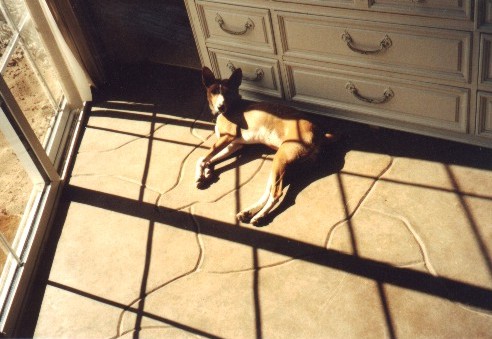 |
Our dog Sunbeam enjoys the warmth from our sunlit adobe floor. |
Scoria, a volcanic stone similar to pumice, is light and full of air pockets. This makes it very useful as a natural insulating material. I built nearly my entire house with this stuff (in a crushed form), putting it into polypropylene bags. When the bags are then sealed on either side (I used papercrete for this), you end up with a wall that is very well insulated (estimated at about R-40.) Scoria can also be used as sub-floor insulation to good effect. This stone has been used as an aggregate in cement, which results in a material that is as strong as concrete, but much more insulating. The most common use for scoria is in decorative landscaping. Our local variety is a rust red, but I have seen it black, white, and other colors.
 |
|
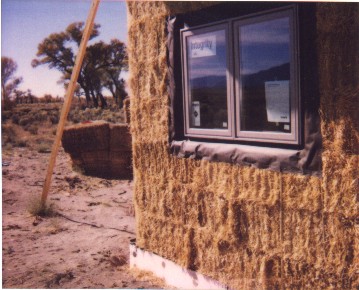
| Straw bales have become a common building block. |
A renewable building material that has become quite popular is straw, baled into tight, three-string bales. For insulation, straw bales cannot be beat (said to be about R-60). The walls go up fast, and yield a pleasingly thick, cozy feeling to a house. Care must be taken at all stages of construction to keep the bales dry, which basically means allowing the bales to breath when the house is finished. The temptation is to seal the straw bale walls completely from moisture from the outside with a vapor barrier in order to keep them dry. This would be a mistake, because the moisture in the air on the inside of the house will eventually condense on the inside of that vapor barrier, which will lead to rotten bales, and eventually failure of the wall.
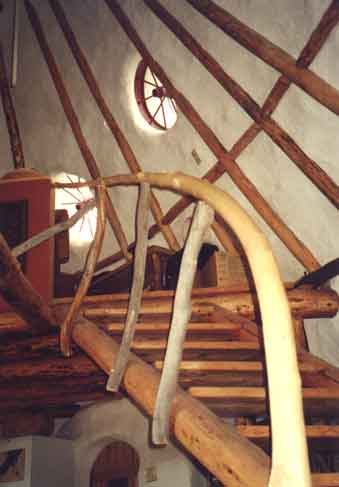 |
The view up to my office loft. Parts of natural trees were used for step runners, balustrades, railing, loft vigas, posts to support the vigas, and structural dome supports. |
The last local building material I'll mention is trees. Wood is clearly one of the most useful building materials on this planet. This usefulness has unfortunately led to its demise in many places. I generally advocate using wood sparingly, as decoration, or in places where nothing else will work. This is why I especially like domes, because a roof can be made without wooden supports. When trees are utilized in their natural rounded, and/or contorted shapes, rather than sawn into boards, there are many benefits. It is possible to find dead, but still solid trees in many locations that can be used in many ways. Parts of trees can support tremendous weight in a decorative, pleasing manner. By keeping them round, you retain the inherent strength that the tree had in the first place. Small poles that result from thinning an overly dense forest can be used both decoratively and structurally in many ways.
So, when you are thinking about a building project, either large or small, I suggest you first look around at the materials that nature provides nearby. You just might find more treasures than you suspect.
Note: For resource links related to using local materials, refer to the specific materials listed in the Natural Building section.
beingsomewhere.net a lovely example of using local natural materials to build a comfortable and beautiful home.
For Email contact go to About Us
Established in 2001, GreenHomeBuilding.com is primarily a labor of love. Kelly, and the GreenHomeBuilding team of experts, have answered thousands of questions for readers over the years, and we continue to publish up-to-date information about increasingly important sustainable architecture. If you feel moved to assist us in this work, your kind donation would be much appreciated; this can be easily done through our PayPal account:

VISIT OUR OTHER WEBSITES:
[Natural Building Blog] [Earthbag Building] [Dream Green Homes]
Disclaimer Of Liability And Warranty
I specifically disclaim any warranty, either expressed or implied, concerning the information on these pages. Neither I nor any of the advisor/consultants associated with this site will have liability for loss, damage, or injury, resulting from the use of any information found on this, or any other page at this site. Kelly Hart, Hartworks LLC.