Owner/
Builder


Sustainable Architecture

Think Small

Heat with the Sun

Keep your Cool

Use Renewable Energy

Conserve Water

Use Local Materials

Use Natural Materials

Save our Forests

Recycle Materials

Build to Last

Grow your Food

Store your Food

Share Facilities

Keep Your Cool

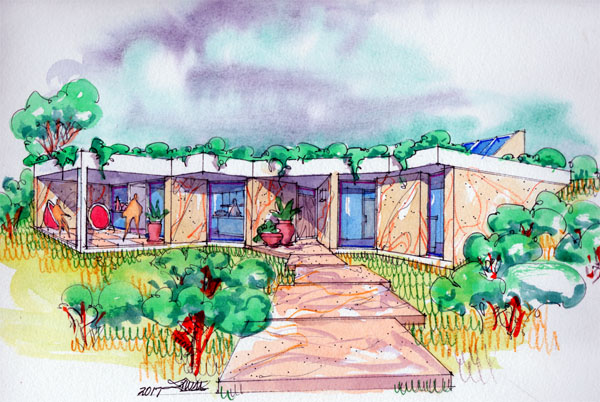
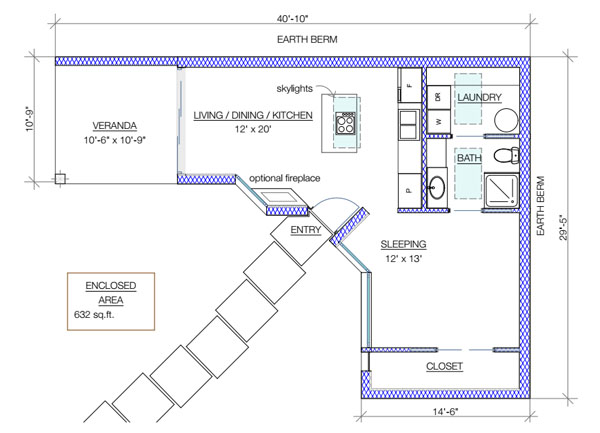
A well designed solar house is both warm when you want it and cool when you want it; that is to say, the temperature tends to stay fairly even. A good way to keep your cool is to dig into the earth. About six feet under the earth, you will find that the temperature varies by only a few degrees year round. While this temperature (about 50-55 degrees F.) might be too cool for general living comfort, you can use the stability of the earth's temperature to moderate the thermal fluctuations of the house. If you dig into a south-facing hillside to build, or berm the north part of the house with soil, you can take advantage of this. The part of the house that is underground needs to be well insulated, or the earth will continually suck warmth out of the house.
RESOURCES

SEARCH THIS SITE

BOOKS & VIDEOS

ARTICLES:
Digging In for Comfort

Recovering America

PLANS

EXPERT ADVISE

with Paul Shippee


How to build underground
Waterproofing
Insulation
Design
PSP
Miscellaneous
INFORMATIVE LINKS

PSP

PSP refers to a method of building developed by Mike Oehler, who wrote The Fifty Dollar and Up Underground House Book. Mike definitely has some ideas worth relating, although they won't appeal to everyone. He did indeed build a fifty dollar house that he is still living in, although I believe he has added on a few hundred dollar wing to it. Much of the savings that Mike has been able to attain is through a combination of using recycled materials, logs harvested from his own land, and a simple method of building underground.

PSP stands for Post/Shoring/Polyethylene. The framework of the building is created with posts that are preserved in various ways and planted in the earth. These posts serve to support both the walls and the ceiling. The space between the posts is planked with used dimensional lumber, such as from wood pallets. This is what he calls the "shoring". Then the whole thing is wrapped in polyethylene plastic before it is backfilled with earth, making a truly underground home. Instead of conventional flooring, Mike advocates using the existing earth, finely raked and smoothed, and then carpeting thrown over it.
To me the most impressive aspect of what Mike has to offer is in his design concepts for building underground. He has come up with a system for designing rooms that can provide daylight and proper drainage for a wide variety of arrangements. His thinking goes way beyond what most underground architects have accomplished.

BOOKS & VIDEOS


Click on image to buy from Amazon.com
 

The Fifty Dollar and Up Underground House Book, by Mike Oehler, 2000.


Click on image to buy from Amazon.com
 

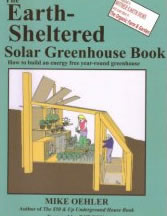
The Earth Sheltered Solar Greenhouse Book by Mike Oehler, 2007. The author writes, "my secret is that on the south wall of the greenhouse I dig a pit down eight feet and build a walkway up four or five feet where I can walk and bend over the growing beds to work on the plants. The pit allows cold winter air to flow downward to be heated by the earth rather than lying on the plants. On flat land I'd sink my north wall and all the grow areas about four foot deep and pile the earth up on the north side leaving at least a foot of north wall exposed for ventilation "windows" that can be opened as needed. I'd put some rigid foam insulation over that mound of earth on the north and a layer of polyethylene to keep it dry and some inches of earth to protect the poly from the sun. That north mound will serve as a heat sink then, to radiate heat back into the greenhouse at night."

undergroundhousing.com This links to information about Mike's book and videos, presented by the publisher.


Click on image to buy from Amazon.com
 
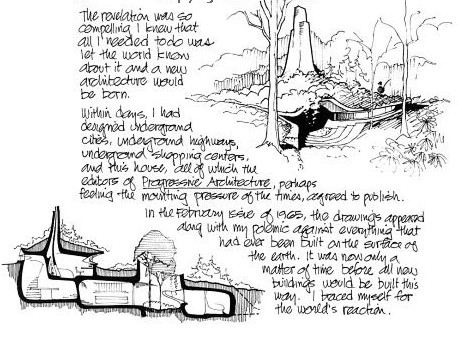
The Earth-Sheltered House: An Architect's Sketchbook by Malcolm Wells, 1998. The author's perspective on design and the building process is based on millennia of use of earth-sheltered homes by animals and humans, using the earth to keep warm in winter and cool in summer. His imaginative architectural drawings, sketches, and design plans are surrounded by his handwritten commentary about Earth-friendly building and design, cryptic remarks and humorous asides that make this book a pleasure to browse or read. He offers a breathtaking assortment of some of the most creative and unusual home and building designs ever assembled. Some are fully underground structures, some partially earth-sheltered, but all make the best use of light sources, designed to benefit from the sun and seasonal changes, and to protect or restore the natural habitat around and above them.


Click on image to buy from Amazon.com
 
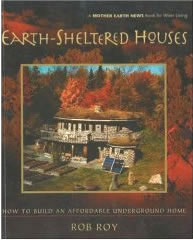
Earth-Sheltered Houses: How to Build an Affordable Underground House by Rob Roy, 2006. An earth-sheltered, earth-roofed home has the least impact upon the land of all housing styles, leaving almost zero footprint on the planet. Earth-Sheltered Houses is a practical guide for those who want to build their own underground home at moderate cost. It describes the benefits of sheltering a home with earth, including the added comfort and energy efficiency from the moderating influence of the earth on the home's temperature (keeping it warm in the winter and cool in the summer), along with the benefits of low maintenance and the protection against fire, sound, earthquake, and storm afforded by the earth. Extra benefits from adding an earth or other living roof option include greater longevity of the roof substrate, fine aesthetics, and environmental harmony. The book covers all of the various construction techniques involved, including details on planning, excavation, footings, floor, walls, framing, roofing, waterproofing, insulation, and drainage. Specific methods appropriate for the inexperienced owner/builder are a particular focus and include: pouring one's own footings and/or floor, the use of dry-stacked (surface-bonded) concrete block walls, post-and-beam framing, plank-and-beam roofing, drainage methods and self-adhesive waterproofing membranes.


Click on image to buy from Amazon.com
 

Earth Sheltered Designs, Davis Caves Construction, 2000. Over 80 earth sheltered floor plan designs and artist's renderings, prepared by architects and engineers. Floor plans range from 670 square feet to over 7,000 square feet of residential and commercial space.


Click on image to buy from Amazon.com
 

Climate Responsive Design: A Study of Buildings in Moderate and Hot Humid Climates by Richard Hyde, Peter Woods, 2000. The increasing interest in effective energy use in buildings and of the effect of this on human health, has generated the need to consider more carefully designing buildings with climate in mind. This book provides a unique source for those requiring guidance on climatic design. Covering theory and application, it provides examples of innovative and best practice in 'responsive architecture' through case studies. The book also covers the broader topic of technology as a generator in design which will be of interest to all those involved in design and building. The book focuses on tropical climate but some of the theory can be applied to other climates; the difference in application is clearly delineated.


Click on image to buy from Amazon.com
 

Underground Homes, Louis Wampler, 1980. "Underground Homes" offers the layman a complete and thoughtful approach to planning, building, and inhabiting an earth-sheltered home. Author Louis Wampler takes the reader step by step through a potential maze of construction problems. He uses simple language and numerous diagrams and illustrations to answer the questions people ask most about an underground home.The book offers information and guidance on such key factors as: Planning interior and exterior design, Choosing the proper site, Insulating for maximum energy savings, Waterproofing the structure, Deciding which roof will work best on your house, and Selecting appropriate heating and cooling systems. "Underground Homes" also addresses specific problems associated with subterranean homes-- determining the local water table, reinforcing concrete with steel, and using skylights and windows. It also discusses the common psychological barriers to living underground, presenting solutions and insights into these problems.


Click on image to buy from Amazon.com
 

Planting Green Roofs and Living Walls by Nigel Dunnett, Noel Kingsbury, 2008. The latest techniques for planting roofs and walls to enhance our buildings and benefit the environment. In this comprehensively updated, fully revised edition of their authoritative reference, Nigel Dunnett and Noël Kingsbury reveal the very latest techniques, materials, and plants, and showcase some spectacular new case studies for the non-professional. Green roofs and walls reduce pollution and runoff, help insulate and reduce the maintenance needs of buildings, contribute to biodiversity, and provide habitats for wildlife. In addition to all this, they are attractive to look at and enhance the quality of life of residents. The authors describe and illustrate the practical techniques required to design, implement, and maintain a green roof or wall to the highest standards.


Click on image to buy from Amazon.com
 

Underground Buildings: More Than Meets the Eye, by Loretta Hall, 2003. Unusual as they seem, underground buildings are surprisingly common. Every day, millions in North America work, shop, dine, study, and play in the more than three hundred public and commercial structures and five thousand private homes nestled in the earth. Underground buildings are safe, attractive, useful, and comfortable places to frequent and live. Unlike a common misconception, most are dry and warm, and they are often sun-filled. More than one hundred underground buildings are included in this fascinating subterranean tour. These buildings range from the famous to the unnoticed. Some were built for pragmatic reasons, others for aesthetic considerations, still others, for a combination of both. There are impressive success stories and discouraging tales of failure. Some underground buildings are incredibly energy-efficient, for example, while others leaked so badly they were abandoned. A vast spectrum of structures is presented, ranging from stunning examples of hidden opulence to humble subterranean cubbyholes where unassuming people immerse themselves in nature’s simplicity.


Click on image to buy from Amazon.com
 

Building Green : A Complete How-To Guide to Alternative Building Methods by Clarke Snell , Tim Callahan, 2006. This absolutely groundbreaking manual doesn't just talk about eco-friendly building techniques, but actually shows every step! More than 1,200 close-up photographs, along with in-depth descriptions, follow the real construction of an alternative house from site selection to the addition of final-touch interior details. Co-authors Clarke Snell and Timothy Callahan (a professional builder and contractor) provide thorough discussions of the fundamental concepts of construction, substitutes for conventional approaches, and planning a home that's not only comfortable and beautiful, but environmentally responsible. Then, they roll up their sleeves and get to work assembling a guest house that incorporates four different alternative building methods: straw bale, cob, cordwood, and modified stick frame. The images show every move: how the site is cleared, the basic structure put together, the cob wall sculpted, the bales and cordwood stacked, a living roof created, and more. Most important, the manual conveys real-world challenges and processes, and offers dozens of sidebars with invaluable advice.


Click on image to buy from Amazon.com
 
The Earth Sheltered Solar Greenhouse Book by Mike Oehler, 2007. The author writes, "my secret is that on the south wall of the greenhouse I dig a pit down eight feet and build a walkway up four or five feet where I can walk and bend over the growing beds to work on the plants. The pit allows cold winter air to flow downward to be heated by the earth rather than lying on the plants. On flat land I'd sink my north wall and all the grow areas about four foot deep and pile the earth up on the north side leaving at least a foot of north wall exposed for ventilation "windows" that can be opened as needed. I'd put some rigid foam insulation over that mound of earth on the north and a layer of polyethylene to keep it dry and some inches of earth to protect the poly from the sun. That north mound will serve as a heat sink then, to radiate heat back into the greenhouse at night." Mike is the author of the classic book The Fifty Dollar and Up Underground House Book  so he has a lot of experience with underground and earth-sheltered construction.


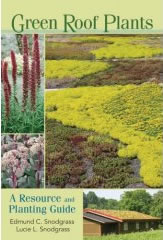
Green Roof Plants: A Resource and Planting Guide
, 2006
by Edmund and Lucie Snodgrass


Click on image to buy from Amazon.com


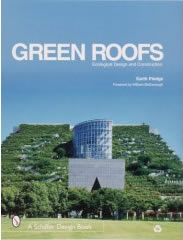
Green Roofs: Ecological Design And Construction
,
2004
by Earth Pledge Foundation


Click on image to buy from Amazon.com


The Fifty Dollar and Up Underground House Book
by Mike Oehler, 1982


Click on image to buy from Amazon.com


Earth Shelter Technology
by Lester L. Boyer, Walter T. Grondzik, 1987


Click on image to buy from Amazon.com


The Complete Book of Underground Houses
by Rob Roy, 1994


Click on image to buy from Amazon.com


Earthship: How to Build Your Own
by Michael E. Reynolds, 1990


Click on image to buy from Amazon.com


How to Build an Underground House
by Malcolm Wells, 1991


Earth Shelter Handbook
by Gregory Baum, 1980

Earth Sheltered Homes: Plans and Designs Underground Space Center
by University of Minnesota Underground Space Center, 1981

Earth Shelter Technology
by Lester L. Boyer, Walter T. Grondzik, 1987


PLANS

SunEarth House Paul Shippee, Designer

This earth-covered, passive solar, 1863 sq ft house achieved the very best performance in a HUD-sponsored energy survey when it was first built in the late 1970's. For three years after the house was built, it was computer-monitored, and according to the National Solar Data Network, the SunEarth house out-performed hundreds of passive solar houses in the country. The house was designed, built, and marketed by Colorado Sunworks. The furnace was put to rest during its first winter because the pilot light was wasting natural gas. All of the space heating demand is supplied by the passive solar system.

The heating system is a direct gain, passive solar system and drum wall. The south side exposes 300 square feet of glass windows. The windows are two panes of insulated glass that run floor to roof. Behind the windows are 54 large, vertically stacked barrels. Sunlight directly warms these 55-gallon oil drums that are painted with a flat black finish and filled with water. During the day, the water and interior concrete walls inside the house absorb the sun's heat. The heat is released slowly after the sun sets.

At night, when temperatures begin to drop, a blower pushes polystyrene beads between the two panes of glass, providing insulation to keep the daytime heat inside the home. On winter nights, this moveable Beadwall insulation converts the large window areas to R20 heat loss barrier. Six vertical skylights are arranged on the north side of the earth roof. Maximum solar energy takes place during the winter, and minimum solar energy occurs in the summer.

Winter Mode

Stored solar heat is released from the water containers as needed. Heat flows naturally by low temperature radiation and by warm air convection to the north side of the house, thus balancing comfort zones throughout the living space.

Summer Mode

Interior thermal mass is cooled down on summer nights by providing a natural air now path. Daily heat gains aree rejected by this method through turbine roof ventilators. The cooled massive house is then closed up on hot summer days for comfortable living.

For more information about this plan, and many others, visit our sister site www.dreamgreenhomes.com, where you will find a wide range of plans for sustainable homes, greenhouses, small buildings, garages, and food storage space for sale. Dream Green Homes is a consortium of outstanding architects and designers, who have pooled their talent and expertise for your benefit.


LINKS

malcolmwells.com Malcolm Wells, the grandfather of earthsheltering, has a wonderful site about his work.

earth-house.com wide ranging site mostly about earth sheltering.

pinecrest informative and personal site of John McMillian's experience with his earth-sheltered home.

greenroofs.com very informative site featuring a variety of concepts for growing roofs.

insuladd.com makes both an additive that can be combined with any paint, as well as their own formulation of paint that utilizes miniature ceramic spheres to reflect radiant heat, so that buildings that are coated with this are much better insulated from unwanted incoming heat and loss of heat from the inside...a remarkable product!

arquitecturaorganica.com features some wonderfully fanciful earth-sheltered designs by a Mexican architect.

doefactsheets general facts about earth sheltering.

schundler.com/greenroofs a discussion with photos and links about various green roof applications utilizing perlite.

solterra.info The Semrock's vision and ongoing constrcution of their earthsheltered home.

earthshelters has information and plans for a passive solar heat storage (PAHS) system.

ourcoolhouse showcases a couples' exploration of earthberming.

Seabird Island Project shows unique design for the solar heating of water and space through warm air collection and geothermal heat tubes.

stormbear.com some speculation about using concrete pipes for underground "Hobbit" homes.

earthlink.net a rambling exploration of the possibilities of burying culverts or quonsets for homes.

squidoo.com/greenroofs information, links, and photos related to green roofs.

williamlishman.com a description with photos of a unique underground home.

americansheltertechnologies.com manufactures steel arched buildings that can be placed underground.

greenroofs.com "The greenroof industry resource portal"

marant1946.blogspot.com this blog is very informative about the construction of this Texas earth-sheltered home.

Disclaimer Of Liability And Warranty
I specifically disclaim any warranty, either expressed or implied, concerning the information on these pages. Neither I nor any of the advisor/consultants associated with this site will have liability for loss, damage, or injury, resulting from the use of any information found on this, or any other page at this site. Kelly Hart, Hartworks, Inc.


Home       Site Map        STORE

For Email contact go to About Us
Established in 2001, GreenHomeBuilding.com is primarily a labor of love. Kelly, and the GreenHomeBuilding team of experts, have answered thousands of questions for readers over the years, and we continue to publish up-to-date information about increasingly important sustainable architecture. If you feel moved to assist us in this work, your kind donation would be much appreciated; this can be easily done through our PayPal account:
Google
 
Web www.greenhomebuilding.com
VISIT OUR OTHER WEBSITES:

  [Solar Car]      [Earthbag Building]     [Dream Green Homes]