![]() |
|
![]() |
|
Hybrids In a sense, virtually all buildings are hybrids of one sort or another. Most modern buildings employ a wide range of materials, some "natural" some not. A strawbale house, for instance, is most likely a hybrid of strawbales and conventional wood framing. Unless the building is a dome or vault, the roof is likely framed with wood or steel. Our domed home is a hybrid of earthbag and papercrete materials. I know of a fine circular home that was minimally framed with 2X4 studs and then strawbales set on their ends provided the insulation. I am completely in favor of using hybrid building concepts, because it frees the mind to use whatever material or technique is appropriate for any given application or aesthetic. Cob is a wonderful material for creating curved, sensuous forms; adobe and rammed earth are great for thick, fairly straight walls that serve as thermal mass; earthbags can be used for either curved or straight walls that can be either insulation or thermal mass, depending on what they are filled with; strawbales are best used for straight, thick, insulating walls; cordwood construction provides both thermal mass and insulation, and is easiest when forming straight walls; old tires make great retaining walls, or even foundations for other materials; aluminum cans can be mortared into walls of any shape; papercrete is primarily an insulating material that can be used as a plaster, or a structural material and is extremely malleable; rocks provide wonderful thermal mass and can be stacked in a variety of shapes. I suggest that you take advantage of the materials that can be found nearby that do the job required and appeal to your fancy. If it weren't for building codes, the only rules for how you build would be the laws of physics and mother nature. So, go for it when you can!
|
RESOURCES Earthbag/Papercrete/Steel Quonset Vault EXPERT ADVICE
|
Building with Bags: How We Made Our Experimental Earthbag/Papercrete House 1 1/2 hr. DVD produced by Kelly Hart.We wanted to build an environmentally sensitive and aesthetically pleasing home at a moderate price. We chose to create earthbag domes covered with papercrete (recycled paper combined with cement and sand). This honest DVD documents details of the construction, insights gained, and the ups and downs (literally!) of the building process. Several other earthbag homes are also shown. For more information about the house see Photogallery & Description of Our House or Construction Details of Our House . To view a streaming video intoduction to this DVD click here. |
|||||||||||||||
|
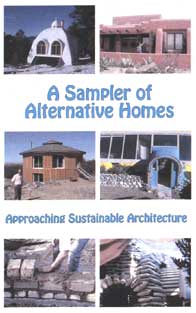
A Sampler of Alternative Homes: Approaching Sustainable Architecture . This two-hour DVD, produced by Kelly Hart, provides an overview of sustainable building concepts. You can enjoy a look at a fascinating variety of homes and the creative people who built them! Discover how passive solar design and environmentally low-impact materials can be used to create comfortable and economical homes. See the use of both traditional materials, such as adobe, and innovative materials, such as papercrete and earthbags. This program offers a wealth of information about construction details and other considerations. It covers adobe block construction, piled adobe (similar to cob), rammed earth, both load-bearing and post and beam strawbale, earthships, earth-sheltering, cordwood, thin-shelled concrete domes, papercrete, earthbags, hybrid structures, and recycling various containers for housing. To watch a streaming video introduction to this program, click here. $29.95 |
|||||||||||||||
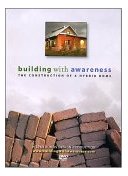
Building With Awareness: The Construction of a Hybrid Home, DVD, 2005. This beautifully photographed how-to DVD will show you how to build straw bale walls for insulation, adobe walls for interior thermal mass (which greatly increases the efficiency of a straw bale home), earth plasters for a beautiful finish, 100% electrical generation by sunlight, and passive solar heating and cooling. This video could save you thousands of dollars in design and construction costs. Beautiful aesthetics and energy-efficiency can both come from the same materials. It is how the structure is designed as a whole that makes the difference. Follow the design and construction of one house - from start to finish - and see how aesthetics, comfort, and energy efficiency can all come from the same materials and design parameters. This video is jam-packed with green design and construction techniques from professionals working in the cutting edge of home building and design. Although the video emphasizes the idea of building small, the concepts can be scaled to any size structure. You will learn about rubble-trench foundations, post-and-beam framing for straw bale walls, step-by-step straw bale building techniques, adobe wall construction, roof framing, roof insulation, acid-stained concrete floors, rainwater cisterns, graywater plumbing, photovoltaic electrical systems, wiring for straw bale and adobe, radiant floor heat, window placement & installation, green materials, earth plaster mixes and techniques, and much more. Includes a full-color, 8 page quick-reference booklet with a floor plan of the home, plus a 16 minute narrated slide show of construction details. A second audio track, that doubles the design and construction information to over 5 hours, covers the pros and cons of various materials, construction costs, and discusses the experience of building your own home. |
|||||||||||||||
The How-To Guide to Building a Monolithic Concrete Slab Foundation DVD, produced by the folks at StrawBale.com. Details of 4 different types of foundation... knowing these will present you with some options you can use for your projects. Learn why a thorough site evaluation is absolutely essential and will save you time as the project progresses. Learn what to look for when clearing a site.... what to leave, and what to remove. Learn how to build around existing structures, eliminating the possibility of damaging existing structures. Know why it is essential to remove top soil to minimize the possibility of moisture coming up from below and cracking your concrete slab. Learn the different methods to check for the grade of your site. Find out the best type of gravel to use and the thickness you need for your concrete pad. Learn why it is essential to thoroughly compact the ground prior to pouring concrete to prevent cracking in your foundation.
Design-Tech: Building Science for Architects by Jason Alread, Tom Leslie, 2006.
Taking a fresh, holistic approach to the topic of architectural technology, this indispensable book looks at the why as well as the how of building science, providing a comprehensive, clear and concise introduction to the subject. The demands faced by architects in their training and education are constantly changing. Written by two practicing architects who teach building technology and design, this text ensures that the reader is given the full picture of the discipline, as it integrates technical material with design sensibilities. Incorporating structural design, environmental principles, material science and human factors, this book shows how these topics rely upon and influence one another in architectural design. It also relates the technical with the theoretical, illustrating how technology and design have influenced one another historically. Offering highly practical guidance to the essentials of building design, this book is the first to provide the full spectrum of building science for architects in one volume. Design-Tech includes hundreds of illustrations and numerous case studies that show how these theories work in practice. |
|||||||||||||||
|
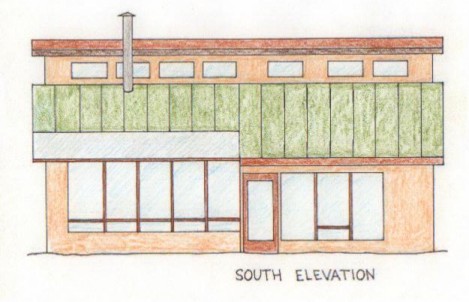
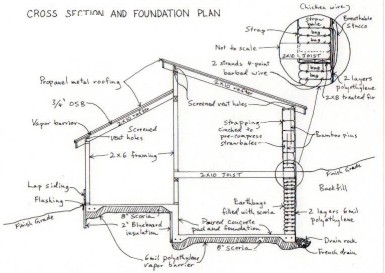
Baca Hybrid Kelly Hart, Designer
For more information about this plan, and many others, visit our sister site www.dreamgreenhomes.com, where you will find a wide range of plans for sustainable homes, greenhouses, small buildings, garages, and food storage space for sale. Dream Green Homes is a consortium of outstanding architects and designers, who have pooled their talent and expertise for your benefit. |
|
Earthbag/Papercrete/Steel
Quonset Vault I have designed a garage/workshop
on my property. I wanted it to blend in with the architecture of our
house, which is an earthbag/papercrete combination of domes, vault
and planes. It also needs to be inexpensive to build, conservative
of energy input for heating and cooling, and fairly quick to build.
The idea I came up with was to erect a steel quonset building, which
is essentially a vault, covering it with earthbags filled with crushed
volcanic rock (like our house) and then use a final plaster of papercrete
to protect the bags from the sunlight and abrasion.
At the point of connection between the
bags and the steel is a buffer of 2X10 wood with steel angle brackets
to which the steel ribs are bolted. Once this wood gets embedded
with the bags going over the vault and eventually papercreted, the
whole thing will become rather monolithic. The wood is also pinned
to the bags with half inch rebar to further anchor the quonset.
To make the whole thing more rigid and to be able to support the
weight of the bags, there will be either cables or wooden floor
joists for the loft tying both sides of the vault to each other
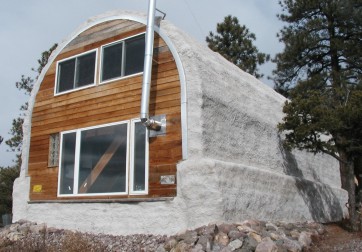
at the point where the arc begins (the spring line). So far I am pleased with how it is all coming together. I raised the first section of the quonset by myself on a day that was windier than I liked, by stretching a rope between the two trees and running a cable from the top of the roof section through a pulley on the rope, and then winching the section to a vertical position. Writing this is much easier than it actually was, because the steel was much less rigid than I expected and was sort of flopping around as I tried to raise it. I really should have had a couple of assistants guiding it up on either side, but I persevered I finally got the thing to stand on its own. Once I got it bolted and tied down, it was relatively stable. The second section was erected one piece at a time (each section is composed of five pieces). Now the vault is sturdy enough for me to climb around on it with confidence. As you can see from the picture,
I have begun to plaster the earthbags that cover the steel quonset
vault with papercrete, and am rushing to beat the deep-freeze
of winter at 8,000 feet in Colorado. I am attempting a single
application of the plaster, with a papercrete mix that has a lot
of sand in it to give a harder, more durable surface that will
be more resistant to fire and will shrink very little. I lined
the earthbags with 2 inch chicken wire before applying the plaster,
to resist cracking and provide a more monolithic coating.
You might notice that there is a board mounted just outside the bags above my head. This is a retainer (2X6) that is bolted all the way through the bag wall and the steel shell, right at the point where the vault starts to curve inward. This retainer will keep all of the bags that are stacked above it in place, so they don't topple the vertical portion of the wall.
The photo shows the front end, which was created with wood
framing and siding materials. Most of this wood was either recycled
from nearby building projects (taken from the dumpster), or
bought as remnants. The cedar lap siding actually represents
four different styles, so the fascade has a rather patchwork
quality. The door and windows (except for the glass blocks)
were all recycled as well.
I am quite pleased with
how the steel quonset/earthbag/papercrete portion of the structure
is working. I finished this part last fall, so it has wintered
over with no apparent problems. Now that the heat of the
summer
is upon us, I can testify that the interior space is remaining
deliciously cool, something that would not be expected with
an un-insulated steel building. I believe that this method of
construction has tremendous potential for residential use;
it could even be earth-bermed successfully if desired. The interior of the
shell could be finished in a variety of ways, or even left with
the steel showing, as I intend to do with this workshop. Cloth
material could be draped over it, sheetrock could be scored
on one side to allow it to curve to the shape of the vault,
or wood tongue and grooved siding could be installed, to name
a few possible surfaces.
|

Michael Shealy in conjunction with Leonard Jones, P.E., has been designing structures using tire bales. These are massive bales made by compressing about 100 tires into a 5' wide x 6' long x 2.5' high block and banding them with heavy duty (~3/16") stainless steel wire. Each bale weighs about 2000 lbs. They can be used as giant building blocks to put up walls or columns in a building. The footprint is very large and even though the weight is quite a bit more than a conventional house, a foundation is not needed... Just excavate the existing soil, level and compact it, and start stacking tire bales... The only restriction is that you ought not to start stacking these on organic or expansive soil.
Once you have the bales stacked, you add a bond beam - more as a place to fasten your roof structure than as a means to hold the building together. Then you stucco/plaster the exterior or interior, either by hand or by gunniting. When the wall is stacked, there are some considerable voids between the bales which should be stuffed with insulating material before the building is stuccoed/platered...
The bales are very strong. One bale was tested on a giant compression testing machine at the Colorado School of Mines (CSM). It resisted compression with very little deformation until one wire broke at a load of 600,000 + lbs and they concluded the test.
The bales have not been tested for thermal conductivity or heat capacity, although a group of students at CSM attempted to model thermal conductivity based on the tire bale constituents. It will be interesting to see how a house built from tire bales works in "real life."
The pictures were taken at the tire baling facility near Fountain, CO... just south of Colorado Springs. The folks on the bales are Mike Shealy and his grandson. The wall is 4 bales high (10 foot).

This picture clearly illustrates that there is no shortage of this resource. The distant black-colored areas are thousands of tire bales. The area in the foreground contains a tire-baling press and tens of thousands of loose tires.
Mike Shealy wrote: "In 1998, I was contacted by the folks at Midway Tire Recycling, having found that I was doing (generic) rammed-earth tire-house designs, and asked if I would be interested in the tire bale as a building block for residences? I took a drive down to Fountain to see them and immediately WAS interested. The Houtchens, Vernie & Ann, wanted to build their own home on their property by the tire recycling facility. After some discussion, I suggested they create an engineering document for the tire bale, ie, test results, statements of practical & comparable bearing loads, coefficient of friction and insulation values, from actual tests. This document, I told them, could/would be used in all future building using T-bales as a *bearing* building material. They told me that the T-bale wasn't *suitable* as a unit in a load bearing wall and presented me with a study done by CSMines students that concluded the same, based purely on the fact that they continue to compress as pressure is increased. This study gave no attention to the actual loads that would be developed from framing a roof on them, hence it was not practical.
They asked me who would create this document and I suggested Tom Griepentrog, the engineer who created the rammed-earth-tire-wall document for the Dennis Weaver home. Tom quoted a very thorough procedure, acceptable to me and probably future engineers. This document would make it easy for all future engineers to verify the stability of the T-bale as a berm/bearing wall for use in residences ...BUT... The Houtchens apparently had different ideas, didn't like the price for the document ($8,000), and they dumped me (& Tom) and elected to go to a non-engineered use of the T-bales, as purely *infill*, as in straw bales, using a steel post & beam structure instead. This was unacceptable to me, as it gave nothing to future uses. So, until 2002 when I 'met' Leonard on an alternative building mailing list, I just held the idea between my ears, but since meeting him have had four commissions to design T-bale homes."
To see what Mike Shealy has been up to with the tire bale projects, you can visit: www.touchtheearthranch.com
frtirerecycle.com sells these huge bales of recycled tires.
|
This is about our Roundhouse at Brithdir Mawr, near Newport in Pembrokeshire, Wales, UK. A self-built and designed ecohome of wood, cordwood and cob construction, partially earth sheltered and with a turf roof. This website describes the use of lightweight straw-clay sandwiched by ferrocement to form structural panels. hybridadobe.com Site with lots of pictures and description of a variety of hybrid papercrete/adobe/strawbale structures. groundwork.org Groundworks Institute's Nicaraguan Project details how they constructed a $300 house using local materials. greeninventor.org/strawjet describes an innovative way of creating load-bearing beams using long straw and papercrete. simondale.net/house A wonderful example of a hybrid home made from local, natural materials in the United Kingdom. |
|
Disclaimer
Of Liability And Warranty
For Email contact go to About UsWe
are interested in exchanging links with other
|