Owner/
Builder


Sustainable Architecture

Think Small

Heat with the Sun

Keep your Cool

Use Renewable Energy

Conserve Water

Use Local Materials

Use Natural Materials

Save our Forests

Recycle Materials

Build to Last

Grow your Food

Store your Food

Share Facilities

GROW YOUR FOOD

Few things give me more pleasure than living amongst green plants, especially when they are edible. If you couple this with the possibility of helping to heat your house, you can readily see why people become attached to their attached greenhouses. I have built several of them, with different materials and designs, but the basic concepts are really pretty simple. It is best to design an attached greenhouse into the original house plan, but it is often quite feasible to retrofit one onto an existing house. You need some space on the south side of the house wide enough to accommodate a growing bed and space for access. The area should not be obstructed by trees or other things that would limit the available sun light. It could have an outside entrance, but it doesn't have to.
RESOURCES

SEARCH THIS SITE

BOOKS & VIDEOS

ARTICLE:
THE GLORY OF AN ATTACHED GREENHOUSE

PLANS

EXPERT ADVICE

with Kelly Hart

and
Maya Madrigal

INFORMATIVE LINKS


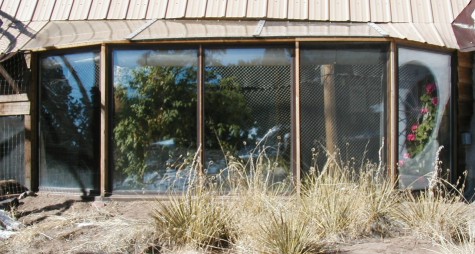
This is the attached solar greenhouse that is part of Kelly and Rosana Hart's earthbag home. What looks like a tree through the glass is actually a group of cherry tomato plants. The geranium on the right has grown nearly to the cieling.
 
BOOKS AND VIDEOS


Click on image to buy from Amazon.com
 
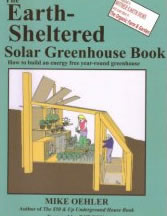
The Earth Sheltered Solar Greenhouse Book by Mike Oehler, 2007. The author writes, "my secret is that on the south wall of the greenhouse I dig a pit down eight feet and build a walkway up four or five feet where I can walk and bend over the growing beds to work on the plants. The pit allows cold winter air to flow downward to be heated by the earth rather than lying on the plants. On flat land I'd sink my north wall and all the grow areas about four foot deep and pile the earth up on the north side leaving at least a foot of north wall exposed for ventilation "windows" that can be opened as needed. I'd put some rigid foam insulation over that mound of earth on the north and a layer of polyethylene to keep it dry and some inches of earth to protect the poly from the sun. That north mound will serve as a heat sink then, to radiate heat back into the greenhouse at night." Mike is the author of the classic book The Fifty Dollar and Up Underground House Book  so he has a lot of experience with underground and earth-sheltered construction.


Click on image to buy from Amazon.com
 

Home Solar Gardening by John H. Pierce, 1992. In his clear and easy-to-follow text, author John Pierce shows how, by using the heat and light of the sun, you can grow beautiful flowers, high-quality produce, fresh herbs, and plants for use in homemade beauty care products. Learn how to build and maintain an attached or freestanding solar greenhouse, how to adapt a pre-fabricated conventional greenhouse or toolshed for solar growing, and how to construct a solar sun pit. Interesting alternatives for gardeners who don't have room for a solar greenhouse include solar frames, boxes, cloches, and crop shelters; balcony and rooftop solar gardens; and window gardens.


Click on image to buy from Amazon.com
 

The Passive Solar Energy Book: A Complete Guide to Passive Solar Home, Greenhouse and Building Design by Edward Mazria, 1979. Even though this book would seem to be dated by its publication date, I still consider it to be one of the best all-round guides to passive solar design, whether for home or greenhouse or both. I often refer to my tattered copy of this book when I want to know what the experts think.


Click on image to buy from Amazon.com
 

The Random House Book of Indoor and Greenhouse Plants by Roger Phillips, 1997. Random House has compiled a unique photographic guide to subtropical plants that can grow indoors, in greenhouses, or even outdoors in frost-free climes. There are excellent color photos of 1,100 plants, complete with the necessary details of history, characteristics, and cultivation. Covering magnolias, passion flowers, hibiscus, and figs, citrus plants, peas, bougainvilleas, and more, this gardening reference is beautifully executed and exceedingly well done. With details on the history, characteristics and cultivation of each plant, Indoor and Greenhouse Plants is an essential addition to the popular Random House garden series by Roger Phillips and Martyn Rix.


Click on image to buy from Amazon.com
 

The Indoor Plant Bible : The Essential Guide to Choosing and Caring for Indoor, Greenhouse, and Patio Plants by Dorte Nissen, 2005. Indoor gardeners who open this comprehensive guide will discover imaginative ways to transform any home's interior into a bountiful Eden. The author shares her foolproof indoor gardening secrets and offers tips on providing optimum growing conditions for a wide variety of plants. She opens with advice on what to look for when choosing and buying indoor plants. Readers are then instructed on how to determine the best location for each plant within the house, with attention to such factors as light and temperature. They will find extensive information on pots and potting, pruning, fertilizing, plant propagation, and feeding and watering requirements for each variety. Profiled in these pages is a wide range of house plants, including colorful geraniums and cineraria, ambient ferns and palms, and the more exotic orchids and cacti. The Indoor Plant Bible is beautifully illustrated with more than 400 color photos.


Click on image to buy from Amazon.com
 

Rodale's Illustrated Encyclopedia of Organic Gardening by Maria Rodale, Pauline Pears, 2005. Whether an experienced gardener is looking to go organic or a beginner wants to create a healthy, eco-friendly garden, the Rodale's Illustrated Encyclopedia of Organic Gardening contains the tips and techniques needed to produce beautiful flowers, top-quality herbs, and appetizing, wholesome fruits and vegetables. Explore the latest methods for cultivation without chemicals, discover the benefits of composting, and learn how to maintain an organic garden year-round.


Click on image to buy from Amazon.com
 
Indoor Gardening the Organic Way: How to Create a Natural and Sustaining Environment for Your Houseplants by Julie Bawden Davis, 2007. Gardening organically outdoors is prevalent in most horticultural circles today, but what about gardening indoors? Indoor Gardening the Organic Way is a definitive guide to growing houseplants organically. From the dirt on mulch to eco-friendly ways to handle plant pests, Davis has provided this essential resource for novice and experienced gardeners alike.


Click on image to buy from Amazon.com
 

Greenhouse Gardener's Companion: Growing Food and Flowers in Your Greenhouse or Sunspace by Shane Smith, 1998. Through lively writing that balances wit with commonsense advice, Smith draws on his more than 20 years' experience to cover everything you need to know to establish a charming and productive greenhouse. This edition includes detailed information on greenhouse construction, heating options, interior design, pest and disease control, the latest greenhouse gadgets, from glazing materials, to fans and vents, to misters and watering devices. There are many illustrations, photos, charts, and appendixes listing garden associations; suppliers (with website addresses); climate information; helpful references, and more.


Click on image to buy from Amazon.com
 

Natural Enemies Handbook: The Illustrated Guide to Biological Pest Control by Mary Louise Flint, et al, 1999. This book is the best-ever practical guide to the identification and biology of beneficial organisms that control pests. Growers, pest control advisers, landscape professionals, home gardeners, pest management teachers and students, and anyone fascinated by natural enemies and their prey will want this book to find, identify, and use natural enemies to control pests in almost any agricultural crop, garden, or landscape. The Natural Enemies Handbook is superbly illustrated with 180 high-quality color photographs and 140 expertly rendered drawings, showing hundreds of predators, parasites, and pathogens that attack pest insects, mites, nematodes, plant pathogens, and weeds. The handy Quick Guide allows readers to locate natural enemies that they are likely to find on almost any crop or in the garden and landscape. They can then go to the main text for clear, detailed information.


Click on image to buy from Amazon.com
 

Black & Decker Complete Guide to Porches & Patio Rooms: Sunrooms, Patio Enclosures, Breezeways & Screened Porches by Phil Schmidt, 2009. This book offers design advice and easy-to-follow, concise instructions for adding living spaces that bring the indoors and outdoors together in delightful ways.  In addition to offering hundreds of inspirational ideas, the book provides thorough plans and photo directions for six versatile, flexible architectural projects. For the 500,000 homeowners now building sunrooms each year, this book explores the most popular functions and then offers step-by-step instructions to design and build those specific spaces. A sunroom can serve as a full room addition to a home, complete with protective walls, ceilings, and electrical service; can serve as an indoor garden space for green living plants; or could be put into service as a music conservatory for an elegant grand piano.


Click on image to buy from Amazon.com
 

Gardening in Your Greenhouse by Mark Freeman, 1998. Freeman gives tips on gardening year-round in greenhouses, with information on selecting equipment, preparing the soil, watering, regulating heat and light, starting seeds, fighting pests, transplanting, and hardening off--all presented in a lively, down-to-earth manner. Helpful hints on growing vegetables and herbs, flowering and nonflowering houseplants, and flowers that can be harvested in quantity. Mark Freeman, author of Building Your Own Greenhouse and The Solar Home lives in East Greenwich, New York, in a solar home he designed and built. He gardens in an attached greenhouse, which he also designed and built.


Biodynamic Greenhouse Management
by Heinz Grotzke, 1990


Click on image to buy from Amazon.com


In Your Greenhouse:
A Beginner's Guide
by Greta Heinen, 2000


Click on image to buy from Amazon.com


Natural Pest Control: Alternatives to Chemicals for the Home and Garden
by Andy Lopez, 1996


Click on image to buy from Amazon.com


From Seed To Bloom
by Eileen Powell, 1995


Click on image to buy from Amazon.com


The Greenhouse Expert
by D.G. Hessayon, 1994


Click on image to buy from Amazon.com


Greenhouse Gardening:
Step by Step to Success

by Jonathan Edwards, 1996


Click on image to buy from Amazon.com


Greenhouses
by Fiona Gilsenan, 2001


Click on image to buy from Amazon.com


The Complete Book of the Greenhouse
by Ian Walls, 2001


Click on image to buy from Amazon.com


Greenhouses: Natural Vegetables, Fruit, and Flowers All the Year Round (Organic Handbook)
by Sue Strickland, 1996


Click on image to buy from Amazon.com


Ball Identification Guide to Greenhouse Pests and Beneficials
by Stanton Gill , John Sanderson, 1998


Click on image to buy from Amazon.com


Bedding Plants IV: A Manual on the Culture of Bedding Plants As a Greenhouse Crop
by E. Jay Holcomb, 1994


Click on image to buy from Amazon.com


The Homeowner's Complete Handbook for Add-On Solar Greenhouses & Sunspaces: Planning, Design, Construction
by Andrew M. Shapiro, 1985


Click on image to buy from Amazon.com


Solar Gardening : Growing Vegetables Year-Round the American Intensive Way
by Leandre Poisson, 1994


Click on image to buy from Amazon.com


Four-Season Harvest: Organic Vegetables from Your Home Garden All Year Long
by Eliot Coleman, 1999


Click on image to buy from Amazon.com


The Greenhouse Gardener
by Anne Swithinbank, 2007


Click on image to buy from Amazon.com


Growing Vegetables From Seed: Successfully, All The Information You Need For Planting Right At Your Fingertips
by Fern J. Ritchie, 1998


Click on image to buy from Amazon.com


PLANS

Sunworks Greenhouse Paul Shippee, Designer

This attached solar greenhouse is designed for the Rocky Mountain (8,000 Degree Day) climate. It provides about 100,000 BTUs per day to help heat the house, as well as the 300 sq. ft. of floor space for growing plants. It is a 2X6 wood frame structure with a large glass facade (210 sq. ft.) aimed at the winter sun. The glass is insulated at night by a Beadwall system to help maintain minimum air temperatures of 55F degrees.

A small fan moves hot air out of the greenhouse and into the main house delivering heat and humidity on clear winter days. The fan is necessary to prevent temperatures in the greenhouse from climbing over 90F at mid-day. Barrels of water stacked two high along the north wall for thermal storage rise about 15F degrees on a sunny day. They store heat for night time use, preventing daytime overheating.

Glass is tilted 58 degrees to the horizontal to gain maximum solar aperture at this site. It has to be shaded by exterior curtains is the summer. The 350 cfm fan brings heat in winter to the house, dropping 15F before it returns to the greenhouse through an existing door. Summer ventilation is by roof ventilator and by cross-breeze through doors.

For more information about this plan, and many others, visit our sister site www.dreamgreenhomes.com, where you will find a wide range of plans for sustainable homes, greenhouses, small buildings, garages, and food storage space for sale. Dream Green Homes is a consortium of outstanding architects and designers, who have pooled their talent and expertise for your benefit.

LINKS

Appropriate Technology Transfer for Rural Areas extensive list of resources related to solar greenhouses.

howtogardenadvice.com
is a very well organized site with lots of detailed information about all aspects of gardening.

fertilegarden.com features natural and organic products along with informative guides for their use.

world-food-project.org
ambitious educational project about sustainable greenhouse concepts.

growingspaces.com description of the advantages and possibilites of using solar geodesic grow-domes for gardening.

urbangardencenter.com the Urban Garden Center has assembled a tutorial on composting.

bidstrup.com a fascinating description of a concept for creating greenhouses in desert locations without extra water!

bugging-out.com information about diatomacious earth, a non-toxic insecticide.

youtube.com this Youtube video is a silent slideshow of building a solar greenhouse.

composters.com frequently asked questions answered about composting.

gardensupermart.com features several informative articles about how to compost organic materials.
Disclaimer Of Liability And Warranty
I specifically disclaim any warranty, either expressed or implied, concerning the information on these pages. Neither I nor any of the advisor/consultants associated with this site will have liability for loss, damage, or injury, resulting from the use of any information found on this, or any other page at this site. Kelly Hart, Hartworks, Inc.


Home       Site Map        STORE

For Email contact go to About Us
Established in 2001, GreenHomeBuilding.com is primarily a labor of love. Kelly, and the GreenHomeBuilding team of experts, have answered thousands of questions for readers over the years, and we continue to publish up-to-date information about increasingly important sustainable architecture. If you feel moved to assist us in this work, your kind donation would be much appreciated; this can be easily done through our PayPal account:
Google
 
Web www.greenhomebuilding.com
VISIT OUR OTHER WEBSITES:

  [Solar Car]      [Earthbag Building]     [Dream Green Homes]