Using Natural Materials
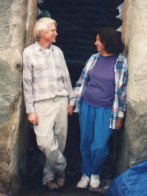
 Kelly Hart is your host here at greenhomebuilding.com, and has been involved with green building concepts for much of his life. Kelly spent many years as a professional remodeler, during which time he became acquainted with many of the pitfalls of conventional construction. He has also worked in various fields of communication media, including still photography, cinematography, animation (he has a patent for a process for making animated films), video production and now website development. One of the more recent video programs that he produced is A Sampler of Alternative Homes: Approaching Sustainable Architecture, which explores a whole range of building concepts that are earth friendly. Kelly is knowledgeable about both simple design concepts and more complex technological aspects of home building that enhance sustainable living. He has even designed and built a solar-electric car that he drives around his neighborhood. Kelly, and his wife Rosana, live in the earthbag/papercrete home that is profiled on the earthbag page. He is available, at a modest fee, for consulting about sustainable building design, either for remodeling existing structures to more fully embrace these concepts, or for new architectural designs.
Questions and Answers
Q: What are the benefits of using natural materials and where does technology fit in?
A: From an ecological standpoint, natural materials have the advantage that they generally don't require much energy to manufacture or even transport them. This savings in energy will likely diminish the amount of greenhouse gas (CO2) that is emitted and also the amount of fossil fuel consumed. From an aesthetic/emotional standpoint, natural materials feel much more, well, natural. Technology is always behind the scenes in our modern world, and I am not one to spurn its use when appropriate. I just feel that one should look to the simpler, natural solutions first, before employing more technological ones.
Q: Why do you use materials such as wood, bamboo, earth and mud?
A: These natural materials can be sourced locally, have very little, if any, embodied energy, do not off-gas toxic fumes, and in the case of wood and bamboo, are renewable. So, by definition, they are very green materials.
Q: Would you believe I purchased 2A of secluded Ridge at tax sale, and it was riddled with garbage, cans, 100's of tire, a small stone house w/rotten wood and a dilapidated mobile home. I paid $2K for a crawler loader to remove most junk but all the time I was thinking how could I utilize these items. Kinda wish I would have read about earthships last year. Anyhow my original thoughts were with cordwood but after learning about papercrete, earthships, earthbags, ferro-cement, my mind is open. A rustic theme will prevail around whatever I do but my new challenge will be to build the best I can with the least amount of money. I think I have clay soil there as well as enough, red oak, black locust and cherry that needs to be cut to let the sunshine in and the ridge faces southeast, so I have a lot to dream about. Any reading material you could recommend?
A: It sounds like you have a wonderfully challenging project ahead, with lots of possibilities. I would think of utilizing some of the local resources, like the clay for cob or adobe, or plaster, or floors...and some of the wood for cordwood...the local stones for thermal mass inside...earthbags filled with the soil, ect. I'm really into hybrid building, using what is there in appropriate ways. This is often the least expensive way to go also.
Q: My partner and I are committed to living a life that supports the sustainability of this earth. We are eager to build a natural home. Our dilemma is that we are moving to Alaska in the spring to set-up a new life and have not come across much material that supports this kind of construction for land that far north. Any suggestions, comments or direction to specific resources would be very helpful. Again, your life path is inspiring and highlights our need to integrate this into our life.
A: I would look at any local materials that are in sufficient abundance to consider building with, such as rocks, clay and sand soil, sustainably harvested trees. If there is volcanic pumice-like rock in the region, then you might consider using it in earthbags like I did for my house, as this is insulating...then you can use the rocks and/or adobe soils for thermal mass inside. Another possibility for insulating material to put in earthbags is either perlite or vermiculate, if that happens to be available. I'm guessing that strawbales are not so available that far north, but if they are these could work too.
Q: After seeing a documentary on a German cable on the earthship of Michael Reynolds in New Mexico I was totally amazed. I do not know much about earth building, or how it is accepted and used in the world and I have been asking myself a few questions. I would like to work with the ISF or that would be the IWB (engineers without boundaries) in english I suppose, because I have always wanted to use technology for a good cause. I realize now that it is much easier with earth building to develop help in the places who need it. It is not only an ecological solution but also a social one. What I am asking you is if earth building is diffused around the world in countries who need help for resources such as the ones earth ship can give? I hope you will answer me and maybe give me a few information on earth building around the world.
A: I appreciate your interest in earth building and the Builders without Borders organization. You are right that earth building is especially appropriate for many places where other forms of building would be impossible or too costly. This is especially true of the use of adobe, earthbags, rammed earth, cob, etc. As for the earthship concept that uses lots of used tires and cemented aluminum cans, etc., this may not be as appropriate, because these materials may not be so available. It really depends on what can be found in the area where the house it is to built.
Q: We own 50 acres in southern Belize and we want to start building there in November. I am highly interested in building eco-friendly, self sustainable structures there.The purpose of the land is to be a healing center/community/ tour guide spot for folks to see Belize. For now we want to build a home or two for our personal use. I want to know what is the best materials so use, best design, and cheapest way to do this. There are so many different types of eco-homes, I just don't know which way to turn. Basically we have to drive in any materials that we need which are not locally there, so it needs strategic planning. That is why I am looking for help now.
A: One of the main tenets of sustainable architecture is to use locally available materials as much as possible, so naturally I would ask what materials are usable on this land? Earthbag building can be done almost anywhere, and digging into the ground, especially in a warm climate can help keep the house cool. I am guessing that you are in a tropical forest, so there must be some usable wood available; even if this is not really straight wood, it can still be used for structural supports, decorations, or possibly cordwood walls. Local stones can be used in many ways...there are lots of possibilities.
Q: I am remodeling a 200 year old farm house with environmentally friendly materials- and am a bit stuck on what to do for the exterior. I really would like to try to earth plaster it, but have been strongly "cautioned against" putting that up on a conventionally built home. I have also considered brick and cedar, but would really like something completely natural that I can do myself- any ideas??
A: I presume that your farm house is made of wood, so it depends on how extensive of a remodel you are doing as to what might be appropriate. If you are basically rebuilding some walls from scratch, then you could use quite a variety of materials (straw bales, adobe, stone, cordwood, etc.) but if you need to put something up against the wood, then you need to be careful to arrange things so that the existing wood is not compromised with moisture condensation and such. Conventional stucco treatment over wooden walls includes tar paper as a first layer, then stucco netting (chicken wire) stapled to this to hold the stucco. This same treatment could be used for an earthen plaster, or perhaps stone work. The composition of the wall needs to provide adequate insulation for comfort over the seasons, though, so be sure to allow for this.
Q: I would like to build in Southern Ohio, in a forest, some sun, lots of shade and some damp conditions. What would be some options for building green in these conditions?
A: I would say that you can use most any of the materials and techniques listed at this site, as long as you follow the recommendations for proper foundations, roofs, etc. I might suggest you particularly examine cordwood construction, since it is fairly easy to do, can utilize some of the wood from your forest, and creates a well-insulated wall that is very easy to maintain.
Q: I have read through all the different materials and construction methods offered on this inclusive website. What methods and materials would you suggests for the Mediterranean environment? Rocks and soil are plentiful. We get a small amount of snow each year and the summers are dry and hot. There is a rainy season and dry season.
A: You will need some insulation in the shell of your home to be comfortable in that climate, and rocks and soil will not provide that. It is possible to make a double wall with stones, so that insulation can be created in the hollow space, but this is a lot of work. Also, earthen materials can be insulated (ideally on the outside) with synthetic insulation, and then plastered. More natural insulation materials that you might find are: strawbales, rice hulls (placed in earthbags), crushed volcanic rock (placed in earthbags). Most likely some sort of hybrid structure utilizing a variety of materials will work best for you.
Q: I'm in Alaska at the present, working and I'm about ready to purchase about 20 acres in NE Washington state. My construction experience is none. I'm hoping to build my own home and I'm trying to find not only the cheapest way but also the easiest non-experience way. I've looked, well just started looking, at ways and I've found that rock seems doable. It's the first time I've found out about papercrete and I'm quite fascinated can you help me get this dream started? Remember I'm looking for the cheapest and easiest way.
A: Building with stones may be cheap, but it certainly is not easy. Using papercrete in your location may not be a very good idea because of the potential for mold. Washington state has lots of trees, so I suggest that you take a good look at cordwood construction, as it is inexpensive, fairly easy to learn to do (there are workshops on this method) and it creates a good insulated wall that requires no further maintenance. You will likely need help with a roof structure and all of the other things that go into building a house.
Q: I am a student whose interest is on natural building techniques, especially Cast Earth. I would be very pleased to know if there's any possibility of assisting me to achieve my aim. My research is on Diffusion of innovative building systems.
A: Of all the building systems outlined at Greenhomebuilding.com, cast earth is one of the most difficult to become involved with; it is proprietary in the US and requires training with a crew and heavy equipment. Many of the other earthen techniques, such as adobe, cob, rammed earth, and earthbags are much simpler and more direct to employ.
Q: Where can I find information about a good housing system for poorer families in Belize (Central America)? Most of the houses around here are concrete with metal roofs. An ideal house would be termite-proof, cool on hot days, and good under hurricane winds. Resources here include bamboo, lots of tropical woods (mahogany), white lime, and earth.
A: I am partial to the use of earthbags in situations like you describe. I have published a description of how to build a small earthbag domed building at greenhomebuilding.com/riceland . These are termite and hurricane proof, and can be bermed with earth to make them generally cooler. Depending on what you fill the bags with, they can be either insulative or be thermal mass. Even filled with the local soil, the walls are thick enough to provide quite a bit of protection from the heat. Lime can be used for a fairly durable plaster over the bags. Your local woods or bamboo can be used to frame windows, doors, make lofts, shelves, etc. Most of the work of construction is not very skilled.
Q: Do you have any hints or suggestions regarding log homes, either faux logs or something similar. We are preparing to build a home in the Wet Mountain Valley of South Central Colorado about 10 miles north of Westcliffe - on the east side of the valley looking at the Sangre de Cristo Mountains (home elevation ~8100 feet). My wife has her heart set on a log home but I'm pushing back and am seeking an alternative (less to maintain, better insulating properties, more environmentally friendly, ...etc.)
A: I lived for many years just over the mountains from you in Crestone, so I know how extreme the climate can be there. Given this fact, I would highly recommend that you opt for the best insulation you can muster, and that typically is not logs. My other objection to log homes, is that in general they use a lot of a dwindling resource, the extraction of which is undermining ecological health in forest environments. I would suggest that if you want the log home look, to just use the rounded slabs on the outside as a siding to a very well-insulated framed wall. I also suggest that you employ a passive solar design to help with heating your new home.
C: You recently sent a document for review titled "Development of Straw-Cement Composite Sustainable Building Material for Low-Cost Housing in Egypt". I did read the manuscript and can offer you some of my observations. First of all, I applaud anyone who is seeking sustainable solutions for building technologies, as these are essential for our continuing health and success as a species. The aspects of the concept presented for manufacturing building blocks from rice straw and cement that I would consider sustainable are:
-
One component (the straw) is a surplus renewable material that when utilized will take it out of the waste stream and avoid possible air pollution from burning it.
-
The straw is free, which lowers the cost of the production
-
The straw-cement blocks can be produced locally by relatively unskilled labor, again lowering costs
-
The resultant blocks provide better insulation values than conventional concrete blocks.
- Every component (clay, sand, water, straw) is potentially free
- Every component has little embodied energy
- These materials are potentially available on site, or locally
- These building blocks can be used in load-bearing walls, or for other compressive purposes (which the straw-cement blocks cannot)
- The mud bricks provide nearly as much thermal resistance as the straw-cement blocks (R-1 per inch)...neither of which is very impressive, especially in a hot climate, but at least the mud blocks provide better thermal mass, so under certain circumstances they will perform better thermally.
- Mud bricks can be "stabilized" with a relatively small amount of Portland cement (or asphalt emulsion) for use in circumstances where a greater degree of durability is required.
- Mud bricks can be produced with relatively unskilled labor.
Q: I would like to build a natural, environmentally-friendly and beautiful home. How should I go about choosing what to build with? When should I go with cob/adobe/strawbale/earthbags/rammed earth/papercrete?
A: There are several criteria that can help you make these choices. The first thing to focus on is actually not the material, but the design and function and that will be guiding you. Once you know what and where you want to build then you can look at how and with what materials. Often people will say that they want to build a cob house, for instance, when in fact cob would not be a wise choice for a house in their particular climate.
Generally, in any climate where one must endure extremes of temperature, the outer shell of a home should be constructed with materials that provide good insulation. These materials are usually fairly lightweight, such as strawbale, earthbags filled with volcanic rock, or papercrete. Other denser materials can provide insulation if they are used in such a way to create a void in the wall that can be filled with insulation.
Another principle is to place plenty of thermal mass materials on the inside of the house. These are the denser, heavier things, such as adobe, stone, brick, tile. Thermal mass materials will tend to stabilize the interior temperature of the house, keeping it comfortable most of the time.
So you can see that what I am advocating is quite possibly using a variety of materials to build with in a hybrid fashion.
Other criteria for making materials choices that are sustainable have to do with the "embodied energy" that any given material represents. This means the amount of energy that has gone into its procurement, manufacture, and transportation to the building site. You want this to be as low as possible because, typically, energy consumption these days means air pollution and fossil fuel depletion. For this reason it is best to use local, natural materials for the most part.
Fortunately, natural, non-industrial materials also tend to be healthy and non-toxic...which is another sustainable criteria. Building to last is a final consideration. Use durable materials in such a way that the building will be there without lots of maintenance for centuries.
Q: What key strengths and weaknesses (or limitations) of each of these materials do I need to know about?
A: Cob, adobe, and rammed earth are all basically the same material: soil that is composed of roughly 70% sand and 30% clay. Cob has some added straw that gives it some extra strength and insulation, but not much. These earthen materials are generally best used as thermal mass, and so should be insulated from the external atmosphere. They tend to be extremely durable and will last for centuries.
Strawbales and papercrete provide very good insulation indeed, but must be protected against deterioration from moisture.
Earthbags have the unique capability to be either thermal mass or insulation, depending on what they are filled with. As insulation they can be filled with crushed volcanic rock, rice hulls, perlite or vermiculate. As thermal mass they can be filled with practically any native soil.
Cordwood uses short pieces of scrap wood in a matrix of mortar, with a hollow space on the inside, and this way they represent a natural building technique that provides both insulation and thermal mass.
Natural stones provide excellent thermal mass and durability.
Q: We are getting ready to build on an ocean front lot on the Big Island HI. What to use? I want to build green and have concerns about the ocean and salt corrosive qualities, and mildew is a problem here. Any suggestions?
A: In Hawaii you are blessed with a lot of volcanic stone, so I would consider working with this material for your home. It is very corrosion and mildew resistant. You can use it to fill earthbags like I did with my house (see This page ) or another possibility is a sort of pumicecrete like shown at here...or you can just build with the larger stones as with ordinary stone masonry.
Q: My son and I would like an eco friendly home and are not sure which way to go. My son is going for a degree in recording, and eventually would like to establish a recording studio, as eco-friendly as possible within this home. We are wondering what the possibilities of this are and which medium might be the best to go with.
A: Sound recording studios require quiet, well-insulated rooms with good acoustics. There are many materials that can provide this, but one obvious choice is strawbale construction, since it is also ecological. Another possibility is earthbag construction, but this is not as common. Actually any well-insulated or thick-walled house might serve your purpose.
Q: I am a sculptor and I have always had a disdain for square or rectangular rooms, spaces, etc. It never felt right and it still doesn't. It feels like a box and if you viewed my neighborhood from a plane, you'd see a whole bunch of boxes, each with people believing they live according to their own design. It all feels so inauthentic somehow.
Anyway, I have wanted to build an adobe or cob style home for a long time but I live in Canada, currently in the Toronto burbs but soon to be north/west of Edmonton. The first thing that I picked up from your site is that cob homes are not suitable for cold weather (I think you said "extreme" which is probably what I'll be getting out there. It can get pretty darn cold in that area, like -40C.
How can I build an insulated home in those conditions and have it be like an adobe or cob home? Maybe it would have to be straw bail? Something else?
A: I agree with you about how much people take for granted that rectilinear dwelling space is natural, which of course it isn't...and how wonderful it feels to spend time in more curving spaces.
And you are right about cob not being the best choice for a climate like yours. But that doesn't mean that you can't enjoy living in a natural, sustainable and rounded home.
Strawbale homes are great for insulation and for naturalness, but the bales themselves are rectilinear and therefore do not lend themselves to imaginatively curvy spaces, although it is possible to force them into somewhat curved shapes.
A better choice might be either earthbag or cordwood construction...especially earthbags, since you might be building partially underground, but a hybrid of the two might be nice too. If the earthbags are filled with an insulating material, such as crushed volcanic rock (as I did with my home) or perhaps perlite or vermiculite, then it should be quite comfortable.
Q: The most compelling homes I have seen are the earth homes. They have organic shapes, no straight lines, and they feel cozy and warm. They also have that Santa Fe clay stucco look that I love. I wanted to build quite a large home and I'm not sure how big you can go with earth bags. Maybe it would have to be multiple "mounds" connected together, rather than more stories/floors, as in a geodesic type of dome. This would probably be better for heating and cooling. I have been trying to figure out how I would do that with a large open space concept dome with 3 floors (ground, second, and third).
A: Earthbags are very malleable in terms of shapes they can form, so spaces can be large or small, curved or straight...whatever you want. Very large domes (over 20' in diameter) can be difficult to engineer, but they can be connected together as you suggest. Domes with lofts are easy to create, but three stories would be difficult. Natural earthen plasters can be put over both straw and earthbags as a final finish.
Q: I'm concerned about straw because of what might be living in there that could get trapped inside and die, like mice or rats. I guess I should be concerned about bugs in the dirt too in regards to earth bags. How does one effectively avoid killing anything?
A: While it is true that rodents can burrow into straw, I think it is rare that any actually get stuck in a wall and die there. Once the walls are carefully plastered it is difficult for anything to get into the straw. Also, compacted soil or crushed rock is not a pleasant habitat for insects or animals, so that is unlikely.
Q: Do you know any insulation ratings on earth (rock) bags and straw? Maybe I would have to do a double thick outer wall?
A: The R-value of straw depends to some extent on the size and compactness of the bales, but most are probably around R-30 or R-40. While I am not aware of any scientific ratings for scoria (volcanic stone), my empirical experience would place them in the same category as straw, or about R-2/inch. This is pretty good, considering that many houses considered well-insulated only have walls of R-20, say.
Q: I'd love to see some alternative style homes but I don't think that there are any around here. Oh, what about building permits and restrictions? I'm wondering if I will even be "allowed" to create my organic home.
A: I'm sure there are plenty of alternative homes in Canada, but finding them might be difficult. You might try asking local builders or realtors if they know of any. Most building authorities do allow some alternatives to conventional building, but it often is necessary to prove to them that the building will be sound; this may mean having an engineer review and stamp the plans.
Q: Last question... the stucco layer, is it mud? How does it fair to snow and rain? How much maintenance? Should I have something more durable for our climate? I want something that not only can stand the test of time, but can stand the test of the likely upcoming earth changes.
A: Earthen plasters can be stabilized to some extent with the addition of a small amount of Portland cement or other additives. Lime plasters are more durable and yet still breath to allow transpiration through the wall (essential for straw). Cement stucco is the most durable, but does not breath well, nor does it have that natural feeling. Houses with substantial eaves will protect the plasters much better than would exposed domes.
Q: My children's charter school Building Committee is looking to design and build a new school. The process has just started with the conceptual phase. We have hopes of construction being completed in about 6 years. I want to make the case for alternatives to concrete and steel. Since it's a Montessori school with a strong inclination towards green strategies, I want us to consider what is feasible for our part of the country.
We're in Raleigh, NC. Which of the green building materials would work best for this low-rise construction? The school will be of several smaller buildings--all single floor. The total square footage for the approx. 500 students is expected to be 85,000 sq. ft. Of course, codes are a concern so nothing too drastic, but which of these materials are feasible and suitable for our southeast climate? Can you guide me to the correct resource?
A: There are a variety of green building materials that should do fine in your area, including, strawbale, earthbags, cordwood, adobe, cob, stone...but the more important question is the overall basic design of the building. Once you have decided on the function and layout, then you can address how best to accomplish this, based on local availability, greenness and appropriateness of the possible materials. Often a hybrid approach is the best solution.
Addressing local code requirements is another consideration, and for this it is sometime necessary to get a local architect or engineer to stamp the plans, or at least get the approval of the local authorities.
Q: Would straw and bamboo go well in Jamaica?
A: Both straw and bamboo could be used for building projects in Jamaica if these are locally available materials. They are both vulnerable to rot from exposure to the weather, so you have to be careful to protect them from the elements.
Q: I have been doing some searching over the internet for ways of building a modest house from natural materials, however I haven't been able to make any decisions of what materials would suit my needs the best. I live in a pretty cold and humid climate in northern Europe (60oN, 25oE). Traditional ways of building here consist mostly of different types of log building. What would be the best way to build green in this type of climate? I've been considering earthbags, strawbale and cordwood or combinations of these materials. My main concern is finding a material(s) that can withstand rain, snow and humidity and be insulating enough. I have access to as much spruce (Picea abies) as would be needed, from our own forest.
A: Obviously in your climate you want to build the shell of your house with materials that provide good insulation, and that can handle the weather well over time. Earthbags (when filled with insulating materials such as crushed volcanic stone or perlite), strawbales, and cordwood walls can all do well in this regard. Log homes insulate only moderately well, as I'm sure you know. The other operative factor will be availability of materials locally, and obviously wood scores very high in this regard. For this reason I would suggest you look into building the walls with cordwood, probably using a post and beam framework to get a roof overhead at the beginning. This will utilize your local materials to the maximum. I like cordwood for many reasons, and you can read more about it here.
Q: I came across your site searching for permaculture designs in Yucatan, Mexico. I am a mother that has been offered a piece of land to build/live on. My budget is minimal and I want to live in harmony with the earth. I am hoping to find someone familiar with the land that can offer some suggestions for using building materials from the land. Do you have any ideas? It seems that there is plenty of limestone. I would really like a cob or adobe type home, but not sure that is possible with what is here?
A: Cob and adobe use the same basic materials: clay and sand, with some chopped straw added, especially for the cob. Adobe, of course used to be extremely common in Mexico, but now it has been replaced by concrete and bricks and steel. But often the old adobe houses are more comfortable because the walls are much thicker and moderate the temperatures better. It shouldn't be very hard to find some local old-timers who live nearby who are familiar with making adobes and can advise you. The limestone might work well for the foundation.
Q: I am really interested in getting info on ecofriendly low cost homes. I live in North Carolina...lots of red clay soil. I would like advice on what types are suitable for this area and how to go about getting started.
A: Clay soil can be used in making adobe, cob, and rammed earth homes, if it is mixed with a sandier soil. It can also be used as part of the mortar for a cordwood, or "cobwood" home, which might actually be better in your climate, since soil is generally not very insulating.
Q: Do you have any roofing materials that you prefer over others? The place where I'm building has many cedar trees so I'm planning on cedar shakes if I can get the hang of making them.
A: If you are able to make cedar shakes from local wood, that sounds great. They should last a very long time and be beautiful. I know that it takes some pretty large tree trunks to expect to split very uniform shakes. Maybe there is someone in your vicinity who has experience doing this who can show you how.
Q: My wife and I would like to build a small house (800-900 sq. ft. or so) that is made from as much sustainable and natural materials as possible, that is relatively easy to build as owner builders with not much experience on a tight budget, yet performs well with as little extra heating and cooling needed as possible and will last because this is most likely where we'll live for the rest of our lives. Our gently sloping site is in SW VA which screams earth bermed on the north and I would like an attached greenhouse on the front, so on the one hand concrete block on the north earth bermed side per Rob Roy makes sense, and we like straw bale, so maybe that on the east and west sides, but with solar collector windows on the south plus the greenhouse rules out strawbale on the south possibly indicating wood frame construction, but in the end this plan seems way too complicated for newbie owner/builders. At this point I am feeling so overwhelmed I don't know which way to turn- any suggestions, references, books to look at, etc.?
A: It sounds like you have some good ideas about the basic layout of your house-to-be. It is often true that passive solar southern walls are best wood framed in order accommodate more glass. And obviously anything that will be bermed is best built with materials that can do well in that situation, like concrete, as you suggest. Other, greener options for this might be earthbags or stones. The rest of the house does need to be well-insulated, so strawbale, cordwood, or earthbags might be good options there. In other words a hybrid structure is often the best design solution. For some design ideas for bermed structures you might browse these: http://dreamgreenhomes.com/styles/earthsheltered/earthbermed.htm
Q: My son is a 7th grader, who has entered a competition called "Future City." They have to design sustainable & affordable housing for those who have lost their homes to disasters or financial hardship in a city in the future (150 years from now). What material, what design and the future trends/innovations in design, material and community might he look at?
A: Well, it is hard to know what will be happening 150 years from now, but you can be sure that there will still be soil beneath our feet in most places around the earth. So soil would be a good sustainable building material to consider, which means adobe, rammed earth, cob, or my favorite: earthbags. Earthbags can be filled with a wide range of materials, which are either insulating or thermal mass in nature, and they can be shaped into a wide variety of building forms. You and your son can study this idea in detail at my other website, www.earthbagbuilding.com and see what you think.
Q: I have been debating with myself what type of house I would like to build as an owner builder where I live in Maine/ New England. It is a toss up for me between "Cordwood" or "Earthbag." I like the style of the earthbag and its durability. I also like that it can be a monolithic structure and incorporate its own roof by making a dome. That would definitely keep the cost down. The two cons that I have might just be me being to leery. They are: lots of wet weather over a lime-plastered roof and it takes a long time to build as a one person builder. As for cordwood, it seems to be a very good low cost durable home that can last as long as an earthbag dome. I could probably cut the cost by cutting the wood myself and as a tile setter I know how to mix the mud and 'set' the logs already. My biggest concern with cordwood (load bearing) is the cost of the materials needed for the roof is the price of the materials for the earthbag dome alone. But I would know that it would last and hold up in our weather. So really I would prefer to go earthbag, but I am not sure about it's ability to resist the rain here. Or the plaster's ability to resist the rain. I should mention that I have read 2 of Rob Roy's books and Kaki Hunters book on earthbag. And I don't want to use a concrete plaster for the exterior.
A: It sounds like you a have done some excellent research into the pros and cons of these alternative methods of building and understand the underlying issues. Assuring a water-tight exterior plaster on a earthbag dome can be problematic in some climates, and the common approach does seem to be the use of cement-based plaster. Lime plaster will resist water to some extent, but if exposed to the direct weather it may not be sufficient. Another approach would be to place a plastic moisture barrier over the dome before plastering, but this would then render the walls unbreathable and make adherence of the plaster to the bags more difficult, requiring a mesh structure most likely.
Cordwood construction does have some advantages in that the walls naturally provide a good balance of insulation and thermal mass, do not require further plastering or finish work, and are fairly easy to erect. Cordwood might also have the distinct advantage of being more acceptable to your local building officials (if any), especially if you do as Rob recommends by building a post and beam structure with roof first, so the walls are not load bearing. Obviously you are going to have to choose what is most important to you.
Q: So many choices. Straw, earth, cork, wood. How to get a clear idea of the pro's and con's of each without having to read too too much?
A: All materials do have pros and cons for building, and there are rarely simple answers, but you can get a sense of what the parameters for the choices are if you want to go green by looking down the left hand side of the home page at www.greenhomebuilding.com and browsing a bit.
Q: I'm a senior at the Colorado School of Mines and I've been reading a lot about sustainable design and utilizing recyclable and natural materials to build homes. I was wondering what progress construction companies have been making recently to contribute to Pollution Prevention methods. Maybe you can lead me in a direction to speak with the people who design and build papercrete, cob and other natural materials.
A: The best way to avoid pollution in building homes is to use as much natural, local materials as possible for the construction. So, to some extent, the choice depends on what is available nearby. Also, good design that minimizes energy and water consumption is a goal. All of these topics are covered at my website, along with in depth questions and answers provided by a variety of expert panelists over the course of many years. If you have any specific questions, I would be happy to pass them on to the appropriate person.
Q: We are looking at building an earth home hybrid. I was hoping to get some advice on roofing. I have not seen anything detailed on what system works best for a natural roof that is strong enough to support a person walking on top of it and be water tight. Is a concrete slab a good option?
A: A concrete slab is certainly strong enough to walk on, but is hardly natural...although you could use this as a base for a living roof with plants, etc. Natural roofing options are not numerous. Thatch is nice, but expensive to install and usually too steep to consider walking on. You can walk on cedar shakes if necessary, and they last quite awhile, and that might also be true of slate.
Q: I am from the Philippines and I would like to learn to apply natural building techniques such as cobbing and the use of earthbags to our farm. I know that given proper construction tools and techniques, cob houses and earthbag buildings are superior than conventional ones in terms of cost efficiency and how these structures can withstand stress. So I would like to ask for your advice on which is more viable and cheaper for our immediate concern, that is housing for livestock raising: cob building or earthbag building?
A: I suppose that cob building might cost somewhat less that earthbags because all you really need is the appropriate soil and some chopped straw to do most of the walls. With earthbags you need to have the bags, barbed wire on hand. But in terms of time to build, cob is very time consuming, because of all the mixing required and putting the wall together handfuls at a time. With earthbags you can erect the wall much faster, although it does then need to be plastered to preserve the integrity of the bag material. All-in-all, I would choose earthbags myself.
Q: I am doing some research on eco friendly building materials. Could you please give me an example of a building material that interests you and... a) Describe its progress from the cradle to the grave, including the following aspects: production, transportation, installation, useful life, demolition/disposal. b) Assess what positive or negative effects each aspect has on people and/or the environment. c) Conclude with an overall rating both health-wise and ecologically?
A: There are many different designations of earthen building materials, but they mostly have the same constituents: sand and clay. Both adobe and rammed earth have nothing but this, and cob has some chopped straw added. The progress from cradle to grave is a very short one, since the soil is usually dug near where it is used, and often right on the spot. This means that when the useful life of the building has run its course (if it ever does), then these materials simple return to the earth from which they came. There is usually no adverse effect of using this material either on the environment or on people, so I would have to give them an A+ in this regard.
Q: Which method (adobe, cob or earthbags) allows for the most creativity in building, offers the most durability, and requires minimal maintenance?
All of these methods are about equal in these regards. I might mention that there is another building method that I would recommend that you explore: cordwood. I mention this because it is durable, requires little maintenance, is both insulating and provides thermal mass in one wall system, is relatively easy to learn to do, without undo strain. Once the cordwood wall is laid up there is no need for further plaster or finish work either on the inside or outside. And if your property happens to have wood that is suitable, it can be economical as well.
Q: I have an empty lot in Madison, WI in town. I would like to build an Earth House. I would like to be the first one in Madison to build such a thing and also show the community it can be done and look good. What sort of building material would work best in the North region of the US where it's cold and wet in the winter and hot and humid during the summer?
A: I'm glad to hear that you want to do this. I always suggest looking for local, natural resources for building. One that comes to mind in that area that isn't exactly earthen, but is certainly ecological, is cordwood masonry. This method of building has the advantage of being quite thermally efficient, fairly easy to accomplish, and requires little maintenance over time. Also, if a simple timber frame support structure is erected, it is easy to pass building code requirements and you can have a sheltered place to work year round. Truly earthen building is also possible, using adobe, rammed earth, earthbags, or cob, and if insulated properly can also be beautiful and efficient.
Q: I live in the upper Peninsula of Michigan. I have read 9 books on natural building: Cob, Strawbale, Cordwood, passive solar, natural building... I can't decide what materials to build with. HELP. I realize that with our winter weather I need to have a frost wall and lift the natural building up from the ground. I have access to everything needed, clay, soil, strawbales, rock, marble, left over wood from logging sites...... All free. I just can't decide which building materials are best for our area. Straw has the obvious insulation factors, but my building will be small (700 sq feet or so). I plan to use wood heating so insulation isn't really a big factor in such a small area. Nobody in my area builds naturally and I would like to start people thinking in this way... (So, I want my building to be a good example).
A: You are blessed to have such an abundance of natural building materials nearby! Rather than tell what material is best in your situation, I suggest that you forget about materials for awhile and focus on design. Meditate on what home design is perfect for you, and once this is clear you can look at material choices. Often the best materials will be dictated by the design, and this could easily be a hybrid of several different materials, depending on how they perform thermally or otherwise. With the background study that you have already done, you should have a good basis for evaluating the attributes of the various materials that you list, and can make wise choices. I wrote an article that might help guide you through this process.
Q: I live in the black land prairie region of Texas. What sort, if any, of these techniques and materials would best suit this expansive soil and humidity. Also if underground isn't cost effective can this soil be a flat roof top material vs the all too wasteful attic and shingle mess?
A: Earthen materials generally do very well in humid situations because they can help moderate the humidity to some extent without damage to their integrity. This means that adobe, rammed earth, cob, earthbag, and strawbale with an earthen plaster would all be good choices. Earth sheltering or homes with living roofs can also help with the heat. Your expansive soil can be used for any of these techniques if you adjust it with sand so that the clay/sand ratio is between 10 to 30% clay.
Q: I live in the uk, so we have very cold winters. I've been looking into both straw bale and cordwood construction. Could you advise me as to which would be the best, as there is so much info on both? I'll be building myself and wish to make it as eco as possible.
A: Either cordwood or strawbale would be a good choice in the UK, as there are successful examples of both there. It partly depends on the availability of these materials in your area which might be preferable. They both have very good thermal properties, are natural materials, and the construction process is fairly easy, as far as the walls go. Foundations, roofs and interior finishing are all about the same. I would personally favor cordwood, since there is less risk of problems with moisture potentially getting into the wall and because once the walls are erected there is no further finish or plaster work that must be done, either inside or out.
Q: Do you think earthbag might be any easier than cob?
A: I would say that earthbags definitely tend to be easier than cob in terms of labor. Cob requires some intensive mixing of materials, and then can only be applied in small portions at a time. With earthbags you can often use the soil directly without the mixing (although this might be necessary if your soil doesn't contain any clay) and there is no limit how quickly you proceed with the building process.
Q: What in your opinion is the best material to build a sustainable house out of that could look like a typical house when it was constructed?
A: It is possible to build a sustainable house that resembles conventional construction using virtually all of the materials that I discuss at www.greenhomebuilding.com if sufficient attention is given to design and execution.
Q: There is so much out there and way too many options to choose from when building your own home. Every person or every builder is going to have their own opinion as to a better method. So my question is simple, but complex at the same time: what are the most obvious and unseen advantages and disadvantages of the most popular building methods, ie earthbag, strawbale, earthship, cob, etc.? And which one, if there is one, regardless of price, stands above the others and why?
A: Much as I would like to generalize, I cannot give you a simple answer to this question. There are too many factors to consider that would influence the answer, depending on location, design, needs, aesthetics, etc. True sustainability demands sourcing materials as locally as possible, so that also makes a big difference in appropriate choices. My advice is always to first look at the specific home design that will satisfy your needs, and then to look at the best materials to accomplish that. You might like to read an article I wrote about this for a better understanding. Also, if you look over the many pages devoted to the various building methods you will get further clarification about your questions.
Q: It would be helpful to me if there were an information source comparing different typesof bukilding methods: earthbag, cob, the rammed tires of earthships, CEB, rammed earth (as in the monolithic walls made inside forms)... How do they compare with one another in terms of structural strength, vulnerability to moisture, labor intensity, earthquake resistance...? There are many possibilities and permutations, including mix and match scenarios. I wonder if I could make a press for tire ramming, e.g. All I've ever seen is information extolling each particular type. I'm having a hard time honing in on what's best for me without something more comparative in nature. Can you refer me anywhere?
A: I can see how this lack of easy comparison might be frustrating for you. I have never seen such a detailed comparison chart, probably because it is a complex and nuanced matter to make such comparisons. In all of the Q and A material posted on this site there is a lot of discussion that relates to the merits and demerits of all of the earthen building techniques. My best suggestion is to just dig into it, come up with your own evaluation and actually try the modes that most appeal to you to find out what suits your needs the best. Perhaps then you can create your own comparison chart; if you do please share it with the rest of us.
Q: I would like to know what are the alternative to using wood or bamboo in building a mud hut in the Congo since these two items are not necessarily cheap in my country. As well as how to minimise cracks on the walls and methods of protecting the wall from tropical rain and wind?
A: Most of a mud hut can be made with mud, especially if you mix some dried straw or other fiber in it to help hold it together. This is what is done with traditional cob and adobe. If you can find polypropylene feed sacks or grain sacks you can use these to fill with local soil to build earthbag buildings as shown at www.earthbagbuilding.com. These would need a good plaster, which can also be earthen but stabilized with some lime or cement to make it more durable.
Q: Do you think the use of natural materials (earth, stone, strawbales, lime, bamboo, untreated wood, etc.) is possible for construction in urban environments? Why or Why not?
A: I see no reason why natural materials cannot be used in an urban environment. Care must be taken to assure that the properties of the materials match the need and location, but that is true anywhere.
Do you think the use of natural materials is desirable for construction in urban environments? Why or why not?
Using natural materials is always preferable to heavily industrial materials because they are generally non-toxic, have low embodied energy, and fit in with the local environment.
How do you see natural materials being utilized in new urban construction?
Natural materials are particularly suitable for smaller residential or commercial buildings of only a few stories. Larger high rises generally require more industrial materials.
Are there specific natural building methods that are particularly appropriate for use in urban environments? Why?
I think that virtually all common natural building methods could find a place in an urban environment. Perhaps something like wattle and daub would be less suitable because it is less secure and less likely to fit in with local architecture.
What about natural building and health in urban environments?
If anything, natural building is more important in urban places because of the greater concentration of toxic materials in that environment.
Are there any other thoughts you may have about the use of natural materials in urban environments?
Another reason to focus on using natural building in urban places is that there is a greater opportunity there to educate the populous about the advantages of this.
Are you aware of any modern examples of natural building in urban environments?
What City Repair has done in Portland, Oregon comes to mind. I have been renovating an early 1940's adobe house in Silver City, NM. It fits right in with the local architecture and culture and is nearly as good now as the day it was built.
Q: I am planning to build a home in Todos Santos to be near my family. My sister and her family live there, and my dad just bought a plot of land next to them and is planning to build a home for himself and also for me. It is my dream to build a natural built home... it is important to me to build using healthy, local natural materials and build in harmony with the natural environment as much as possible, and I also believe this is the way to have a healthy, beautiful, comfortable home. However in this area it seems like all the new buildings are basically like concrete boxes, which doesn't feel like home to me. The builders there told me that they can't build with adobe or natural materials because of termites, but I find that hard to believe, because before concrete there were still homes... and there has to be a way, even with blending old and new materials and techniques. I am wondering what is your opinion on building with natural materials vs. concrete in this area? What about the termites?
A: I would definitely choose building with natural materials over concrete. Termites can infest woody materials, but there are ways to protect this from happening; termites will not usually impact earthen materials, like adobe. If the land that you are building on is not dealing with a high water table or vulnerable to flooding, then I suggest that you choose an underground, or earth-bermed plan. This is because in that region the year round underground temperature is a comfortable mid 70's degrees F. and you would not need additional heat or air conditioning.
Q: I'm Marco from Italy. From all the method of natural building, which is the best one for the modern era, cheap, and that could adapt in Italy Mediterranean climate? There is a problem of going into debt for 50 years to buy a house, which is a primary need. This is a shame for young people.
A: Marco, there is no one best way to build in your climate. It would depend on the natural resources available in that region. Earthen materials are certainly available, so adobe, cob, rammed earth and earthbags are possible; you might also consider cordwood or straw bale. Homes that are dug into the ground some will need less energy to keep comfortable.