The Ratio of Materials in Papercrete
 Kelly Hart, who is your host at greenhomebuilding.com, has been involved with papercrete from the early days of its popularization. He included interviews with papercrete pioneers Mike McCain, Eric Patterson and Sean Sands in the video he produced: A Sampler of Alternative Homes: Approaching Sustainable Architecture. He also chronicled his own use of this amazing material in his video: Building with Bags: How We Made Our Experimental Earthbag/Papercrete House. Kelly has built and used both an electric barrel mixer, and a McCain-designed tow mixer. His house is plastered inside and out with papercrete and can be seen here. He can speak from his experience with this novel stuff, and is frank about both its pros and it cons.
Questions and Answers
Q: For folks unfamiliar with papercrete, what exactly is this material?
A: Papercrete is a malleable material made from paper pulp, Portland cement, and water, with the possible addition of mineral materials, such as sand. In some cases clay soil can replace the cement, especially where water exposure is limited.
Q: I want some information on papercrete stucco, papercrete blocks: %paper %cement %water.
A: Basically the mix that I use mostly is: 50/50 paper and cement by dry weight, and the amount of water doesn't really matter...just enough to make the slurry. This is for "pure" papercrete, without sand. For a more durable product that doesn't shrink as much and is less likely to burn, add some sand to the mix, and reduce the amount of paper proportionally by wet volume. It is best to experiment and come up with a mix that works for what you are doing.
Q: I used papercrete on an earthbag foundation. The outside skin is 1 bucket concrete, 5 buckets paper trash and very low sand. For the inside I will use 1 bucket concrete and 30 buckets paper trash and 1 bucket sand. Now my question, what will happened, if it rains very strong and maybe rain comes through a crack on the inside mixture, and starts the paper to rot, because the outside skin is to closed to let it go away?
A: OK, my experience is that once the paper/concrete mix has cured, it will not rot, even when saturated with water, as long as it has an opportunity to eventually dry out. But that is with a mix that is probably 1 cement to 4 or 5 paper. The thinner mix that you mention might not resist rotting as well. I might suggest that you use more sand in the mix because it will make it much more fire proof. My final coat is something like: 1 cement, 3 paper, 4 sand (by volume)...this gives a very durable coating that can be troweled smooth if you want.
Q: To use much sand in my test material shows me that the sand has no good contact to the other materials. All the concrete is around the papercuncks. Has the sand no good contact to the other materials in your case too?
A: When I first started mixing sand into the papercrete, I thought that it wouldn't mix very well, so I did two batches (one with just sand and cement, and the other with paper and cement) and then mixed the two batches together. This worked out pretty well, but was a lot of work because I was doing it all by hand. Then when I made the big tow mixer that I pull behind my car, I tried mixing it all in one big batch, and that has worked out well also. The sand does seem to get coated with cement. The paper does have a tendency to filter the cement sometimes, but not enough to weaken the final product.
Q: And my test shows that if I use much paper, it needs a longer time to dry than the test with lower paper. Maybe this is because my material has so many chunks, or is this normal with or without chunks?
A: It takes papercrete a long time to cure no matter how chunky it is; the more paper there is, the longer it will take to dry.
Q: Would there be any advantage to using lava rock with a lot of fines in place of sand in a papercrete mix?
A: I'm not sure there would be any advantage to this, because the papercrete is so insulating in the first place, the addition of lava rock would not necessarily enhance this. I do know somebody who added scoria powder to some papercrete to give the final product a nice pinkish tone, so coloration could be a reason to do this.
Q: I read at the yahoo papercrete forum that papercrete should be only paper to provide a better fire barrier. They/he said the batches with cement/sand smoldered to ashes but papercrete did not support a burn. What is your take on this? In your Q & A you mention to someone to add more sand in the mix for fire proofing. Is this older information that needs updating??????
A: I think you have some erroneous information here. I have not done independent tests myself, but everything I have read anywhere about the combustion of papercrete suggests that pure papercrete (without mineral content and only a modest amount of cement added) will smolder until it is nothing but ashes. The more cement or sand that is added, the less likely it is to burn. In fact tests have shown that when the mineral content approaches 75% of the product (by weight), the papercrete will not support combustion. Another factor is how compressed or dense the papercrete is; the denser it is and the less air is trapped in there, the more fire-proof it will be.
Q: I live in Oregon and would like to construct house walls by pouring papercrete into forms between peeled fir posts, ( maybe 48" x 48" x6" panels, reinforced with two layers of 4" hog wire fencing, between each 8" post). They will sit on a concrete foundation and have a wide roof overhang so that rain should never touch the papercrete. My question is this: Since the papercrete would most likely absorb moisture from our damp air, could I add something like a quart of water-based wood glue to the water before adding the paper, (It should make the paper water-resistant when it dries), or would it be better to coat the exterior with waterproofing, or even paint?
A: Your plan sounds like a good one, in terms of the foundation, posts, wire reinforcement and roof overhangs. I haven't heard of anyone using glue in the papercrete mix to waterproof it, and I have my doubts of this working, because of the basic porousness of the papercrete material. I suggest that you run some experiments to see if this might actually work (and let me know the results.) A more sure way to waterproof the wall after it has dried is the silicone caulk mixed with mineral spirits painted on, and then a possible final coat of Elastomeric paint (this method was used by papercrete pioneer Eric Patterson).
C: I have used lime in papercrete. It made a very smooth mix that took a little longer than a cement mix to get hard. Borax in the mix will help combat mold, is supposed to be good for fireproofing and insect repellant too. I used about five pounds of borax per mixer load for my dome. I have not seen any mold but I live in an arid region. I have seen insects die after crawling onto wet papercrete with borax.
Q: Is it possible to use compost as substitute for paper? After all compost used to be paper; and is it possible to make an earthship home filling the tires with papercrete instead of dirt?
A: I think the answer to both of your questions is NO. I'm afraid that compost used instead of paper would promote rotting and mold. The reason the tires in an earthship are filled with dirt is that it can be compacted to create a stable wall...papercrete would not cure well in a tire, would be too compressible, and could lead to problems with mold in the wall.
Comment: I added Calcium Chloride to shreaded paper in the blender. I dried a slug of it in the oven. It dried like a rock!! and it won't burn.
Q: I was looking at creating a mold for making ceiling tiles out of papercrete (2'x2' or 2'x4'). I'm going to try some different thicknesses for sound barrier. My question is about he mixture I would need. I read that latex paint could be used instead of cement to help make a bond. What would you suggest?
A: I know that recycled latex paint has been mixed with cellulose insulation to make a putty that hardens and becomes waterproof. It is possible that such a mix could be used to make ceiling tiles of that size...it would take some experimentation to find out. I suspect that whether you did this or used traditional papercrete to make such tiles, you would need to embed some form of reinforcement (such as chicken wire) in them, or the tendency would be to break apart over time. I would try using a mix for papercrete that would be pretty light, such as 50/50 (by dry weight) of Portland cement and paper pulp. This product would be more insulating than the latex paste.
Q: There seems to be some discussion on various sites that many of the original builders of papercrete are moving away from using cement in their mixtures to a paper/soil block. Can you say if this trend is continuing? If so why?
A: People are always experimenting with papercrete mixes and uses. The use of cement has a negative environmental impact, and of course it is more expensive than the soil at your doorstep. Also, purists want to be as natural as possible. The use of cement will stabilize papercrete over time, whereas the soil can dissolve in water. For this reason I would recommend the soil-paper combo to be used exclusively indoors, or at least in well protected areas.
Q: I have read a lot about papercrete and come up with the following idea:- since paper is a wood product, what if I use fine sawdust for the same application as it is simple to process and widely available in my locality.? I am from equatorial East Africa.
A: I have heard of sawdust being used this way in the past, but I am not sure how successfully. I suspect that there are several variables that would be a factor in how well it would work: the specific type of wood used, how fine the sawdust is, what ratio of cement is used, and whether any other mineral material is added. I would suggest experimenting with all of these factors to see what seems to work best.
C: There is a firm in France producing 'compressed wood blocks' (parpaign bois) made from recycled woodchip waste. But as far back as 1927 'Bucky's (Richard Buckminster Fuller's) and his father in law's Stockade Building System appears to have been based on the use of compressed woodwaste blocks. They had 4 or 5 factories and built about 240 houses before they fell foul of the building unions and building codes!
Q: I want to know the relative material in volume units not in per cent as you show in your web site, for example: 6 volume of paper, 3 of sand and 1 of portland cement.
A: The formula for papercrete is rather flexible, not exact, but I would say that in dry volumes it might be 3 paper, 0-3 sand, and 1 cement. However, once the paper is wet and pulped, this would expand to maybe 10 paper, 0-3 sand, and 1 cement.
Q: One person mentioned adding wintergreen to pc mix to keep it from spoiling ? Does pc mix spoil ?
A: I have never tried the wintergreen, so I can't say much about it. The only pc that I know to spoil is slurry that is left standing too long (over a week), especially if no cement has been added to it. This can begin to smell pretty foul.
Q: Another person suggests adding borax to pc for fireproofing and mold retardant.
A: This might work, although I have not tried it. Borax is added to some forms of insulation (wool and cellulose) for this same purpose.
Q: I have a client who wants a home that papercrete might work with. I am interested in the various formulas.Do you have any suggestions?
A: The more mineral material and Portland cement that is added to the paper pulp, the denser and more fire-resistant it will be, but also this diminishes the insulating value somewhat. I did some calculations based on the size of my tow-mixer and realized that it holds about 0.6 cu. yards of slurry when full. Into this hopper I put 1 sack (94 lbs) of Portland cement, 1 wheelbarrow full of sand (unless I need a "light" mix) and the equivalence of a stack of folded newspapers some 12" high and weighing about 40 lbs. (dry). Without the sand, the amount of paper would be increased to 60 lbs or so(dry). The slurry that results from this, once the excess water is drained from it to make a putty that can be applied by hand as a plaster, produces only about 0.4 yards, I would say.
Q: I am mixing all kinds of different constituents for testing in my back yard. I even picked up a bag of lime. Trouble is I know absolutely zero about lime. I want to test blocks made with it. Do you have any idea of how I would proceed? That is, how much lime to use in a given amount of papercrete to make a block? The lime is powdered. I need to make two cubic feet of mix for two test blocks - 12" x 24" x 6". Two cubic feet is about 15 gallons of paper pulp. So, any idea of how much lime to put in? Also, do I just throw the powder in the mixer with the pulp or put the powder in first? I don't want it blow up on me. I will wear gloves, safety glasses, overalls, etc. Any insights you can provide would be very helpful.
A: I have never tried using just lime, but I have often thrown in some with the Portland cement, and I once had quite a few free bags of mortar mix, that has lime in it also. I presume that the lime you have is "hydrated", which means that it has already gone through the process of water being added (or slaked), and then this was dried again for reuse. This stuff is much safer to work with than the other kind that will actually bubble and boil when water is added. If you are intending to use just the lime to get the PC to congeal, I think you going to be in for a long wait; just the straight lime (lime putty) takes a long time (maybe a couple of weeks) to thoroughly cure, and if it is added to the wet paper pulp, it will take much longer, maybe months, to harden...I am guessing. It does not "set up" like cement. As for how much lime to throw in, I would suggest at least as much as you would of Portland cement, say a full shovel-full for 15 gallons of pulp, and maybe much more. I would put it into the already mixed pulp. Like I say, I have never tried this. How it will behave after it eventually cures, is also a question...whether it will hold up to abrasion or moisture? If this works though, it could be an environmentally more benign PC, in that the lime actually absorbs CO2 as it cures.
Comment: In your Q&A about papercrete you write "could be an environmentally more benign PC, in that the lime actually absorbs CO2 as it cures". Sorry, friends, this is only one half of the story: when lime is produced, CO2 is split up and gets into the air. Not much more CO2 is absorbed then produced during processing before. So CO2 which is produced *for* the production processes (e.g. heating the ovens), air pollution from cars and whatever can not be absorbed by using lime in papercrete block. So a "make more lime papercrete to help environment" campaign would be a naive fallacy.
Q: Do you have any information regarding papercrete density?
A: The density of papercrete really depends on how much cement and other mineral material is added to the mix. With not much cement and no added earthen material, papercrete is quite light and not very dense, perhaps with a density of around 25 lbs/CF. Otherwise, with the addition of lots of mineral material it could approach the density of lightweight concrete.
Q: Do you know the pounds per square foot (PSF) of a one-inch layer of papercrete? And a one-inch layer of cellulose spray without the concrete? I'm planning on putting papercrete on the outside of a 22 gauge quonset-style metal building and cellulose spray insulation on the inside.
A: I don't know exactly the PSF figure for 1" of papercrete, but I would guess somewhere between 1 and 2...which would likely be more than the cellulose without the cement. The value for papercrete would vary depending on the formula used and the addition of any mineral material.
Q: Have you heard of any experiments involving papercrete and used motor oil? I had this crazy idea that if oil is added to the mix it may help make the papercrete water resistant. I am concerned that it may affect the bonding properties of the cement though. Any thoughts?
A: Yes, I think that this is a rather crazy idea; I would be very surprised if it works. Oil floats on water, so it will just float on the slurry until all of the water is absorbed or drained out of the pulp/cement, then it will coat the surface of the papercrete at that point. You could try to mix it into the moist papercrete, but I doubt that it will do much more than weaken the bonding of the material. If you try any experiments with this, let me know it works out.
Q: Water-cement ratio has something to do with the strength of concrete. Isn't it true for papercrete also?
A: Interestingly, the ratio of cement and water has no affect on the ultimate strength of papercrete. Basically, all of the cement becomes bound with the paper fiber which filters it out of the water, so the effluent is nearly crystal clear. The ratio of cement to paper fiber is what determines the strength of the product.
Q: I've been using a formula for papercrete that uses pumice in place of sand. My slurry is easier to mix (because the pumice doesn't sink to the bottom of the mixer), the blocks are lighter and have a higher profile. I'm happy with the blocks but would like to be more environmentally responsible by using fly ash in the mix. I've read they are capturing fly ash at the power plant in Bloomfield and saw a container labeled fly ash at the Lafarge plant in Santa Fe but haven't been able to find a source for a small user like myself. Lafarge doesn't sell it. Do you know where I can get some? Is there a commercial mix (like Quickcrete) that includes fly ash? I'm in Abiquiu, NM about 50 miles north of Santa Fe.
A: That is interesting about the pumice mix. I know somebody else who experimented some with something similar, adding scoria fines to his papercrete, and it turned the product pink, but it was sound. I wondered about experimenting with fly ash as well, but was never able to locate a supplier in small quantities. I'll forward your query to our adobe specialist who happens to live near you; perhaps he will have some idea about where to get fly ash in your area.
A: (Quentin Wilson) APS (Arizona Power Something) views the flyash as a"product" and not waste material. Therefore, they are looking for ways to market it. My understanding is that the product goes out in large bulk hauling semi trucks. Much of it is used as an admixture in the concrete industry where it makes concrete easier to pour and level while apparently reducing the amount of Portland cement required. We had hoped to get enough to fool with here at the College but it never worked out even with our slight "insider" advantage. It requires care in handling since it is in a finely powdered form. Anything finely powdered can be a problem for human lungs. I am thinking that they simply do not have a system for filling small containers in a safe manner at the power plant.
A: (Bruce Salisbury) Fly ash is a Manufactured material. As long as I include an MSDS for it. It can be shipped. It is not classified as Hazardous, so I can ship it via UPS. I frequently ship it in 5 gallon containers.
Q: Would adding alkaline pesticide to the mixture be a good way to avoid papercrete's susceptibility to termites?
A: My experience with papercrete is that it is not susceptible to termites...they don't seem to be attracted to the fiber once it is coated with cement.
Q: Would the following mixture of papercrete be able to pour in molds, or does it contain excess of water making forming it difficult? 160 gallons of water
60 pounds of paper
94 pounds of portland cement
65 pounds of sand
A: Virtually all papercrete requires excess water to make the slurry, and this excess water must be allowed to drain away, either in the molding process or just prior to it. The excess water can be recaptured for future batches if desired. The formula that you list looks like it would probably work, if you have a big enough mixer to handle it.
Q: Would it be possible to use the bagged cellulose insulation sold at Home Depot?
A: I see no reason why bagged cellulose couldn't be used to make papercrete, but given that you can find lots of free surplus paper in most localities, why would you want to?
C: (Kathryn) I just got my first set of results back from a soils engineering laboratory on a paper amended mud line of products I'm developing, and the compression strength of the standard sized adobe block is a whopping 2,300psi. A regular asphalt emulsified block comes in at 300 psi. The block actually exceeded the capacity of the compression machine with 300,000 pounds applied on it without rupturing. Amazing! I've put some lime putty into the block mix as well to build in the water resistant qualities, rather than depend on plaster applied afterwards. Blocks left outside over the monsoon season of summer have edges on them as sharp as the day they were formed. This strength was demonstrated with half mud made of 30% clay, and half paper. The next generation of mix to be tested will be 25% mud with 75% paper that we get to keep out of the landfill. We seem to have some room to play in complying with the 300psi standard coming down from 2300psi!!!
Since we have no vehicular access to the building sites, the paper mud product is being developed for a lightweight high performance building material option. We'll be using it not only for furnishings such as countertops, benches and tables, walls, domes and vaults, but also for interior and exterior floors and for roof systems. I'll be trying to keep information current on my blog http://www.domes. blogspot. com .
Q: I was wondering if you have any knowledge to offer regarding building with regular desert sand in a papercrete formula? I was wondering if their are any options for processing desert round sand so that it develops the sharp characteristics of building sands?
A: I used quite a bit of regular desert sand in the papercrete that I used to plaster my earthbag/papercrete home in Colorado. It worked just fine. I don't think it matters much with papercrete how sharp or slippery the sand might be, since the final material is not dependent on it for strength; the paper fibre is much more important in that regard. Where slippery desert sand does not excel is as a fill material for an earthbag dome structure because it doesn't pack into a solid shape; nor does desert sand contribute to making the best concrete or mortar. But even for cob, adobe or rammed earth where the sand gets mixed with clay, I think that this kind of sand works fine.
Q: You mentioned that clay-rich earth might be substituted for Portland in dry climates. I am wondering if the behavior of the soil with the paper pulp is similar to that of cement, especially with regard to the adhesion of the soil to the paper pulp, resulting in reusable water. Is the adhesion of clay-rich soil to paper pulp as complete as Portland cement?
A: I haven't really done any experiments with clay-only papercrete, but I know some who have. The impression that I have is that the clay can bind the paper fiber together quite well to form a very solid block, but that the resulting material must be kept from getting wet or it might become mush again. My guess is that the paper fiber would filter the water in a similar way to how it works with Portland cement. It would be a simple matter to run some tests to see...let me know if you do.
Q: I wonder if using pumice or scoria instead of sand would add some compressive strength to the block without adding weight or diminishing the R-value. Is that a reasonable assumption?
A: You might be right about that, depending on how much scoria you put in...although papercrete alone usually has plenty of compressive strength to suit the uses to which it is put.
C: I've experimented with a few mixes and the best by far has been a paper, sifted adobe earth, and cement mix, where cement is the smallest ingredient. The addition of adobe allows the blocks to retain their shape and volume better. The cement-only batches contracted to almost half the size for the same volume of material and were more distorted.
R: Right, the more mineral material you put in with the paper, the less it will shrink, the more solid it becomes, and the less flammable it is...but also it becomes less insulating...
C: If you add concentrated Pau D' Arco tea to the mix it will take care of any mold problem before it starts. It kills fungus of all kinds. Also colloidal silver stops mold from growing and is easy to to make in bulk. Being that it would not be used internally it would also be very cheap to make. Literally pennies per gallon.
Q: Has anyone considered chipping up plastic bags and adding the chips to the mix of papercrete? I wonder if this would help reduce shrinkage? I know using plastic bags is not very "green" but the bags are common and finding another use for them could reduce the amount going to landfill.
A: have not heard of anyone trying this. Whether it would reduce shrinkage is hard to say...I suspect not much. If there were very much plastic in the mix it would tend to weaken the bonds between the paper fibers that hold it all together.
Q: I'm located on the southern tip of Africa and have been trying to get a papercrete block process going here for the past two years. We have finally located similar parts and are ready to construct our tow mixer, 900 liter. We modified the trailer so a donkey can pull as cars are rare for the locals. We are working on our molds and mixes now but have a concern for the water quantity required. We do have a surplus of brackish water...any idea if this would work? Also I have been trying to get a comparison chart together regarding paper block vs. concrete block that includes technical test results and mix ratios. Do you know if one has been developed?
A: If your brackish water can be used for making ordinary concrete it will probably also work for making papercrete. All I can suggest is that you run some tests to see how well it works...if the papercrete sets up well enough once it dries. There are some comparisons between PC and concrete blocks at http://masongreenstar.com/ and if you want to pay for them some PDF reports available at http://www.livinginpaper.com/
Q: Several years ago here in my home in France I built a small (20m²) south facing extension. I originally planned to use home made papercrete blocks, but in view of the lack of space and the longish 'curing' period involved and the small amount of 'wall space' involved, I finally chose commercially available lightweight cellular concrete blocks. I have recently started to 'reinvestigate' papercrete again and even made one or two blocks with different 'mixes' and several questions arise from my 'trails' :
1: If paper and cardboard are pre chopped finely (as in paper shredder) can they be added dry to the binder mix and how does this effect the final 'performance' of finished blocks. This question arises because having 'soaked' roughly ripped paper and cardboard overnight and then mixed (with power drill mounted paint mixer) to make a slurry and then added binder (I have tried both cement and cellular concrete glue/mortar) and making a block or two and a few 'compressed bricks', the curing time seems extremely long.
2 : Here in France about 60% of houses are still built with standard CMU concrete 'parpaign' blocks. Have you any information on the inclusion of papercrete (as a partial component - in what %?) into the industrial production of different type of current 'concrete' block products, either as dry 'shredded' matter or pre prepared 'slurry'. If this was done, it would reduce weight and improve insulation qualities, but would this alter substantially the normal 'performance' of such blocks (resistance fire resistance etc)?
A: Yes, it takes quite awhile for papercrete to cure, and I doubt that adding bits of dry paper would affect this much. The dry paper would quickly become saturated with water from the slurry, and hold this moisture as long as the block itself it damp. Since the dry paper fiber would not likely become an integral part of the matrix of wet fibers, I would expect this to actually weaken the resulting blocks. This is just a guess, since I haven't actually tried doing this.
To my knowledge there has been very little use of papercrete industrially. I know of only one firm (http://masongreenstar.com/ ) in Texas, USA, that is marketing such a product, and it is mostly paper fiber. Adding paper fiber does enhance insulation and make the blocks lighter, but weakens compression strength and increases fire danger (although rather marginally, when other mineral materials are included). Paper fiber also changes the water absorption qualities of a block, and this may not be desired.
Q: I am soon to retire and wish to build a house in the Philippines. I know that the locals there use the lahar ash from Mt. Pinatubo to make building blocks. I'd like to investigate the possibility of using this with the papercrete formulas to try an experimental house. Could you give me any advice?
A: My main advice would be to experiment with the idea and see what works. I have no experience using ash, but it might work quite well as an additive. I know that some volcanic ash will react with cement so that you don't need to use as much cement in the mix.
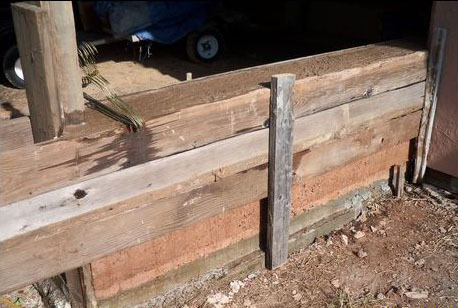
C: I have been slip forming papercrete walls, or in my case I might call it paper adobe because my mixture is (by volume) 3 parts wet paper pulp, 2 parts fine clay, 1 part portland cement. This formula works very well for me and dries very quickly.
Q: My little self built house has strawbale walls. I got one end and two corner sides mudded on the outside this summer (Yeah no more plastic!) and plan to work on the interior over the winter, when I can do a little in the evenings after work and on weekends, even if there is a blizzard outside. Since the ground will soon freeze do so I can't dig up dirt (good clay/sand mixture in the soil) I plan to finish the interior straw walls in papercrete. I've got room to bring in a 30 gallon trash can to soak paper in (been harvesting from folks in the office and the office shredder), and I've lots of 5 gallon buckets from making mud. What I would like is your best recipe for plastering on straw and in quantities I can mix in a 5 gallon bucket. I need to stock up on some Portland and sand, I guess - once it starts snowing I have to sled stuff in and out and since I am 59, I don't want to make anything too hard.
A: I have seen papercrete used as a plaster over strawbales and it worked out fine. Basically the mix that I use mostly is: 50/50 paper and cement by dry weight, and the amount of water doesn't really matter...just enough to make the slurry. This is for "pure" papercrete, without sand. For a more durable product that doesn't shrink as much and is less likely to burn, add some sand to the mix, and reduce the amount of paper proportionally by wet volume. It is best to experiment and come up with a mix that works for what you are doing.
Q: I understand the issue with papercrete and water wicking. Instead of a continuous run of paper through the wall allowing water to wick through, why not use paper pellets that hold their shape during mixing and curing, so that you still get the insulative quality of paper, but the pellets would all be isolated by the cement, and sand surrounding them. In this way the paper is not touching and contiguous throughout the thickness. The paper pellets would be pebble sized and mostly impervious to water absorption, so as to not fall apart when wet. As the cement cures the paper pellets would sit in place of the aggregate, but they would also be isolated, so as to not allow water to transfer. What do you think about this? Could paper pellets used for animal bedding be used? Maybe a more gentle mixing to prevent pellet breakdown.
A: That's an interesting idea that I haven't heard before. I am not really familiar with paper pellets, but I presume that they are made from the pulp that paper is made from, just compressed into pellets and dried. It might be that if such pellets were put directly into a cement slurry, mixed a bit, and cured, that the resulting product would be quite different than traditional papercrete, more like lightweight concrete that uses perlite or polystyrene. It would take some experimentation to see how this works and if it would have any advantages. You would pretty much need sand in the mix for the matrix of concrete to become solid enough to isolate the pellets, so the product would not likely be as insulating as regular papercrete. There might also be the danger that moisture wicked by the cement could be absorbed by the pellets and they would eventually try to burst or expand like ice crystals do, resulting in fracturing.
Q: How can we treat the papercrete block with boric acid? Is it like painting it and keep it for drying or do we need to dip it in the acid ?
A: (Barry Fuller) I have a section on my website under "Tests" which covers some "Informal Tests" and includes the boric acid solution. www.livinginpaper.com/tests.htm I've never had any problem with fire myself - even with untreated blocks - so I think the fire issue is moot. If one uses enough Portland in the mix, (I use a full bag of Portland in a tow mixer), the inorganic material comprises a high enough percentage of the mix to make it unlikely that a fire will occur. At worst it will smolder like a charcoal briquette. However, once it starts smoldering, it does take a concerted effort to put it out. On two occasions had to cut off pieces of rebar inside a papercrete wall with a 4 inch grinder. The sparks were everywhere as was a fine powder of papercrete. I was sure that it would result in a fire, but it didn't. I'm really not sure that boric acid is necessary at all, but if a person wants to be super cautious around outlets, fireplaces and the like, this is the way to do it. We just sloppily sloshed it on with a brush.
Q: I live is south Texas, in very fine sand. It holds almost no water without adding compost. I want to build a slab of papercrete 10X10 and imbed it with rocks I have collected all my life. The recipe I want to use is 60% paper 20% sand and 20% Portland cement with hog wire fence I have left over. Will this work? Any Ideas? How long will it take to dry?
A: You don't say whether these percentages are for dry or wet materials. Basically the mix that I use mostly is: 50/50 paper and cement by dry weight. This is for "pure" papercrete, without sand. For a more durable product that doesn't shrink as much and is less likely to burn, add the sand to the mix, and reduce the amount of paper proportionally by wet volume. It is best to experiment and come up with a mix that works for what you are doing.
Drying time depends on temperature, humidity, wind, etc...so it is hard to say. Usually you can expect papercrete to dry from 1 - 4 weeks. I think the hog wire reinforcement is a good idea for what you propose.
Comment: Are you aware of how extremely effective adding some regular laundry borax to the papercrete mix can be? In fact, if the papercrete is not going to be structural, but mostly insulation or infill, one can drastically reduce the amount of cement and other mineral content in the papercrete if borax is added. The borax can also be extremely effective in warding off mold, termites or other insects, and also is a very effective fire retardant.
Another option to treat existing papercrete that is encountering mold is spraying a wall with a boric acid solution. Misting with a garden type pump up sprayer should do the trick nicely. (Wear long sleeves, long pants, and a respirator during application.) If one is careful about controlling the runoff water when draining borax treated papercrete mix to avoid contaminating fertile soils and ground water, it can be used responsibly. Borax doesn't outgas, although it is wise to avoid skin contact or breathing the dust if cutting borax treated papercrete, but then it's always smart to avoid breathing most any dust of any kind. That should be common sense.
Q: Which type of paper is used in Papercrete and what type of cement is used in Papercrete? What are the mixing proportion for Papercrete?
A: Almost any kind of paper will work. Newspaper is especially good because it dissolves very easily. Ordinary Portland or construction cement is used. If you measure the weight of the paper when it is dry and add the same amount of cement (by weight) then that is about right.
Q: I'm collecting paper for a papercrete building (size is 18' x 20') and am wondering how much paper should I have before I begin to mix. Can you tell me how many truck loads of newspaper it will take? My truck bed is only 5 feet long.
A: Well, if you plan to use a standard 50/50 ratio by dry weight of paper and cement, and if a standard cubic foot of cured papercrete weighs about 25 lbs, then you would need about 12 lbs of paper for every cubic foot needed to build your walls. So you can figure out the total volume of papercrete needed in cubic feet and multiply that by 12 to arrive at a total weight of dry paper needed. It is hard for me to estimate, but my guess is that you can build a small house with as little as 10 loads in your pickup.
Comment from Quentin Wilson: I have some papercrete bricks that I made without the crete. After two winters they still hold their shape on top of an adobe wall. My paper bricks are just paper. I had the idea that there might be enough of whatever chemicals originally held the paper together to do so a second time. It's all sort of paper - newspaper, junk mail, magazines and a few books. I just added water in half a 55-gallon barrel and let it sit a few days then ran it through my cement mixer. Poured the slurry into adobe forms and got 10 x 14 x 4" bricks. Indeed, after a couple of days they dried out and held their shape. Mainly, it was an exercise to avoid more stuff in the landfill. I have about 150 bricks around. Some on top of an adobe wall, some turned into a dry stacked wall play fort and some just waiting to be used.
I think paper bricks could be used for very informal structures based on no more testing than my leaving them out in the weather for a couple of winters and summers. They certainly soak up a lot of moisture from rain and snow but then dry out after several days. Mankind has learned to build with wood that can rot, steel that can rust and adobe that slumps, by isolating those materials from wet conditions. A paper brick wall with a good foundation and a good roof should not perish from this earth. I used the Lex and Janice Terry technique of casting bricks in long forms on top of an existing adobe wall. It seemed as if it worked fine but one day my wife lifted the paper bricks off the adobe so they would dry faster, thinking she was doing me a favor. I have a paper build-up in progress and this round might find me building a small structure casting paper bricks right on a foundation on up to a bond beam.
Q: I recently got interested in papercrete construction. I and a colleague have a way to shred used cardboard boxes as a replacement to shipping "peanuts." Wanting to play a little I bought a sack of Portland cement, soaked a couple of handfuls of shredded cardboard, blended it down to oatmeal consistency and mixed it up. I liked what I saw. Is there anything you could think of that would make using cardboard a mistake?
A: As long as the cardboard gets down to a pulp, it should work. It might take longer to soak than regular paper. You might try soaking it overnight.
Do you see a functional benefit over regular paper?
Cardboard fiber may be a bit coarser and more robust; as long as you can reduce it to the original pulp form, it should work fine.