Mixers for Making Papercrete
 Kelly Hart, who is your host at greenhomebuilding.com, has been involved with papercrete from the early days of its popularization. He included interviews with papercrete pioneers Mike McCain, Eric Patterson and Sean Sands in the video he produced: A Sampler of Alternative Homes: Approaching Sustainable Architecture. He also chronicled his own use of this amazing material in his video: Building with Bags: How We Made Our Experimental Earthbag/Papercrete House. Kelly has built and used both an electric barrel mixer, and a McCain-designed tow mixer. His house is plastered inside and out with papercrete and can be seen here. He can speak from his experience with this novel stuff, and is frank about both its pros and it cons.
Questions and Answers
Q: I tried making papercrete by just soaking paper in water for a long time and then agitating it with a hand churn. The resulting mixture was fibrous but seemed OK. Does papercrete have to be mixed by machine or if left long enough in water, will the fibers disintegrate to form the right kind of gunk?
A: This probably depends on the nature of the paper that you use. Newspaper tends to become pulp more readily that higher quality paper. The whole process is definitely easier with a machine.
Q: Thanks so much for putting online your wonderful website!!Quick question about a papercrete mixer (just been building and operating one, based on a 55 Gal drum, 5HP motor): Have you ever heard of anybody using a ball or wheel bearing inside the mixer to support the shaft that the blade is attached to? I've been having having problems with paper fibers getting into the bearing and being compacted so much that the additional resistance kept overheating the motor. (5 HP, down geared from 3400 RPM to half of that by pulleys) I'm thinking of replacing the bearing with a plastic or bronze bushing (which I might have to replace once in a while). What would you think about that?
A: I guess there are a couple of potential problems with having a bearing inside the barrel. One is the thing getting jammed with papercrete, as you have discovered, and the other is corrosion from moisture. On my barrel mixer, I used a metal pipe flange bolted to the bottom of the barrel, with a pipe nipple threaded into it. The shaft from the motor is inserted loosely into the nipple. This arrangement does allow for wear, and I recently had to replace the nipple, after several years of use. Using bushings might do just as well.
Q: While my 50Gal/5HP mixer is working reasonably well now, I feel the need to build a larger one, and have decided to go for the 200 Gal tow mixer. The most pressing question I have is: How did you seal the opening where the drive shaft goes into the drum?
A: I took Mike McCain's advice and snipped open a hole big enough to insert the part of the differential that needed to protrude through the tank. Then I simply caulked the whole area around the opening with Bondo, the stuff used for car body repair. It sets up rather quickly so you have to work quickly, but it certainly does the job. Even if there are still a few little leaks, eventually the papercrete will seal them, so not to worry.
Q: I have an old mortar mixer and was wondering if you know or have heard whether or not a strong mortar mixer would do the job for mixing papercrete?
A: About the mortar mixer making papercrete, I have my doubts, unless you use very well soaked newspaper, which falls apart easily. I know that ordinary cement mixers don't work well. You need something that actually cuts into the paper, the shearing action of a blade, to do the job. Perhaps you could just rent one for a day and experiment.
Q: I've read about the mixers using old car axles. My problem is that I wish to build in the mountains and driving that mixer to the top of my ridge where I plan to build makes me nervous. Can't a regular cement mixer be used?
A: Regular cement mixers don't actually work very well to make papercrete, because they don't really make a pulp of the paper...it takes more of a cutting action with a blade to do this. You could make a stationary mixer using some of the same components as a tow mixer, and then have a separate motor, or even attach a second axle with the same bolt pattern to a stationary vehicle to power the thing. The Building with Papercrete book outlines various such possibilities.
C: I am using an old washing machine that I found on the side of the road to pulp soaked paper. Since I do small batches right now it works fine. I was using the 1/2 drill method but found that it was putting to much wear on my drill. Soak Paper In Barrel. Fill by hand with Bucket(s) to Washing Machine. Place on Wash Cycle. Remove with a scoop. In five gallon bucket mix your recipe.
C: I am using a flower bulb digging auger to mix paper. It seems to work very well. It can take the high speed of a direct drive motor.. does not clog and circulates the mix.
Q: After ordering the book on Papercrete from your website, I would like to know if any further research was done on the use of a kitchen disposal / cement mixer to make Papercrete? It was mentioned briefly in the book, but there were no details. Do you know where I can find more details? I am working alone, and seek the simplest method for beginning. I would rather put my time into building my structure, not a mixer.
A: As far as I know nothing further has been done with this concept. Mike McCain once demonstrated his disposal idea to me, but I was not all that impressed. The volume that it could handle was small, and it required quite a bit of fussing with...and it only made the paper pulp without any cement or mineral material added. I am still convinced that a tow mixer is the best way to go, since it makes a lot of papercrete at a time, very easily and quickly...the paper doesn't necessary need to be pre-soaked and it can handle lots of sand. I'm still using mine after about 6 years of considerable service. I do store the mixer with the tongue in the air when not in use, in order to keep the differential bathed in oil.
Q: What do you think about using an outboard boat motor to mix small amounts (50 gallons) of papercrete. Some outboards are air-cooled. I haven't had the money to buy the motor yet, but I think it might work pretty well - although it would probably be necessary to blow air through the cooling fins with a compressor or fan. A boat motor would certainly emulsify anything coming in contact with the prop turning at 4000rpm.
A: Sounds pretty interesting. Let me know how it works if you try it out.
Q: I'm a novice at building and would like to build a shed from papercrete. I can build the windows and do the glazing myself. For me it looks like buying a big paper shredder and cement mixer will be the go.
A: Unfortunately your plan to make papercrete with shredded paper and a cement mixer would be a likely disappointment. You need to be able to re-pulp the paper, and a cement mixer will not do this. You need something with more of a cutting action, with a blade that will actually tear the paper apart. This could be with a small barrel mixer, or a larger "tow mixer".
C: I noticed on the dirt cheap builder site the use of a 50s washing machine with shredded paper but the thing about volume is that it's always bigger than you think, the problem with being 3-dimensional I guess...
A: It might be that after much agitation, newsprint would become mush, but I suspect that it would take quite awhile, and there still might be some pretty good sized pieces of paper. I am more particular when it comes to PC; I prefer mine refined and unreadable.
Q: How fine should the paper and cartons be chopped for making papercrete?
A: The paper is ideally returned to its basic fibrous state, like it was before it became paper. This can be done by soaking the paper in water (usually for several hours) and then stirring it briskly with a metal blade until it has becomes a slurry. This is easier to do with paper (especially newsprint) than with cardboard, probably because of the binders that they use with the cardboard.
Q: What will I use for cartons if I run short of newpapers...Are there any choppers available?
A: Finding suitable papercrete mixers has been the Achilles Heal of making papercrete. Nothing works as well as a machine that is designed specifically for that purpose. It is not really a matter of cutting the paper as much as blending the softened paper in the water enough to force the pulp to disintegrate from its paper form. This can be done in small batches with a 5 gallon bucket and a power drill with a paint mixing tool attached...but this is just for small batches. If you want to build an entire house, you will need to make a dedicated machine.
Q: How do you know the paper pulp is ready for the Portland? I'm not sure of exactly what I'm looking for. I made a batch yesterday and was at it for quite some time with a hand drill. While the mix became a pulpy gray, I could still make out the shape of individual bits of paper. Is that normal, or are we really looking for the paper to be so pulped that there is no remnant at all of it's former self?
A: Ideally you would not be able to read the news any more, but a few bit of paper won't hurt anything.
Q: I'm planning to build a tow mixer for papercrete, but I'm having a hard time finding the right tank. All the livestock tanks I see being sold are too shallow. Do you know of a good source to find these tanks, and whether or not a good cylindrical plastic water tank will do the trick? I'm looking for something with about a 40" diameter.
A: I used a steel livestock tank for my tow mixer. I think that it was about 30" deep and 40" in diameter...it worked fine, except that it did start to leak at the seam around the bottom eventually. I fitted it with a sturdy top so that it didn't slop too much when I towed it. I have seen people use plastic stock tanks for this same purpose, and they also seem to work.
Q: I want to build a mixer using a 55 gallon drum and a 5 Horsepower motor. Can you tell me what other parts I will need to connect the blade to the motor and how I should stabilize the mixer. I want to make one just like the one Mike McCain used to make his mom's house.
A: I'm not sure I have ever seen a barrel mixer that Mike used; I have only seen his various tow mixers. I did make and use a barrel mixer, however, using a 55 gallon plastic drum with a hole cut on one side of the top big enough to place the paper, etc. My motor was only about 1 hp as I recall, so I had to careful to only drop small fragments of paper in to be shredded. The motor was mounted near the middle of top of the barrel on the outside. A hole was cut to allow the shaft of the motor coupled with a long piece of half inch threaded rod that went all the way to the base of the barrel. On the bottom was secured a simple bushing that kept the spindle in line; this was rather sloppy, but worked. My blade was a small piece of stainless steel cut with a hole in the middle so that it could be secured to the spindle with nuts and washers on either side. I suspect that if you experiment you can make it work. After using this for about a year, I graduated to a tow mixer which was way easier and faster to use.
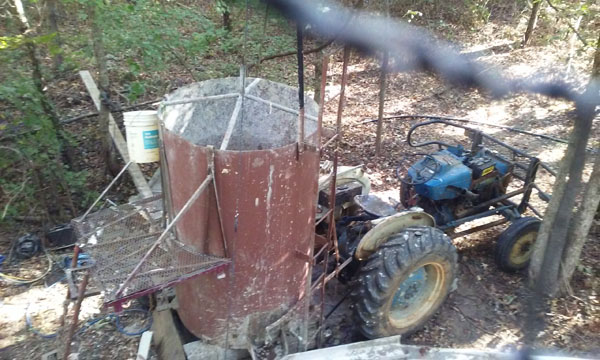
Comment: I built an 800 gallon blenderdo. It is just a small bush hog gearbox inverted with four mower blades welded on. The first test run it would not barely run... too big of a bite... so I cut the blades in half and it vortexes out and runs very smooth. If you can sell them, I can build them. John Schaffrina johnschaffrinaATgmail.com