Foundations for Cordwood
 Rob Roy is Director of the Earthwood Building School, which has specialized in cordwood masonry instruction since 1980. Rob and his wife, Jaki, have built four innovative cordwood homes for themselves since 1975, including the Earthwood home where they have lived for over three decades. Earthwood is a 2400 SF two-story round, load-bearing cordwood home, earth-bermed and earth-roofed. Details of construction are in Rob's Earth-Sheltered Houses (New Society, 2006) and Cordwood Building: The State of the Art (New Society, 2003) two of fourteen books he is written in the alternative building field. Rob and Jaki have taught cordwood masonry in Earthwood Building School all over North America, as well as in Chile, New Zealand, Australia and Hawaii. They have helped scores of owner-builders with their cordwood projects, including homes, saunas and outbuildings. Earthwood has produced a 3.25-hour DVD on cordwood construction, which, with his books, can be accessed through the Earthwood website, or on the Cordwood page here. Rob is considered to be one of the leaders in the field of cordwood construction and earth sheltering. He does individual consultations at a flat rate of $75/hour, but answers questions here without charge. See also Earthwood Facebook.
Questions and Answers
Q: We are planning to build a cordwood heated greenhouse and art studio. The size is will be about 16 X 16 feet interior with 16-inch thick walls. We are looking for a cost effective green solution for the foundation. Two options seem to be not only cost effective and environmentally friendly but also do not require skilled labor. The first is a rubble trench foundation and the second a rubber tyre footing. Which of the two is most suited to cold climates? Our frost levels can be as much as 3 feet deep.
Was going to limit myself to one question but I can’t resist. We live in Ottawa Canada close to the Ottawa Valley where cordwood building has survived for many years. When those building were erected (some over 100 years ago) what type of foundation did they use?
A: First, the foundation question. Thank you for the link in your letter, which I followed and found to be quite informative. My personal comments are: The rubble trench is a good low-cost foundation method that works extremely well as long as you provide a positive drainage with - for example - a 4" perforated drain pipe near the bottom of the trench, drained positively to some point above grade, as they say "to daylight." The trench needs to be at least as deep as the worst anticipated frost depth in your area, and the slope of the site needs to be sufficient to accommodate drainage as described above. Other readers: if you are unfamiliar with the rubble trench, follow the link in Daniel's question for a preliminary overview. The best discussion I have seen on this method appeared in Fine Homebuilding Magazine (Issue 18, December, 1983, pages 66-68), and can be found in their (unfortunately) out-of-print anthology called The Best of Fine Homebuilding: Foundations and Concrete Work, at page 40. The ISBN # is 1-56158-330-8. This is important because Fine Homebuilding has recently published another book with almost the identical title (and different ISBN number) which does not include the Rubble Trench information. This article is very well detailed and illustrated and is good enough to build from, as my neighbor did for his strawbale home.
As for the tire foundation, I have no personal experience. The Earthships seem to do well when built in the appropriate climate. I am unclear as to what is so environmentally sound about burying tires in the ground. On the other hand, I don't claim to know any other good way to get rid of them.
Second question, about foundations for old cordwood buildings, called "stackwall" in Canada. The ones I have seen (in your Ottawa Valley neighborhood, by the way) have been on stone foundations, both drystone and with mortar. Again, take the foundation down to local frost code numbers.
Q: Could cement blocks be used for the foundation under the cord wood, or is a foundation needed under the wood?
A: A concrete block foundation under the cordwood is acceptable, as long as you attend to frost depth considerations in your area.
Q: I was thinking of building a cordwood home. I currently have sauna tubes in the ground and was going to put a floor on top and build a stick house. Can I go up with cordwood construction or do you think the weight would be too much?
A: Several people have built cordwood on posts or pillars, but they have to be fairly close together and joined by a heavy plate beam around the perimeter of the building. Posts are typically six feet on center in this case. You do not specify your sona tube spacing.
Q: I have been wanting to build a cordwood home for 8 years. I live in Sewanee, TN. We want to use rock at the bottom to avoid moisture problems. Is that a good idea or not?
A: I presume that by using "rock at the bottom," you are speaking of a stone foundation. Certainly, this can be an excellent foundation for cordwood. It can be done with drystone building, with mortar, or by the use of the slipform stone method popularized by Helen and Scott Nearing. Two good books on the slipform method are Build Your Own Stone House: Using the Easy Slipform Method (Down-To-Earth Building Book) by Karl Schwenke and Sue Schwenke and Stone House: A Guide to Self-Building With Slipforms by Tomm Stanley. Try Amazon Books and search: slipform building. Your stone foundation should be the recommended depth for your area, with respect to frost heaving. All three stone wall building methods alluded to above are labor intensive. Drystone and mortared stone are also quite skilled methods, which makes the process even longer. Stonework requires more skill than cordwood, because you are working in three dimensions, instead of two. This may sound odd, but consider this: If your log-ends are of a consistent cross-sectional shape, one end to the other, whatever pattern you do on one side of the wall will also be happening on the other. You don't have to think in the third dimension. Masonry unit selection is much easier and faster. Slipform is also labor intensive, but less skilled, so it goes faster, once you have built 4 or 5 movable slipforms.
Q: I'm planning on building a round surface bonded cement block home, I plan on using your 38'8" outside diameter and 36' inside diameter like you did at Earthwood. You mentioned that the inside is truly round, but is the outside smooth and how good is the bond with the sbc?
A: Remember that we are using all 8" corner blocks - these are blocks without the scalloped ends - and that they are laid transversely in the wall (like cordwood) not longitudinally, as normally done with blocks. Thus, the inner surface is very smooth and round indeed, and there are no gaps between blocks.
On the exterior, there will be a small gap between the ends of the blocks (in the lateral direction) of about a half-inch (1/2"). Prior to surface bonding, fill these gaps with my favorite universal mortar mix of 3 parts sand, 1 part masonry cement. Rub off any burrs. Then surface bond as described in my book Earth Sheltered Houses. Remember to stagger the blocks, even though you are laying them transversely in the wall. Masons say: "Two over one and one over two."
Yes, you will have an extremely strong and powerful wall. And if you fill the little 1/2" gaps on the exterior, as described. the outer surface will be smooth and round. I expect you will be installing a waterproofing membrane, insulation, drainage and an earth berm to the exterior. If not, you have to decide how to insulate this building and protect the insulation. The thermal mass (the blocks) should be on the interior of the insulation, both for ease of heating and cooling.
Q: I was wondering if it is advisable to use 18" pieces of granite over top of a rubble trench foundation? Of course assuming that the trench is dug to frost line and drained properly and packed really well. I would prefer to put something over it other than a concrete frost wall. Also if it is a good option, is it advisable to tie the pieces together with a wooden sill? Or is it fine just to leave them independent of each other?
A: Rubble-trench foundations are very good with a reinforced concrete ring beam (footing) on top of them to prevent spread and separation. The 18" pieces of granite, in my view, just don't cut it. The wooden sill helps slightly, but only if you create a tensile ring beam, such as two pressure-treated sill, overlapping one over the other and mechanically fastened to each other.
Q: We are designing an infill cordwood home, double wall (24" final width) and timber frame with concrete slab.We are putting 2" foam board under the slab and a full 4' width around the perimeter of the slab for frost protection and ground heaving. We live in a relatively dry climate(10" rainfall). To support the cordwalls, 10' high, what would you recommend for the dimensions of the perimeter of the slab to support the wall? We are considering sona tubes to support the timber frame. Are there any rough values that can be used for the weight of cordwood and masonry for say a cubic foot?
A: I'd recommend 30" wide footings by 12" deep. Weight of cordwood walls depends on so many variables, including wood species, but 56 pounds per square foot would be a rough median ballpark. With an insulated double-wall, the weight per cubic foot would probably be less, perhaps less than 50 pounds per cubic foot.
Q: I was in the middle of building a home when I lost my job. I am currently living in a small, cabin, barn, shed on the property with no water; its very hot in the summer and cold in the winter. My initial thought was to add onto it but I think the green home is a much better way to go from an engineering, footprint and energy conservation standpoint. For the new home - I had put in the footings, a French drain and basement walls are up. As you will note from the photo I need to excavate another 1 1/2 - 2 feet from the middle, start the plumbing and then pour or make a decision on the floor (I am thinking adobe). That would make the height 10 or 10 1/2 ft approximate. It made me consider going with a sort of 'plan B' and making this a green home, possibly hybrid rammed earth and or adobe which really in my opinion IS the best way to go. I would need to get as much light in the home as possible and want to put some windows either around the top of the wall, incorporated into the the one that needs to be built, the stepped down sections and or in whatever roof is decided upon. Especially since it will be mostly underground and is technically facing the north. I really can't nor don't want to take on a large mortgage this late in the game and still without a consistent job. I would like to build it with as much light and even recycled material as possible. I have a home that is falling down behind it and I can salvage some material from in there like my wood burning stove and ceiling fans... and possibly the rock hearth but the structure is pretty much gone.
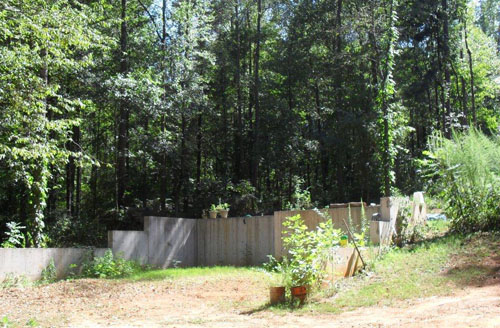
I live in NE Georgia. The soil is heavy clay, sandy and very rich topsoil in the woods here but not where the walls are located. Though this is in the youngest part the nearly six acres is mostly old growth forest with a spring, a waterfall and some really great clay that is not red down in the creek.
A: (Kelly) I can see why you would want to use that substantial existing foundation; it would be a shame not to. Despite it being in the woods, the site obviously does get some sun, which is nice. I noticed that the underground temperature, year round, in your area is about 62 degrees F., so you would want to insulate that foundation around the outside, all the way down, as much as possible, with some rigid foam insulation probably.
It isn't clear exactly how wide the foundation is, but it appears too be perhaps 12". If so, this can support a variety of wall options. If I were in your situation, I would seriously consider building with cordwood. You obviously have lots of available wood, right on your land, so that would be free. Cordwood construction is fairly easy to do, with just a little instruction, and can produce a wall that has excellent thermal properties, being both insulated and with some thermal mass. Once you have erected the cordwood wall, there is no more finish work needed inside or out, which is a real time and cost saving fact.
It is possible to build cordwood walls that are also load bearing for the roof, but many people will first build a simple timber or pole framed structure and the roof so that all of the rest of the work on the house has some protection from the rain, etc. There are many possibilities for design and utilizing the other recycled resources you have available...be creative!
Q: My wife and I are getting ready to build a 30'x70' earth sheltered/cordwood home. It will have 24" thick cordwood walls. As far as foundation for a cordwood home (using concrete block as the foundation) what dimensions would it need to be to support the walls and earthen roof (2' deep earth ). I read one of your other answers that suggested a 12"deep by 30" wide concrete footer, but how would I do this with concrete block? As a medically retired soldier, funds are truly limited.
A: I would not build on concrete blocks without a concrete footing. Sorry, I know this is not what you want to hear.
Q: How near to the ground can I start my cordwood walls without danger of them rotting? Due to building on a slight slope, one side of my foundation is over 1' on the inside, but only 6" on the outside. Is that too risky for cordwood? I do have a 4' porch on that side and we've been careful to make sure the land is sloped in such a way that runoff will be far away from the house.
A: You will be perfectly fine using cordwood masonry on the foundation you have described.
Q: I'm considering buying a 10 year old cordwood masonry bungalow; 1 story on a concrete slab foundation. My question is, the foundation is perhaps only 1 inch above grade. The blades of grass around the house easily conceal the foundation. I see no evidence of moisture issues inside or out but do you think this is a potential issue worth avoiding? The house is otherwise very nicely done.
A: I would be inclined to tear up a couple of feet of the vegetation around the house, and soil, and replace it with landscaping fabric or black plastic, covered with #2 (one-inch minus) crushed stone.
Q: I wanting to build a round cordwood cottage with an interior space of 200 sq ft, so a diameter of 16 ft plus the wall width. I want the walls to be load bearing for they will be between 16" & 24". Can I build these walls over a rubble trench with sandbags on top? If so would I plaster these bags and the directly begin the mortar bead and wood stack?
A: (Kelly) In a recent cordwood project I did exactly what you suggest for the foundation, which was sand-filled earthbags rising above grade about 6". First I placed wire mesh across the top of the bag and then draped it down to a little below the ground level. Then I proceeded to lay the mortar for the first course of cordwood over the mesh ready to receive the wood rounds. I actually used the same mortar mix as a plaster extending down to ground level, covering the bags entirely. This seems to be working just fine.
Q: I've been doing research on building with cordwood and would like to employ this building method in our next home. We are also wanting a basement in our next home, and I have experience with cement block foundations. Is building a cordwood home on a block basement a possibility? What are some things I need to consider?
A: First off, Kurt, you need to know that I am not a big "basement" fan. We put a basement under our first cordwood home, Log End Cottage, almost 40 years ago. Half the cost of the home went into the basement and it got about 5% of the home's usage. Better had we build a full second story on a thickened edge monolithic floating slab - instead of the loft we actually did. We would have had more useful space for less money. If you are thinking "basement," I would ask that you consider going the extra mile to "earth-sheltered space," which means proper waterproofing, exterior rigid foam insulation, drainage, plenty of light and ventilation. Yes, this will cost you more money, but you will have warm, dry, bright, airy space instead of a dark, damp, dingy ... basement! For the difference and all the how-to info, please see my book, Earth-Sheltered Houses.
Having said all that, I must also say that, yes, you can build a cordwood upper story on a cement block foundation. We have done it at 3 homes and others have, as well, all successfully, to my knowledge.
You have concrete block laying experience, a great advantage. My own personal favorite method is the surface-bonding of dry-stacked blocks. Only the first course is set in mortar, this to level that course for the subsequent dry-stacking. A surface-bonded block wall has been found to be several times more resistant to lateral pressure than a conventionally mortared block wall. At Log End Cottage, we built 8" cordwood walls on an 8" (pilastered) basement block wall (conventionally mortared.) The building is still structurally sound after almost 40 years, but we did get a leaking of water at the third course down - due to pour quality backfill. Also, we "waterproofed" with Thoroseal, a cementation waterproofing. When it cracks, it leaks. Better a membrane such as W.R. Grace Bituthene waterproofing membrane - and good drainage, either in the backfill, or by way of a composite drainage matting.
We finally got it right at Earthwood: 16" thick cordwood walls over a 16" surface-bonded block wall, waterproofed and insulated on the outside. This has been a great success: warm, bright, well insulated (the blocks, filled with sand, act as great internal mass heat storage).
Here is an interesting one: A builder not too far away successfully built a 16" cordwood wall on a 10" block foundation. How? He let the cordwood stick out two inches to the outside, over 2" of extruded polystyrene (Dow Styrofoam) coated for ultraviolet (UV) protection. On the interior, he clever "widened" his 10" wall by screwing in 2x4s to the underside of his floor joists, to broaden the effective bearing to the full 16"for the cordwood.
This worked, but the 10" block, as you may know, is the "block from hell." You have to be cutting and fitting blocks every side of every course. You could adapt a similar technique to more sensible blocks, such as 8" or 12" blocks (with 4" pieces). For our 16" thick block walls at Earthwood, we used all corner blocks, laid transversely in the wall like cordwood, surface-bonded both sides. Bright, beautiful, quick, easy ... and massive. Full bearing for the 16" cordwood walls above.
Q: I have come across a product called Faswall to use on both above and below grade walls. Could this form could be used in conjunction with cordwood to make a beautiful owner-built Faswall/Cordwood home. Have you heard of this product? Any red flags?
A: (Kelly) I have Faswall listed along with a couple of dozen manufacturers of Insulated Concrete Forms (ICF's): common in Europe since the 1940's, made with 85% mineralized wood chips and 15% cement or cement and fly ash. They would be among the greener choices for ICF's I suppose, but they still use plenty of concrete and steel. In themselves they are not really wide enough to support a very thick cordwood wall, and they also need their own substantial concrete foundation, so they may not be a good match with a cordwood project; it depends on the design.
Q: My question is about foundation options for cordwood. Has anyone ever tried an earthbag foundation for a cordwood house? ( A rubble trench is made with a french drain, then polypropylene bags full of rock are laid on top of the trench beginning a foot or so below grade and are stacked up a few feet above grade, then earthbags full of earth start to go on. If we use a rubble trench then earthbags of dry gravel as a foundation would it be able to hold the weight of a 2 story 25ft round cordwood home?
A: (Kelly) I did this on a small pantry building to good effect. Earthbags have been used as foundation for many building systems and they are quite sturdy and can support the weight. I suggest double bagging (one inside the other) for security and make sure that the bag foundation has a really good plaster with mesh embedded to protect the bag material.
Q: I noticed that some folks build their cordwood buildings on treated timbers. I'm hoping to build a 8x12 sauna, cordwood style. I was thinking a gravel base, with 6x6 beams, laying on the gravel, and then 6 inch cordwood walls, etc. Are these beams strong enough? Should I go a larger size?
A: I have not built cordwood masonry on a treated timber foundation, such as old railroad ties, pressure-treted timbers, etc. What you are suggesting has been done, but the treated wood foundation needs to be at least 8 inches wide, such as rail ties or 6x8 PT material.
Q: With cordwood 18", how thick should the concrete foundation be?
A: For footings, I'd recommend concrete 9" thick by 24" wide, same as Earthwood. For the floor, an honest 3" of concrete is plenty. Consider insulating both the footings and the floor with an inch of Dow Styrofoam between the concrete and the earth, two inches in the case of in-floor heating, in which case you might want to increase the floor thickness to four inches.
Q: I am planning to build a 34 x 24 cordwood cabin for year round living. I live in central Maine. I would like to have a crawl space under the house to allow access to plumbing if needed in the years to come. I was planning on a slab of 6 "of concrete but am not sure what would be best for a 3-foot knee wall. Can a wood frame knee wall support the weight of the cordwood and will the first row of cordwood and mortar adhere to it?
A: First off, I am not a big crawl space fan. It adds a lot of unnecessary work and expense, not the least of which is the floor itself. I prefer to run electric (in conduit) under the floor, and also put the waste plumbing there, too. Supply plumbing can be in the house itself, exposed or in internal walls. You do not say what thickness your cordwood wall will be, but, in Maine, it should be at least 16", maybe 18" or 20", depending on what species of wood you use.
I suggest that you go the extra mile and use waterproofing, insulation, and good light and ventilation to create high quality earth-sheltered space. But crawl spaces really turn me off. Apart from the time and extra expense, imagine crawling under there to do plumbing or electric work. Finally, to answer your other question, no, you do not want to support a cordwood wall on a framed knee wall.
Q: I am almost to the point of buying my property to build my first cordwood structure. The property is in north-central Virginia. In VA we have plenty of pests to worry about so I was planning to build an 18"-24" stone wall between the timber frame then start my cord wood infill on top of that. Yes I was also planning a radiant heated slab as well. Am I on the right track or completely off base with the stone? I also welcome any other suggestions as this area gets plenty hot and humid during the summer months and any issues concerning the cord wood on top of the stone.
A: I think you are on "the right track," but I think that a 12" stone foundation above grade would be more than enough, even in Virginia.
Q: We plan to build a cordwood pole barn out of white cedar and we’re looking for foundation ideas of what to build the cordwood walls on. Seeing that the cedar poles will be sunk in the ground 48 inches would building the cordwood walls on top of a cedar beam with gravel under it that is notched and nailed to the vertical poles prevent it from frost heaving the walls?
A: I don't think your pole foundation will heave if you build it as you say. However, you must need to know that this white cedar pole foundation has a limited lifetime. I know this from personal experience. It is most likely to rot right near ground level, where all three requirements for fungi (rot) are present, which are: food (the wood itself), water, and air. Above the ground, the rot may not be evident, and below the ground, it is there but not nearly as bad as at ground level itself, where the wood will deteriorate in between 5 and 20 years, depending on drainage conditions. Instead, I would advise the use of 6x6 pressure treated posts made for the purpose, often called "ground contact" pressure treated. Or build on concrete pillars, using Sonotubes.
Q: Is it a good idea to start laying the cordwood directly on foam insulation. It seems to me that there could be danger of it compressing over time and causing subsidence of the cordwood wall.
A: I haven't put cordwood masonry directly on foam insulation and don't know anyone who has. Under footings and slabs I use Dow Styrofoam bluebird, which can support 5600 pounds per square foot with only 10% deflection, a tenth of an inch with 1-inch foam.
Q: I have been working hard on laying a gravel bag foundation (between post frame) for a cordwood masonry building. I am preparing to stucco in my gravel bags and proceed with laying cordwood walls. My question regards insulation. I believe the gravel bag wall will transmit cool/moisture into the cordwood walls. I plan on laying a 1" rigid foam board on top of bags and laying up cordwood on top of foam. I believe I will place barbwire and some mortar under the foam to ensure tight, level fit. Does this sound reasonable?
A: (Kelly) Basically, your plans sound good. I do question the need for foam insulation under the cordwood. When I built a cordwood wall on top of a gravel bag foundation I laid the cordwood directly on mortar over the bags, and this worked out just fine. I do not think that gravel bags will wick moisture upward.
Q: I was planning on building a cordwood home on a rubble trench with a grade beam on it. We are low on money to have the slab and plumbing infloor heat and everything done right away. Could we start on the timber frame, put the roof on, and start on walls and have the slab and stuff done as we come up with the money?
A: Yes. And you'll have the advantage of building the cordwood wall under the protection of the roof. Use a good overhang, at least 16 inches.