Apearance of Adobe
 Quentin
Wilson and
Associates, specializes in solar adobe design and construction. He grew
up in the South Valley of Albuquerque, New Mexico where he watched adobe
bricks being made. In the fifth grade, he made miniature adobes on cookie
sheets in his mother’s oven in order to construct house models for
a class assignment. By age thirteen he made full-sized adobes in the back
yard and ruined the grass. Later, he traveled a bit, went through the
Army, and graduated eventually from the University of New Mexico with
a major in physics, minors in math, chemistry, and education in 1970.
After teaching high school two years and community college math for three
more, Quentin moved into professional solar adobe construction in 1976
as the Project Manager and Instructor for the Sundwellings Demonstration
Project at Ghost Ranch, Abiquiu, NM. He became a licensed general contractor
in the State of New Mexico in 1982. He has been building homes and teaching
seminars and workshops ever since. In the fall of 1995 he established
and taught the full-time Adobe Construction Program at Northern New Mexico
Community College. His website, quentinwilson.com, lists the course schedule and many other resources related to working with adobe.
Quentin
Wilson and
Associates, specializes in solar adobe design and construction. He grew
up in the South Valley of Albuquerque, New Mexico where he watched adobe
bricks being made. In the fifth grade, he made miniature adobes on cookie
sheets in his mother’s oven in order to construct house models for
a class assignment. By age thirteen he made full-sized adobes in the back
yard and ruined the grass. Later, he traveled a bit, went through the
Army, and graduated eventually from the University of New Mexico with
a major in physics, minors in math, chemistry, and education in 1970.
After teaching high school two years and community college math for three
more, Quentin moved into professional solar adobe construction in 1976
as the Project Manager and Instructor for the Sundwellings Demonstration
Project at Ghost Ranch, Abiquiu, NM. He became a licensed general contractor
in the State of New Mexico in 1982. He has been building homes and teaching
seminars and workshops ever since. In the fall of 1995 he established
and taught the full-time Adobe Construction Program at Northern New Mexico
Community College. His website, quentinwilson.com, lists the course schedule and many other resources related to working with adobe.
Q: I wish I could build my own Adobe home. Unfortunately I am just renovating so that I can have the look of Mexican design. Specifically I am looking for information on how to make stucco walls, color washes, and beehive fireplaces. Can you tell me where to go for instructions on how to make my current brick fireplace look like a beehive fireplace? I am wondering if I can simply put something over it to make it look like a beehive fireplace - should I use some mesh and then a stucco mixture. And what typically goes in the mixture.
A: I hate to be so smug, but we have dedicated our lives to doing the real thing. Twenty-five years homebuilding and not a one framed. All adobe. The adobe look can apparently be achieved with chunks of foam board covered with various plasters. There are lots of plaster virtuosos in every state.
Q: I was wondering if you could answer my question about a remodel of my brick f/p into and adobe style one. I do need to know if there are special materials on the market (CDN); does it need a 'frame' ie: wire to be fastened onto the existing brick or is there some kind of stucco/masonry, etc. materials that I could improvise with? I want to eliminate the sharp angles and replace/remodel them into a more rounded (pleasing) shape.
A: Use expanded, galvanized metal lath to form the curved shaped. Standard gypsum based plasters will cover the lath and give the desired shape. As long as their are few air voids behind the lath, the fireplace facade will be very strong.
Q: What can I add to my mud to give it that dark brown "wet look"?
A: Several coats of boiled linseed oil. Apply it with brush, roller, or rag to an adobe surface once it has dried. Remove anything still on the surface after 20 minutes or it will turn gummy. We have used various oil based varnishes if the linseed does not impart enough dark brown color. Some folks even apply a layer of polyurethane or a clear varnish on top of it all. Every dirt works up differently so you get to experiment a bit to find out what works to get the result you want with yours.
Q: I have a small mobile home. I want to do an adobe siding??? Can this be done and how would I go about it . I don't want to do bricks. I don't know if siding is the right word but I want it to look adobe.
A: Paint it brown.
Q: We just bought a home in Southern Utah. The upstairs rooms walls are adobe . We are trying to remodel and make this room suitable for our young children. It looks like someone has wallpapered at least 3 times. How can we finish these walls. The adobe is coming down, the wallpaper is cracking, and the plaster is falling.Is there a certain kind of paint to use, cement? What? We can't leave the walls bare.
A: Wow! Sounds like a real mess. If the plaster is coming off the walls, I think you will just have to remove it. Once removed, the wall can be plastered again with adobe plaster if that is what was used before or a gypsum based plaster such as Red Top which is mixed with three parts of sand or Structolite which is used right out of the bag with water. Anywhere the wall is in good enough condition to be mostly solid, you can paint over the wallpaper, mud plaster over it or Structolite over it. If you choose to paint and if there are ridges left by the wallpaper, you can smooth that up with a big wide sheetrockers taping knife and a bit of joint compound. If you are really, really lucky you might be able to make chunks of falling plaster stick in place with Gorilla glue which is a urethane based product that has proven to be pretty amazing. This is just a guess and you might be the first person to try it but you could get your name in Reader' Digest if it works.
Q: I am in the process of purchasing an adobe brick home. The bricks in the home have been painted over, home was built in 1960, and may have several layers of paint. How do you remove paint from the bricks? Is the only manner to remove the paint, sandblasting? Will this process damage the bricks? The inside of the home has also been painted, however we will most likely sheetrock. Do you have any suggestions for ensuring this process is done appropriately in order to prevent mildew?
A: I have never tried sandblasting on adobe. It might work but it might take a lot of the adobe with it. Never heard of anyone else doing it either. Might just have to find a strong scraping tool and tackle it by hand. Sheetrock? Why buy an adobe house in the first place? It totally ruins adobe walls' thermal characteristics to have an interior surface that is not in thermal contact with the adobe. With sheetrock there will be an airspace to accommodate the presumed furring. That airspace is also another opportunity for those little mildew critters to get a start in life. And that interior paint may act as a a vapor moisture barrier to keep the adobe wall from breathing. If you do use sheetrock, rough up the interior paint in as many places as you can to break the moisture barrier.
Q: My husband and I are about to purchase an adobe home that was completed in about 1989. It seems both the interior and exterior walls were later painted with standard house paint. We very much would like to remove this, and revert to the original natural finish. Any clue how this can be done?
A: Sometimes if you just dampen the wall the paint will fall off or can be easily scrapped off. I have a three head mister from a plant nursery that works nicely to apply moisture at a fine, controllable rate. Spray it until it begins to run then move on. Go back over the wall again and perhaps a third time. Then, good luck. It may be very easy or it may take a lot of work. We got fooled by wallpaper that was on an adobe wall once. We thought it would come off so easily. It took a lot of work. The wallpaper hangers past had penetrated well into the wall and the created a strong composite surface. Quentin Wilson, not the rocket science boy from the movie.
Q: We have built (still building, actually, but we live there) an adobe home in SW Colorado. We are using structolite plaster on most of the interior walls but we have several that we want to leave exposed. What do you recommend for a finish on those that will keep them as natural looking as possible but keep them from "dusting"? How would you go about applying such a finish?
A: Exposed adobes can be washed and smoothed a bit with a sheepskin, a towel, a rubber float from the plastering trades or even left as is for a crisper look. Actually the wall is usually fine with no finish and visitors just have to be reminded not to rub the walls. It they rubbed painted sheetrock walls over a year old, they get chalk on their hands. There is a clear finish that waterproofs the wall yet allows it to breath. It is OKON and comes in two formulations, W-1 and W-2. I can never remember which is which but don't need to. A competent paint company that carries it will have employees who can advise. (Home Depot and such outfits may not.)
Q: My husband and I purchased an adobe block home that was built in 1978. The exterior walls have been painted off white which is in poor condition (i.e. peeling). Is it possible to restore adobe walls to their original appearance after they have been painted? Soft red brick peeks through some parts of the peeling paint. Any suggestions?
A: Probably just simple, backbreaking, brutal, hard work. Paint scrapers with changeable blades, the type with a long handle so you can get two hands on them will work. Sometimes, if you are lucky a stiff wire brush or even a bristle floor brush. Or try spraying the wall with a mist of water and then see if the paint rubs off easier. A steamer can be rented in some places that is used to steam off wallpaper. That might work. Maybe the fact that it is already peeling means that the job will not be as difficult as I may have lead you to believe.
Q: Do you have any advice for the best methods for repairing chips on interior adobe walls after someone else has driven and removed a nail into the wall?
A: To repair former nail holes just wet the wall a bit around the hole and a circular motion of your finger will make a bit of mud and erase it.
Q: Can I use acrylic finish synergy over plastered adobe?
A: Yes you can. However, if this is an exterior wall it may introduce new problems. Most of the acrylic finishes are close to zero permeability: they do now allow moisture in but they also do not allow moisture nor moisture vapor out of the wall. If there is any source of moisture into the wall it becomes trapped behind the acrylic. Then the acrylic and whatever it is adhered to falls off the wall in a chunk!
The best treatments for plastered adobe walls is something that has some small amount of permeability. El Rey Stucco has a product called Adobe Sealer. It breathes and allow any moisture vapor to escape. I think Thompson's Water Seal also breathes. Don't take my word for it; make sure it mentions permeability or breathability on the can, sack or container.
Q: I live in Yucca Valley California. My wife would like for me to transform our house here to a Santa Fe style Adobe home. I am in the building industry and could easily make this house look like an "adobe" home with conventional practices that are being used here to achieve that look. But I just can't bring my self to make a fake copy. Are there any sources that you could direct me to that would show how this could be achieved and if the soil here Adobe quality. I would like to leave most of the exterior walls of the core house and redo the exterior in adobe. The new portions of the house would be entirely out of adobe.
A: Thank you so much for that correct attitude. There is enough of that in Santa Fe. Yucca Valley soil makes fine adobe bricks, mortar and earthen plaster. Mainly you need 30% clay and 70% sand for ideal adobe. PG McHenry's book, Adobe Build It Yourself, is probably the best source of information for your needs. Adobe walls on the interior will need floors, foundations or underpinnings that can carry the weight.
Q: My mother-in-law owns a Chapman Taylor mud brick house. Her husband recently passed away, and was unable to pass on some of his local knowledge about the repairs he often made to the house. I was wondering if you would be able, to advise us on how to repair cracks on the inside of walls of such a house, as we are planning to tackle this job shortly. We wish to paint a room which has cracking and some fairly large holes (1-2 inches wide in places- but not very deep) in the plaster (PS - I'm unsure as to the nature of the existing plaster). Basically, all we wish to know is: 1) What material do we use to patch up the cracks and holes with (fine cement??) 2) What do we then seal and paint over with? Any other information would be very much appreciated.
A: Cracks in adobe bricks and plaster can be filled with just dirt. Sometimes a wet washcloth swirled around on the surface will wet the adobe and move it in to fill cracks.If the plaster is gypsum, lime, or cement based then most spackling compounds will do just fine. It takes very little practice to learn how to feather the compound into the surrounding plaster to make it look like new. Most modern water-based latex or acrylic paints work just fine. Some brands will recommend a primer which they will name, some brands are self-priming. In short, its not any harder than repairing sheetrock walls.
Q: We want to add on, so how should the appearance be with adding on to match what is existing; could we stucco the old and the new to give it an updated look?
A: New stucco can usually be counted on to blend new with old and to fix old problems.
Q: I built an adobe fireplace in a newly constructed room. Have one in existing house already. Existing adobe fireplace has a sealant on it and then painted. Like the looks of just the adobe on the new one. Can I just seal it and leave it natural looking? Asking question from two different perspectives: One durability and one current trends.
A: You can seal it with OKON W-1 or W-2. I can never remember which one is best but it does not make a lot of difference. http://www.okoninc.com/ You can also just leave it alone. If your friends keep rubbing it, get new friends. Friends don't rub friends sheetrock walls, do they? Current trends, especially in Europe, South America, Asia and just about everywhere except USA is to leave it as natural as possible. Maybe just a simple mud plaster or mud wash or just rub the fireplace with a wet towel or sheepskin until the outline of the bricks just begins to fade.
Crown Seal Stucco Protector might be worth looking at. I would call their technical people.
You could also spray on linseed oil thinned 50/50 with mineral sprits or turpentine. It will bond the surface together. But be careful to not get it on too thick. A thin coat will still have some moisture vapor permeability (breathability) so that moisture that gets under the surface can move back
out. If it is too thick as I did on my own wall, underlying moisture causes large chunks to fall off. Okon and El Rey Adobe Sealer are ranked as being moisture vapor permeable.
Q: Recently I had someone tell me to use Beeswax on the adobe fireplace and then leave it natural. Do you have an opinion about that?
A: Beeswax is the latest rage in Santa Fe. I understand that it is best done with nude, youthful bodies hurled at plastered surfaces. Santa Fe parties differently than the rest of the world and us outlanders consider it an affectation of the multimillion dollar casitas as each neighbor tries to one-up his neighbor in costly adornment. It is certainly not out of the vernacular tradition. It gives structolite or diamond plaster a lustrous sheen. I don't have any idea how it would work on adobes or earthen plaster.
Q: I am building a passive solar home in southern Colorado. The home is stick and timber frame, but I am building an exposed adobe wall in the corner next to the wood stove to act as a heat sink. My old home in New Mexico had exposed adobe walls that were painted white. What type of paint should I use to prevent moisture build up in the wall? Do I need an OKON sealer on the wall before painting or will painting negate the breathing features of the sealer?
A: Wall breathability is really not much of an issue for an interior wall. Most of the forces that drive moisture vapor through a wall depend on the temperature and moisture differences between the interior and the exterior. Okon is not moisture vapor impermeable so it works as a sealer. I don't think it is necessary and just cheap latex paint seems to work as well as anything on adobe walls. An oil based paint might be just a bit better since it takes longer to dry and penetrates a little further. Usually the oil is linseed which is what we use to toughen up floors. Really, just about everything works on adobe.
Q: We live in San Rafael, Argentina. We have a small organic finca, approx 20 acres. We have an adobe building on site that needs repair. It has crakes in the walls and the outside of the building is starting to show weathering. We have an Argentine family, that helps us take care of the finca, living there. We wish to repair the home so that they can live more comfortable and safer. Can you help us?? Any information on repair or other web sites that will help us to repair the adobe structure will be greatly appreciated.
A: There are all sorts of schemes to repair cracks in adobe walls up to and including injecting epoxy adhesives. The good news is that just plain mud can be pushed into the cracks and packed in with a stick or small flat board that fits the opening. We have a conference here in El Rito in May and one of the well known presenters, Marcial Blondet, from the Catholic Pontifical University of Peru in Lima will present a paper on just plain mud. There will be no Argentineans this year but there are some knowledgeable people at the University in Mendoza. I guess there are two universities but the one that is in the park with the lake and yacht club is the one. Once my memory straightens out, I will be more specific.
As for the exterior, if it has no plaster or mud plaster it is easy to fix. Just pick up the dirt at the bottom of the wall and mix it with water in a wheelbarrow and trowel it back on the wall. It can even be done with bare hands but I prefer a trowel. A hawk and trowel in fact. A hawk is the wood or metal plate with a handle underneath to hold a bunch of plaster to load on the trowel.
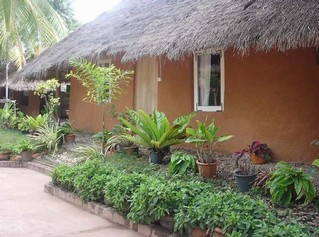 C: (Owen Geiger) This house is part of an adobe cancer treatment center housing complex in Thailand. The buildings are all adobe and thatch, embedded bottles, etc. arranged in a small village around a pond. It's designed to be comforting and rejuvenating. For me, it's what villages should/could look like.
Q: We live in Southern CA (single family) adobe brick home. The bricks on the exterior of the home are chipping, soiled and flaking. What would you advise us do to in order to prevent further damage or preservation of our home?
A: Sometimes the problem is not as bad as it looks to a new owner. But, sometimes it is. OKON makes a product that can be sprayed, rolled or brushed on. W-1 and W-2 are the two formulations and for the life of my I can never remember which is which. OKON or a reputable paint company would have the answer. OKON will not darken the adobes nor will it clean up the soiled areas. You might just have to take a wire brush to the soiled areas and rub off some of the surface. OKON is breathable so it will not trap moisture vapor in the wall. I has some adhesive abilities so it should slow or stop the flaking.
Q: I am considering purchasing a 40 year old adobe home in Santa Fe. The home has exterior vigas that appear to be turning black. Is this mold? Can they be sanded or power-washed to remove the black prior to sealing?
A: It is not likely that the black is mold. More likely just the color that results as ultraviolet degrades the wood. Sand blasting or perhaps power washing will clean it up while removing perhaps a quarter inch of the surface. Lots of homes in Santa Fe have had the protruding vigas removed and an inch or two of the material in the wall dug out and then the holes are plastered over to prevent future deterioration. If they are cleaned and sealed, the NM sun guarantees that periodic re-sealing will be needed.
Q: I have an indoor wood burning fireplace. The area in front of the fireplace and around the opening are natural adobe brick and it has some soot stains. I'm wanting to spot clean it but don't want to damage it either. Do you have any recommendations?
A: First of all, it's just dirt so don't worry too much. Start with 409 and paper towels to see if it will lift the soot. If you want to stay away from the chemicals in 409 - which are not the worst - baking soda and Boraxo would be the materials to start with. If the adobes are natural with no finish, soot may have penetrated a bit. Try an 80 grit sandpaper, of all things, and see if you can sand off a 1/16th or 1/8th of an inch of adobe until the soot is removed. Then you can use linseed oil or oil based clear polyurethane varnish to seal the adobes. It's just dirt so don't take the adobe too seriously. A paintbrush and some tubes of artists oil paint or a selection of water based acrylic paints from Hobby Lobby can match most any adobe surface to the surroundings. It's just dirt so don't take it too seriously. My wood stove sits on an adobe floor that is well protected by multiple coats of linseed oil. Over forty years and my spilling ashes and soot it has darkened a bit. I call it patina and will charge extra for the antiqued effect it if I ever sell the house. I have been told that I take it too seriously and will never get a dime for it.
Q: I managed to break a corner off of an adobe block and want to glue it back on. What type of glue do you recommend?
A: Gorilla Glue. Maybe Elmers Carpenter Glue. With Elmers brush glue on both surfaces and let it penetrate and dry. Then more glue and hold it place until the glue sets.
Q: The outside of the bricks are not sealed and are bare, on the inside of the house the bricks are sealed with something white and glossy. Is this OK?
A: Probably not a problem in a relatively dry climate. Flat, water-based paints are preferred since they are more likely to have modest moisture vapor permeability and will let the walls breathe.
Q: Can I put a limestone wash on the exterior of adobe with ochre to change the color of the exterior without damage?
A: You certainly can and it should be successful unless the bricks were heavily stabilized with asphalt emulsion. Even then a lime wash should adhere to the surface after several decades since construction.
Q: I want to seal a face brick (unplastered) wall to prevent it crumbling / spreading dust and to enhance the colours of the bricks. It was built in the 1820's in Cape Town and the bricks and cement are clay. I'd like to use something in keeping with the heritage of the house and not a modern highly chemical type sealant.
A: Aside from modern masonry sealants available from and for the masonry industry the best non-toxic technique is two stage: Wash it with terry cloth or sheeps skin and for stage two: Don't worry about crumbling/dusting. Linseed oil has been used on some buildings and it imparts a dark tone to the color. It will also leach out from ultraviolet degradation over time.
Q: We have an old adobe home in Riverside, CA, and there are a few bricks that have experienced some erosion due to an exterior drip line. We have old bricks we can use for patching but I don't know how much water to add to the ground up adobe. Can you give me some advice? We also have a beehive fireplace that looks to have been finished with an oil, possibly linseed. But there was a roof leak and some of the adobe is in need of help. Can I just brush away the loosened surface and then apply some linseed oil? If so, is there a particular kind you recommend?
A: Making new bricks out of old will work if the originals did not have asphalt emulsion in them. Just add water until you have a peanut butter paste and let it dry. If it had asphalt, it will be nearly impossible to mix with water. Little particles will dance around on the surface of the water. In that case just find some dirt that has 15 to 30% clay and make new bricks. There is actually lots of automatic adobe dirt around Riverside.
Make sure that any linseed oil is boiled. Otherwise it will never or nearly never oxidize and harden up. I buy it by the gallon and any brand carried in that size works fine. Paint stores an big and little box stores carry it.
Q: We have an adobe home in the San Diego area. Our neighbors car rolled into our garage . The adobe contractor has made replacement adobe, however the concrete he's using between the bricks is too dark. The other sections of our house is more of an orange color concrete (almost clay pot color) What is the best way to match this color?
A: Usually when car meets adobe it is the car that gets damaged and the adobe just picks up a little extra paint. Now you need a little extra paint on the mortar. El Rey Stucco is most common brand in New Mexico and you may have access to that brand and/or Oriental stucco in San Diego. Both companies have touch-up colorants that help to blend colors. El Rey calls it Fog Kote and it is meant to be sprayed onto a stuccoed wall. It can be obtained in all their stucco colors. Oriental should have a corresponding product. They are just thin stucco and can also be brushed on. The problem is it is harder to go from a dark color to a lighter color but with a couple of applications it should work.
You might also be able to obtain concrete colorant which comes in bags or plastic jugs. It is meant to be added to concrete for colored walkways and floors. You should be able to brush it on to good effect. Thirdly, El Rey has a product called Allegro II Cement Coating. They say it will stick to most any cement based material and will cover what is underneath it. It comes in white but can be tinted to the desired color.
You might have to go to an actual El Rey or Oriental supplier who can advise you and help you formulate what you need. Big Box Stores will be helpless,baffled and uninformed unless you run into the unique kid with a smart phone and an interest in the world around him such as I stumbled on the other day at Lowe's. He matched me concept for concept clicking with his thumbs and found a product neither of us had imagined on their shelf! Some old codger over seventy, such as myself, in a big building supply house that has a full range of masonry products for the plastering trades will at least understand and might be able to set you up. Then nothing more remains but some hard work which could actually be almost fun for the artistically inclined. Any leftovers could go on the neighbor's car.
Q: I'm looking to build my own adobe home in the Santa Fe area. I have been researching hydrophobic products with the idea that I might be able to leave the exterior of my home unplastered. Have you any information on this approach to adobe construction?
A: If you consider emulsified asphalt as used in the production of adobe bricks and mortar to be hydrophobic, then that is a workable solution. Anything more exotic is beyond my experience. Santa Fe City and County require buildings to follow the NM Energy Conservation Code and that is often met with insulation on the exterior of adobe walls. If you can satisfy them that you do not need exterior insulation then you can proceed to think about exposed walls and hydrophobic materials. Don't consider insulation on the interior because then the adobe home is rendered thermally equivalent to a frame home.
Q: I learned how to make adobe bricks at the Solar Adobe International Expo in Albuquerque in 1985. After 35 years in the SW I moved to the Andes in northern Ecuador. Last July I purchased a new adobe home built by an Ecuadoran who spent 20 years in the SW. We have a long rainy season which has produced major concerns on the compatibility and finish of my home. Additionally there is an excessive amount of salt in the sand here used in construction. The adobes appear to be plastered and coated with a cement mixture common to the area. The final coating falls off both the walls and the solid concrete trim. Cracking of walls is a real concern as is cement and coating falling from the roof which is a log/concrete/ clay tile construction. Suggestions as to how best to prevent further damage in next years rainy season and what products might work to protect the ado be will be most appreciated.
A: Salt in sand or any other component of adobe bricks, mortar, plaster or cement based plasters and mortars is never good if the concentration is 2% or more. I don't have enough experience with the presence of salt to offer any remedies other than to try to find salt free materials in the future. Every adobe soil and most every cement/lime/sand stucco are somewhat unique in various parts of the world. Sometimes plasters adhere well to adobe walls and sometimes not. Higher clay contents of mud plasters usually lead to greater adhesion. At some point the higher clay content will lead to cracking as the plaster dries out. The remedy has been to add chopped straw or other tough fibers. The adobe bricks in the wall are also part of the equation and certain adobe bricks, especially those with cement or asphalt emulsion stabilizers do not readily accept mud plasters. They may also be resistant to the adhesion of cement/lime/sand stuccos. It is no consolation but I have a tall garden wall in my back yard and it is built with soil semi-stabilized with asphalt. The earthen plasters I have put on it either erode quickly or just fall off in large chunks. Mud plaster likes to stick to mud bricks of the same or nearly same materials. Plasterers talk about "suction" where the dry bricks of the wall pull the moisture out of the plaster. As that happens, it pulls the plaster in against the base material. With stabilized bricks, cement based trim and other materials that are not pure dirt, there is less moisture transfer between plaster and wall and it is slower so the "suction" is diminished.
Should you decide to plaster/stucco again I would first consider looking for a highly experienced plasterer who has worked with adobe. Next it would be good insurance to nail on chicken wire or stucco net with nails about 16" or 40.6482cm apart in horizontal and vertical rows. That net should stand off of the surface about 1/4-inch or 0.635cm. This can be done with nails that have a fiber washer just for the purpose or with net that has a crimp and is called self-furring. Then the first coat of plaster will go through the net and encase the wire in masonry materials. This is called the "scratch coat" and it is deeply scratched with a miniature garden rake looking hand held scoring tool. Clever masons can use a board with nails driven through or a piece of folded netting wire. The purpose of the scratch coat is to get as good a bond to the wall as possible whether through suction or the mechanical attachment of the net. A smooth, even, beautiful finish is not the objective. The second coat of plaster is called the "brown coat" although it is not brown in color. The purpose of the brown coat is to develop a smooth, even surface. The brown coat can be applied to the scratch coat as soon as the scratch coat is capable of supporting the brown. Once it is troweled on to the scratch coat it is further smoothed and straightened with a wood or sponge float which leaves a surface with lots of grains of sand and that's called a sand finish, oddly enough. Now the surface is ready for the final "color coat" and the longer you can wait for the brown coat to cure, the better - even next year. I don't know why. The color coat in the USA usually comes in bags premixed with cement, lime, fine sand and color. In Ecuador it might be mixed on site - hold the salt. It, too can be floated but some people like to texture the surface with blobs, glops, flung drops, swirling trowels and anything goes for the final texture.
A scratch coat is often one part cement, one part lime and six parts of clean sand. A brown coat might be one cement, one lime and five sand. The color coat would be one cement, one lime, five fine sand and one powdered colorant. Not knowing the availability of construction materials in Ecuador, I don't know how yard it would be to find colorant or clean sand.
If the plaster is to be mud based, I would recommend starting with a chicken wire application followed by a scratch coat and a brown/finish coat combined to give two coats or a brown followed by a finish coat to give three coats. 60% clean sand, 40% clay and five big double hands full of chopped straw per wheelbarrow.
As for your cement based trim parts, I have no solution. It is hard to plaster cement based materials onto cured cement based substrates. It's called a cold joint since the chemical reactions in the substrate have already taken place. In New Mexico we have available El Rey Stucco Bonder. It's not much different from Elmer's glue although it might be acrylic based. It is painted on to a cement substrate or old stucco and just as it gets tacky, the plaster goes on over it. Maybe just leave cement trim parts as they are.
In any case, do not use an elastomeric chemically produced product out of a can or bucket. These materials have about zero moisture vapor permeability and are therefore not compatible with adobe. Cement/lime/sand has modest moisture vapor permeability: 5- or 6-perms in fact and they will allow adobe to breathe.
Q: We have an adobe garage in Albuquerque with unfinished interior walls. Can you explain how I might prepare the walls for painting?
A: Primer and paint work just fine on adobe walls. I prefer an oil-based primer because it penetrates a bit further and the oil toughens up the surface. Latex/acrylic primers work, too. Mud plastered walls or exposed adobes accept primer and paint equally. Just plain mud or drywall compound will stick to adobe if you have holes to fill.
Q: We bought a lovely earth brick house 7 years ago. We have noticed that the bedroom walls have what we think is efflorescence. Can you advise on what we should do to correct this, if anything. We were wondering about putting in a heat pump and running it for a week to dry out the walls. Does that make sense?
A: Efflorescence is the formation of crystals on the surface of a masonry wall that somehow has moisture within. The moisture migrates to the surface and evaporates leaving behind as crystals the salts picked up as it migrates through the wall. The first thing is to determine the source of the moisture. It might be coming up from below - the foundation, surrounding soil from a plumbing leak or some source in the floor. It might be coming through the wall from driven rain, lawn sprinklers or other sources. It might be coming from above - a roof leak, downspouts poorly located or poorly joined and sealed, some other plumbing leak. Often this is not easy to trace. I have a $30USD infrared temperature pistol that measures temperatures in small areas depending how far the gun is from the wall. It takes an hour or so but one can take many readings in a room to create a map and areas that are cooler by a couple of degrees or more are usually due to high moisture that is evaporating. Sometimes the efflorescence itself points at the problem as if it were a neon sign.
Roof leaks can be tricky. A leak in one place may not show up anywhere near the breach in the roof. It can often travel along layers of roof, framing, ceilings, insulation, horizontal air/water barriers and all the other components of modern construction.
I don't know what a heat pump would do It might accelerate evaporation - and therefore crystals - or it might quietly dry the wall out and then you can just rub the efflorescence off. When the moisture comes back, so will the crystals.
Q: Wondering what color historically Adobe houses in New Mexico usually once were--natural clay color? What paint brand/shade/color best replicates that? Am looking for a house to buy in Santa Fe: I am greatly dismayed by the popular ceiling-to-baseboards brilliant shiny white paint finishes throughout almost every one of them, including between vigas. What in your opinion is pleasing/better?
A: Adobe houses were meant to have soft colors in matte textures. All this shiney stuff is the Santa Fe influenza. Outside and in the original plasters were earth. Nothing more than dirt, soil, mud, it was right at the feet of the person mixing and applying the plaster often with nothing more than hands. Chopped straw was often added. A good plaster soil has around 30% clay and 70% sand. These plasters on the exterior needed yearly renewal and many of the historic photos of life in New Mexico show people, usually women mixing and applying plaster.
Along came cement, lime and sand stuccos in the 1920's around New Mexico. By the 1950's El Rey Stucco on South Broadway in Albuquerque became the dominant manufacturer. They were bought out by Parex or QuickCrete in recent years. I almost always used their Adobe #116 color and that could be replicated in paint by any paint dealer with one of those machines that put a sample under the scope. El Rey color charts always floated around on my truck's dashboard but I can't find one now. https://thestuccoguy.com/a-few-stucco-color-charts-a-reference-guide/ might be useful and it includes El Rey.
Inside plasters started with mud and most people knew a source of lighter or darker soil of various pale colors to express their individuality. Our hallway is a very light beige color that was pointed out to me by the late Mrs. Pacheco where the highway made a cut through a hill on Hwy 285 in Ojo Caliente. We did not harvest much so the adobe brick walls have a heavy coat of mud to fill and smooth the surface with the special material applied by brush in a manner known as alisando, alise being a slip. There are similar sources near La Madera and El Rito. It is just part of country living to know the local resources and the color and brand of truck that your neighbors drive. Our greenhouse has the lower alise of coppery colored mica soil. The lower part of the alise is bright white with lots of mica to make it sparkle. Our living room is dark with dark brown vigas and rough cut lumber decking. I broke down and painted the walls with cheap, white, flat, water-based paint. The floor is super dark mud with most of the color coming from many coats of linseed oil over the years. I am not about to change that.
Georgia O'Keefe was lucky to live near Hwy 84 which runs through some of the most colorful soils in the state. Dim reds, slightly blues, greens and greys can all be seen from the highway. It's best to dig on private land with permission.
Q: I am looking at an adobe home built in the 1930s that is for sale. For some inexplicable reason, the sellers had a textured semigloss elastomeric coating applied to the exterior walls. I love this home in a historic neighborhood of small old adobe houses. My heart says yes, my brain says this is a moisture retention disaster. Is there a reasonable solution or fix? I want to save this house from turning into a mud pie. I wish I could peel it off like the skin on an orange, but I know that's not possible.
A: It's not that bad. If you are in the arid Southwest, there is not that much moisture in the air for that to be a problem. Moisture can come in from below by capillary action if there is damp soil around the house. By the thirties, builders were building competent foundations that would not transmit moisture upwards. Moisture can also come down from the roof when there are roof leaks or incompetent gutters, crickets, canales, flashings and other problems.
Sometimes when there is moisture present in adobe walls it simply breaks the bond between the elastomeric and the adobe. The first sign of this would be bubbles of air between the elasto and the adobe. You can then peel it off like the skin on an orange.
In my career, we built one house with elastomeric stucco. I don't remember why. The house is around twenty-five years old and I see the owners from time to time. There has been no issue with the plaster. We did not return to the elastomeric system. While I am no great fan of the elastomerics, I am not aware of any house that has returned to mud and slumped to the ground.
If the interior walls are not treated with some moisture vapor inhibitor, the walls can lose moisture inward. Gloss paints are the culpert for interior walls. Just plain cheap flat, water-based paints are the heroes.