Miscellaneous Adobe Q and A's
 Quentin
Wilson and
Associates, specializes in solar adobe design and construction. He grew
up in the South Valley of Albuquerque, New Mexico where he watched adobe
bricks being made. In the fifth grade, he made miniature adobes on cookie
sheets in his mother’s oven in order to construct house models for
a class assignment. By age thirteen he made full-sized adobes in the back
yard and ruined the grass. Later, he traveled a bit, went through the
Army, and graduated eventually from the University of New Mexico with
a major in physics, minors in math, chemistry, and education in 1970.
After teaching high school two years and community college math for three
more, Quentin moved into professional solar adobe construction in 1976
as the Project Manager and Instructor for the Sundwellings Demonstration
Project at Ghost Ranch, Abiquiu, NM. He became a licensed general contractor
in the State of New Mexico in 1982. He has been building homes and teaching
seminars and workshops ever since. In the fall of 1995 he established
and taught the full-time Adobe Construction Program at Northern New Mexico
Community College. His website, quentinwilson.com, lists the course schedule and many other resources related to working with adobe.
Quentin
Wilson and
Associates, specializes in solar adobe design and construction. He grew
up in the South Valley of Albuquerque, New Mexico where he watched adobe
bricks being made. In the fifth grade, he made miniature adobes on cookie
sheets in his mother’s oven in order to construct house models for
a class assignment. By age thirteen he made full-sized adobes in the back
yard and ruined the grass. Later, he traveled a bit, went through the
Army, and graduated eventually from the University of New Mexico with
a major in physics, minors in math, chemistry, and education in 1970.
After teaching high school two years and community college math for three
more, Quentin moved into professional solar adobe construction in 1976
as the Project Manager and Instructor for the Sundwellings Demonstration
Project at Ghost Ranch, Abiquiu, NM. He became a licensed general contractor
in the State of New Mexico in 1982. He has been building homes and teaching
seminars and workshops ever since. In the fall of 1995 he established
and taught the full-time Adobe Construction Program at Northern New Mexico
Community College. His website, quentinwilson.com, lists the course schedule and many other resources related to working with adobe.
Q: My husband and I own 5 acres up in the Uintahs. We have been talking about building a cabin for ages, but just today, when seeing an Arizona hacienda on TV, we both jumped up and said "that's it!" Our land has an abundance of red dirt (clay?) My husband is a cement finisher, so that will help. Next step - what kind of foundation? Do the bricks need to be baked, or just air-dried? Can you refer us to some how-to books? How do you rough-in plumbing, septic tanks, etc. Thanks.
A: Whew, Georgia's question is more a request for a text on homesteading! She might want to join our adobe discussion and owner/builder support group at <adobeATyahoogroups.com>. Might be clay. Usually the red dirts have silt in them too. Just have to make some test bricks to see if it works. Lots of times, adding sand to the soil gives a good brick. Standard concrete footing down to the frost line with a stem wall that gets 6-8 inches above the exterior finish grade. The stem wall needs to be the width of the adobe brick and the footing should be 4-8 inches wider than that. Air dried, sun cured. Adobe build it yourself, by P.G. McHenry, Jr. University of Arizona Press about $25.00. (Available at the link on this page.). Lots of books out there on plumbing. For septic tanks, start with the state to see what the regulations are. As for etc, we are just now writing that handbook. PS Northern NM Community College here in El Rito has the Department of Southwest Construction. We are teaching homebuilders in two semesters. (one in a pinch)
Q: We have a contact in Quebec who built a home out of straw, clay, lime sand and rockwool. Blocks 4'x4'x1' are 5 lbs. Had an article in Harrowsmith April 1996. EXCITING , AND IN-EXPENSIVE (WELL, 65K , Canadian, FOR THE COMPLETED HOME OF 2000 SF) However, we are having trouble really getting some facts about the veracity and soundness of using the product. Anything similar come to mind?
A: (Kelly) One approach to making adobe blocks is with a Cinva Ram press, which is described on this page. I have a friend in New Mexico who used one to make a house over ten years ago that is very comfortable and durable. It cost him under $1,000 and about a year's time. There is an interview with him in the Sampler of Alternative Homes video. Many places do allow construction with adobe, and there are several books that describe how to proceed.
Q: I have been trying to find out more information on concrete homes. How practical are they, how green are they? How do they differ from adobe in durability and sustainability?
A: (Kelly) In general, concrete is not a very green material, for several reasons: 1) A tremendous amount of carbon dioxide (greenhouse gas) is released into the atmosphere during its manufacture. 2) A lot of transportation of materials is involved in both the manufacturing process, and then getting the cement to its final destination. 3) Concrete also must be reinforced with steel, which has its own environmental consequences.
Adobe, on the other hand, is much more environmentally benign. It is basically earth, which can often be obtained on the building site. All you need to make adobe blocks is some clay, sand, straw and water. In some instances a small amount of cement or asphalt emulsion can be added to the adobe, to "stabilize" it in circumstances where it is subject to direct weather. Generally adobe walls are protected with substantial eaves and foundations.
Q: I live in England and am about to buy a house that is in a poor state of repair. The bathroom is located under the stairs and is very cramped...if you wanted to sit in the bath away from the tap end you'd hit your head on the recess! I saw a style of bathroom I liked whilst looking at earthships. The bath was formed from what appeared to be adobe, with some sort of glaze inside it to make it smooth. Would adobe be suitable for this? Do I have to cover it with a sealant to stop it absorbing water and can you paint it after it has set? I'm looking to make a deep, round bath - that won't have to be long so I won't hit my head! Whilst I appreciate that in still owning a conventional house I'm missing the point entirely of what earthships stand for, I would still like to use natural materials. I hope this question doesn't sound too silly!
A: I love adobe more than most anyone. However, an adobe bathtub is a very bad idea for the same reason that a stone, tile, or concrete tub is terrible. The masonry requires too much heat to warm up and robs the heat from the water. Only rich folks who don't care how much heat they waste should have such tubs. Most masonry materials have a specific heat of about 0.2 BTUS/Degree Fahrenheit/pound. Cast iron of which many tubs are made has a Sp Ht of about 0.05 and the metal shell of the tub is relatively thin so not that much heat is lost to the metal. However, think about sitting back against the back of the metal tub as the water fills on a cold day. It takes a real man or woman. Multiply that by twenty to get the heat robbing effect of adobe. But cheer up. That is why adobe is the world's number one heat storage device in passive solar homes.
Q: I would like to know where I can find affordable house plans/blueprints for having an adobe home built.
A: "Adobe Homes for Today, Flexible..." Laura and Alex Sanchez and "The Small Adobe House" Agnesa Reeve.
Q: This is going to be a silly question. Do you know where I might be able to purchase a miniature version of an adobe house. I ran across 1 here in Philadelphia, at a thrift shop, but I couldn't buy it- it didn't have a price tag on it. When I came back for it then next day- it was gone. If you know where I can buy 1, pleas let me know.
A: Someone was selling them through the New Mexico Magazine not long ago. They can be found in various gift and art shops in Santa Fe and Taos. Time for a visit to NM.
Q: I want to avoid the use of plastics at all costs (which rules out a polyethylene barrier) and I was thinking maybe a wax coating would help as a moisture barrier.
A: Might work. Try it and report back. You will be the first.
Q: Hi, I'm not sure if you are the correct expert since my question is not specifically about adobe, but about the vigas which usually go with adobe homes. I live in Las Cruces, NM in an adobe home with wood vigas. These vigas have badly deteriorated due to both sun (vertical and horizontal exposures) and water (primarily the horizontal exposures). I am about to apply some sort of protect ant to this wood and need advice on what product to use (the wood was previously stained) and what process to follow. I'd like to find a product with at least a 15-year guarantee.
A: Welcome to New Mexico, the skin cancer capitol of the USA. Cheer up, Argentina has a worse problem than us since they are close to the big ozone hole in the Southern Hemisphere. Basically, the wonderful, sunny days of Southern New Mexico carry a huge dose of ultraviolet that just boils away anything chemical. I have an interest in boats and lots of paint companies specializing in marine paints/varnishes brag how long their products hold up in the Florida sun or the Sea of Cortez. Those same paints/varnishes used on boats in NM are gone in a year or two. About the only things that hold up to the sun are metals, glass, stucco and the vertical surfaces of timbers. The best protection for wood is the wood itself as it ages. That means that about 1/4 of an inch gets eaten up but then the wood stabilizes. One-inch trim on New Mexico houses disappears while two-inch trim erodes but gets stable at about 1-1/2 inch. The problem with vigas is that most species of trees develop splits and some species twist as they age. If the splits occur on the top of the viga, then the water just moves on down into the viga and lengthwise, too. Often the water is conducted to the interior of the adobe wall or in your case elsewhere along the viga. Some very impermeable products used on wood can backfire. Once some small pinhole develops, moisture gets in and then cannot easily get out resulting in accelerated rotting or the impermeable coating falling off in chunks as its bond to the wood is broken.
Q: Some of the horizontally exposed wood is so badly deteriorated that I am applying epoxy wood rebuilder to the top (exposed) portion of the viga, which crumbled away about halfway down (this applies to only about a 3-4' section of the total 24' length because this particular section was exposed while the rest was not). These are vigas which are structural for the porch roof but where the original design left an opening for a planter and had the vigas continuing through the opening. The frame around the opening was poorly done and caused water damage to the vigas as well as poor maintenance causing sun damage. Is this okay?
A: It is not. If there is no visible sagging of the roof, you are probably okay but something needs to be done to stop further deterioration It's that or replace the viga. Probably not necessary, but if it comes to that, it is not always as difficult as you might imagine.
Q: Mostly, I need advice on the best product to protect all the remaining wood (vigas, wood windows, etc.) from sun damage, which will last as long as possible!
A: I am working on a photo essay on the evolution of canales in and around Taos where the animal has gone through the most change. When that is done, I will start a photo essay on the evolution of exposed vigas. There are two solutions that work. One is to cut off exposed vigas, chisel out the first inch or so into the wall and then stucco over the hole. I have done this myself on several houses. In an extreme case, the School for the Deaf in Santa Fe, steel pipes of different diameters with welded on hatchet marks on the ends were welded to plates which were then bolted to the wall where the wood vigas had been. You can see them if you visit Santa Fe. The other solution is to build a metal cap over the top half of the vigas. They are galvanized metal, vinyl coated metal such as Pro Panel, or in the most wonderful form, copper. Copper in about 26 to 31 gauge thickness is not too expensive and you can work it yourself including soldering on a flange where the viga meets the wall to form a vertical flashing. These caps can be seen in Santa Fe and all over Taos where they have risen to high art with lacy cutouts and other decorations along their lower edges. The important thing about the caps is that they should be nailed or screwed to the vigas on the sides, not on top and the fit should less than snug without the application of caulk or roof tar. This allows air to circulate and moisture an opportunity to leave when it does sneak in. That is just as important to the metal as it is to the viga so the former won't rust while the latter doesn't rot. Properly detailed, this will give you a 22-year fix. It should work also for your vigas in the planter opening.
Q: I am searching for home plans for a large family. We hope to build with adobe, passive solar. We live in Arizona and feel sure it would be criminal to deny the sun an opportunity to serve our home. We are not wealthy, and can not afford to custom design with an architect. We need at least 5 bedrooms. Is there anyone out there selling stock plans of this size? Any information you have would be greatly appreciated.
A: Laura and Alex Sanchez have a book, Adobe Homes for Today. It costs about $25 and has plans for a number of adobe homes, most with a solar feature. From the book you can order plans on a CD at again about $25 per design. With AutoCad you can modify the plans before printing them. Some of the plans allow for future expansion and many allow trimming the house out in three styles. How you are going to handle the solar aspect is highly dependent on your location in AZ as a house that would do well in Flagstaff will bomb out in Yuma.
Q: I plan on building a small (+/- 1800 s.f.) home in Glenwood, NM in the next couple of years. It's in the early planning now. I am considering an adobe home. Have you seen any cost comparisons of adobe construction vs. stick framed construction.
A: Usually a good frame builder can get a building up more cheaply than an adobe building. But the cost difference should not be too great insofar as the cost of walls is usually only 7 to 11% of the total construction budget. What usually runs the cost of an adobe home up is all the other choices that owners make for premium items in the other budget line items. Often, for instance, the cost of interior plaster is equal to or greater than the cost of the adobe walls. The solution is to omit plaster and have exposed or lightly mud washed walls which can easily be painted. The list goes on.
Q: I currently live in an adobe brick home that has mold and mildew growing on the inside walls. Can this be successfully and completely removed? How? There is no active heating system in the house presently, the roof leaks (soon to be fixed), and there is plaster for the ceilings which also have mold. My concern is can this be stopped and completely eliminated? Will the process pose a danger to the structure? The bricks are painted white inside, natural outside. I am unsure of the type of paint used.
A: Sounds as if you have a major case of moisture incursion into the home, probably from the roof leak. If the house is not heated, that further favors the mold and mildew. Hopefully the house is on a proper foundation that rises six- or eight-inches above the outside ground level. Sometimes moisture can creep up a foundation through capillary action and into the adobe walls. A moisture barrier on top of the foundation would have stopped this. If no barrier, and moisture does move up from the foundation, it rarely goes much higher than a foot in an adobe wall since adobe does not support capillary action as well as concrete. If you can get the house dried out mold and mildew go away. I myself don't worry about M and M nearly as much as modern alarmists do. In some cases M and M is a reason to call in the environmental remediation squads to deal with it. I don't know if you should believe them or me. I spent years crawling around in, on and under houses and I survived most likely out of pure ignorance of any danger.
Once the moisture source is found and stopped, you can go over walls and ceilings with a solution of one Clorox in ten water. A stiff cleaning brush or sponge should do the trick. A second pass with a solution of one pound 20-Mule Team Borax in two quarts water painted on the wall will soak in a bit if the paint is not too thick and suppress future spore development. If there is a cavity above the ceiling, there may be more M and M there to deal with and there could be damaged insulation.The clorox/Borax process will not harm the structure but it might not be thorough enough to please a thorough-going remediationist.The problem is not the fault of the adobe walls. When there is moisture and cool conditions, most any wall becomes a haven for M and M.
Q: Any suggestions on sealants, preferably local, for brick floors and exposed adobe walls? Albuquerque area.
A: Boiled linseed oil for floors. Okon W-1 or W-2 for walls can be gotten from Wellborn, now Dunn Edwards Paints. The counter men in Santa Fe, at least, can tell you the right choice between 1 and 2 (888-337-2468). Exposed walls can be washed with a terrycloth or sheepskin to consolidate and soften the surface well enough so that no chemicals are needed. Even painted sheetrock walls will dust after several years.
Q: I have just replaced a 265-foot adobe brick wall and have all the whole bricks neatly stacked on pallets to prove it! I live in Las Cruces, NM in a rammed-earth house 12 years old same as the now dismantled adobe wall. Is there any value to these bricks I should be aware of? Can I build small walls, bancos and end up with a smooth hard-plastered surface suitable for sitting on?
A: Bricks should be worth between 50 and 60 cents each sitting on the pallet. They can be used to build anything normally built of adobe. I built several houses of salvaged adobes. They recycle nicely and can certainly be plastered smooth and hard for interior or exterior use. Outside they need a good foundation.
Q: I am looking to build an outdoor patio area in SW Texas, including a fire pit, BBQ, and wood-fired brick oven, all finished or made from adobe. I want to also build simple adobe walls to enclose the area on 3 sides for some privacy. Can you provide me with some reference materials for such a project, particularly the fire pit, BBQ, and brick oven adobe structures? There are countless books on building houses, but I can't find material for outdoor living structures.
A: PG McHenry's books are the best references. "Adobe Build It Yourself", and "Adobe and Rammed Earth Buildings."Sunset Magazine once had a series of books on outdoor structures. None was for adobe in particular, but several were for masonry in general. There is an adobe brick oven monograph somewhere out there on the Internet.
Q: My husband and I are buying an owner built Adobe home with brick flooring in southern Arizona. The few things that I know about the home are: the brick flooring has radiant heat, the inside adobe walls have been painted white, there is a membrane roof on the structure. We know nothing about Adobe. How do we know if we are getting a quality well made adobe home? How do we find an inspector that knows Adobe?
A: Arizona has seen significant adobe construction in the past couple of decades. There should be some very knowledgeable home inspectors in Southern Arizona who understand adobe. If banks or real estate folks can't give you a referral, try Bob Barnes at Old Pueblo Adobe in Tucson. He should know people.
Q: I am in Corfu, Greece (the most rainy area of Greece) and want to build a stone house (as limestone is available on the building plot, combined with adobe material. My architect is for the idea but also doesn't really know a lot about it. So we both have to learn going along. Is the combination of adobe and stone a good option?
A: Stone and adobe combine very nicely. There are two million earthen homes in central Germany so you will not be alone in working with adobe in a damp region. Worldwide, adobe has been used as the mortar between stones when lime or cement were not available. Adobe just by itself works well too.
Q: I live near Phoenix, AZ in an original Craftsman style adobe home that I am fixing up. I love it. I have an empty lot next to it and want to build another adobe on it. A friend owns an adobe that caught fire. It did no harm at all to the adobe structure. I'd like to take the house apart in small sections (small enough for me to lift and move by myself) and reassemble the house on my lot. I only have to move the material a couple of blocks and it will be given to me free for tearing it down. Is there any reason this won't work?
A: Wow! Your concept should work just fine. It might turn out that the sections end up being individual bricks. I have done that myself and its a time honored method to obtain materials for constructing a home. Depending on where you are in the Phoenix area there might be some interest in both the demolition and reconstruction on the part of the county construction authorities. Arizona has a different adobe code for nearly every different county. I don't anticipate any great problem, but as time goes by local codes get more difficult to predict. I certainly hope you will take pictures so that we could post some on quentinwilson.com.
Q: I have a question about the best method of sealing/caulking the windows and lintels in my stabilized (asphalt) adobe house. # years ago I hired an "expert" to do this. He used "great stuff" expanding foam in the grout joints and the topped it w/ silicone caulk. This worked for about 2 years and now they are leaking again. Please advise, step by step of how to fix and avoid further troubles.
A: A lump of coal for me. I would have recommended "Great Stuff" myself. Maybe tufts of fiberglass insulation poked into the voids tightly but not too tightly followed by a topping of a butylene or maybe polysuldife based caulk. The butylene and polysulfide caulks are more moisture impervious than silicon and somewhat more flexible but not as strong.
The three-hundred minds of the adobe group are going to work overtime. The best suggestion so far is mud for caulk. The walls could be moving a bit and the foam will loose its grip on them. If sunlight hits the polyurethane foam it will degrade over a fairly short time and shrink back from the adobe.
My own second reaction is that there will always be problems trying to maintain contact with adobe which is relatively soft and materials such as wood, aluminum, vinyl, glass which are harder and have different rates of expansion/contraction due to changes in temperature and moisture.
It would be helpful for us to know a bit more about your situation:
Location in terms of altitude and local rainfall
It sounds as if you may have exposed, unplastered adobes for your exterior wall. Let us know.
Is this a Pueblo/Santa Fe style warm, round, brown adobe house with parapets or does it have an overhanging roof.
Do the jambs fit into rough bucks in the adobe wall, or are the windows set directly to the masonry.
Is there a lintel over the windows. Are the windows flush or inset from the outside surface of the lintel.
Is the plane of the glass near the outside, middle, or inside plane of the walls.
Does the window have a sill (integral or added by others) at the bottom or a skirt or apron over the stool.
Is most of the leaking at the top, the sides, the bottom or through the adobe wall itself.
Did the windows come with flanges of aluminum or vinyl
Is there an opportunity for flashing with metal, vinyl, one of the sticky backed state of the art window flashers.
Are the window sash/jambs dark or light colored. It makes a difference in their temperature changes.
Are there Gringo blocks in the adobe wall that might be absorbing moisture.
I left these out. Put 'em where you think they might be needed above:???????????????????????
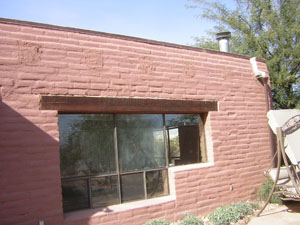
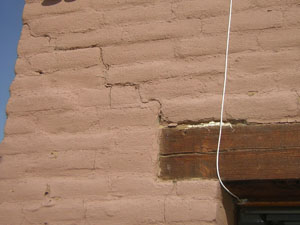
C: I'm going to attach a photograph of the windows that is a problem. Also attaching a photo of a crack that has developed at the corner of the garage. The windows are my main concern right now but if you have a suggestion about the crack I'd love hear that too.
The crack following the mortar joint is usually indicative of some movement in the wall. It does not look like a moisture-induced problem. The big window assembly is a mighty wide opening for the lintel. Usually an opening of about 9-feet is the limit for a 6 x10 lintel. That looks like it has a depth of 8-inches and a width equal to the wall. Might be just fine. There are no cracks above to indicate deflection.
Now, to respond to your questions:
The worse leak is exposed most of the day to sunlight.
We're at +/- 1500 feet altitude w/ 12 inches annual rain (no where near this year).
Yes, as you'll see in the photos, the construction is exposed adobe w/o stucco finish.
No parapets, flat roof, no overhang.
Wooden lintels, and inset
Glass is set mid- wall.
Window sill. Yews but see picture. Sill is concrete over adobe blocks.
Foundation footer is poured concrete.
Leaks have occurred in all areas, top, sides and bottom.
Aluminum flashing was installed by the "expert"., didn't work either
Sash and jamb color is dark.
Gringo blocks: unknown, not sure what this is?
Gringo blocks are wood elements replacing a few adobes in the wall surrounding door and window openings so permit nailing or screwing jambs or rough bucks into them.
I assume that what ever the final decision on the leak sealing method, I'll need to clean out the old caulk. So, how critical is the cleanliness. Do I need to have all new surface (scratch down to new block surface).
Cleanliness is not as important as getting down to firm, solid surfaces. Mud, for instance will be happy to bond to adobe and old foam but maybe not silicone caulk. My experience is that for some strange reason, silicone will stick to adobe bricks, but adobe mud does not get a good "bite" on silicone.
I'm thinking that for appearances the new "Mud" should be used at least as the top coat. What is the formula for the mud/mortar?
Dirt and water. 30%clay and 70% sand is the best mix. It can be stabilized with a bit of emulsified asphalt if available or Franklins waterproof carpenter's glue or similar Elmer's product. Try 3 ounces, liquid, per gallon of mud.
Where might I search for the materials?
The ground, hardware store.
Should a "seal coat be applied over the Mud?
No.
(There have been 2 "seal coats" applied in the past, neither seem to have worked. I have the left over of one type, CP500-W. Don't know what the other was but think it may have been some type of Thompson's water sealer.
If a sealer is a complete moisture, vapor barrier it will sooner or later fall off in sections. Any moisture that gets behind it cannot get out, is stopped at the surface and turns the adobe to mud so the sealer just falls off with a molecular layer or two of adobe.
You probably noticed from the photos sent that the house was also painted. If at some time we decide to have the entire house stuccoed(sp), will it be necessary to remove all the paint?
Maybe rough it up a bit especially to counter its vapor/moisture barrier properties.
I was told that all openings (windows, doors) have rebar and/or steel support reinforcement on the sides.
Whoever told you that, cross 'em off your list of friends or just shoot 'em.
Did I tell you that the adobe block is "stabilized with asbestos"?
Holy rusty banjo strings.
Q: What can you tell me about the materials and process of adobe flooring?
A: 30% clay, 70% sand. Mix and pour using the techniques worked out by the concrete floor people. Takes a long time to dry. You get to trowel it again if you don't like the first results. Once it's very dry, linseed oil can be soaked into the top surface to harden it a bit. Don't leave any linseed oil whatsoever on the surface after 20 minutes. It will turn gummy. It's the worlds cheapest, easiest floor. Don't expect it to last over 3000 years.
Q: In updating the electrical (our house has conduit running everywhere) can the adobe be scored out in runs and then replastered?
A: Yes, that is how it should have been done. The channels for the wiring need to be 2" deep. You can run type UF cable to meet the electrical and adobe codes in New Mexico. Fill the channel with mud almost to the surface then replaster. I find that the use of 3" or 4" gold deck screws are great for anchoring the switch and outlet boxes in the adobe wall. These screws have a large, aggressive thread that really gets a bite and hold the box. I also recommend the use of mostly metal boxes as they have straight sides instead of the slight taper of plastic boxes. The plastic boxes feel to me as if they just want to squirt out of the wall. Besides, each metal box in contact with the adobe wall adds to the grounding of the system which is a major concern in modern electrical codes.
Q: I have a brick fireplace with the top and exhaust pipe made of tin. Can I cover the tin with adobe?
A: You can certainly do that and it has been done for millennia. The International Residential Code does not recognize the fact that adobe is as fireproof a material as can be found so it won't meet Code. To meet Code, you would have to change the tin exhaust pipe for a clay flue tile and then surround it with fire brick or solid pumice bricks. You would probably have to rebuild the entire firebox with fire brick, too. It's a strange world.
Q: Where can I find a variety of floor plans for adobe homes?
A: Laura and Alex Sanchez published a book called Adobe Homes for Today. I can't track it down at the moment. Book costs about $25 and each plan can be built in stages and finished in Pueblo, Territorial or Mountain Gable styles. Plans can be purchased from the Sanchezes on disc in CAD for about $25 each. Plans can be modified by a CAD knowledgeable person. I don't see how they do it at that price. Maybe that's why I cant find it. Most of the houses have adobe perimeter (exterior) walls and frame interior walls. I prefer to build adobe all through the house. Soundproof. Solid. Fireproof. Don't have to learn a new set of materials and tools. My last known email address for Alex is; alexsATunm.edu
Q & A: I am writing to find out if you use insecticides in adobe homes.
I built and renovated adobe homes for 25 years. I never used an insecticide in those homes nor did I place soil poisons under them. Some builders and homeowners do use insecticides and soil poisons but NM has a large number of builders who understand the need for non-toxic homes.
How long do the wooden beams in the ceilings in adobe houses last?
Wooden beams and the round poles, vigas , last hundreds of years as long as the roofing material is maintained.
How much wood is in an adobe house?
Because of the beams and vigas and often wood ceilings and the door and window frames, there is often more board feet of lumber in an adobe home than in a stick built frame home.
How hard is it to build an adobe house?
Brutal
How many people does it take to build an adobe house?
one person 4000 hours. two persons 2000 hours. four persons 1000 hours. Any combination to give 4000 person hours. (Four thousand persons for one hour is awkward but Habitat for Humanity comes close.)
My wife and I only need a house about 24feet by 22feet.
Oh, well then 1328 person hours
We could go 24 by 24.
1450 person hours
I cannot work on mechanical devices very well.
Hire out the plumbing heating and electrical. Those hours are included in the numbers above.
Q: Please advise on hanging animal mounts like elk,etc. weighing 30 to 60 # on adobe.
A: Four or six inch gold deck screws or same size just plain black sheetrock screws driven in at a 15 or 20 degree downward angle will hold darn near anything. We use them to mount stair rails to adobe walls.
Q: We are a small family operated business in Montana. We have been selling tipi poles and fence rails for 20 years. Our business is Whispering Pines Pole Co. We have a source for small round wood. Wanting to find an outlet for latillas, not sure if I am spelling it correctly. Small sticks used in the construction of southwestern building.
A: Latillas are indeed a common decking system over the vigas which are the main structural support of roof/ceilings in many adobe homes. Locally they are marketed as peeled poles of 1-1/2" to 3" diameter. They are often sold in 8' lengths at around $5 for the smaller diameter. Viga spacing is 24 to 36 inches and the latillas may be placed diagonally so it is hard to know in advance precisely the lengths to use with the least waste. Often times the person who harvests and peels the poles sells them from the back of a pickup truck along certain highway intersections around New Mexico. Larger retailers are Adobe Builders Supply in Albuquerque and New Mexico Vigas and Timber in the Espanola area. Old Pueblo Adobe in the Tucson area. They might buy at wholesale prices from a supplier such as yourself. Aspen, cedar/juniper, and pine,fir, spruce are the preferred species.
Q: I'd like to build an adobe wall around my house in place of a wood fence. Where do I begin finding someone to come supervise? Right now, our budget is $900 and we live just outside of Mojave, CA.
A: I will check to see if any of my students can get to Mojave. An adobe wall on a concrete foundation about 4-feet high can cost about $40 per linear foot if you have to buy the adobes.
Q: I'm trying to find an architect or builder who can verify that the interior and exterior walls of Santa Fe and southwest homes are generally irregular and imperfect to create the look of above home styles.
A: I was a licensed general contractor in the State of New Mexico building only adobe homes for 25 years. I am now an academic teaching the only full-time adobe construction program in the USA here at Northern New Mexico College in El Rito. I will be glad to verify that the walls, ceilings and roofs of adobe homes are somewhat irregular and imperfect both inside and out. Builders and tradesmen do their best to make the walls as regular and perfect as they can but there will always be some discrepancies since they are using materials not produced in controlled conditions factories.
I would also be happy to verify that many frame builders, in order to make their homes look as if they were adobe, go well beyond what is necessary in making their work appear to have the perceived irregularities of adobe homes. Builders and tradesmen take great pride in misaligning framing members and keeping things out of plumb while leaving gouges and other faux mistakes and discrepancies in finish surfaces. Thus, the way to tell true adobe construction from imitative adobe construction is that the true adobe is usually far more regular inside and out.
Q: Can adobe be used as a cement to hold stone or other materials together to construct a house? I see where mud has been used to put between logs in cabin building. But is it strong enough to be a bonding material?
A: It was done at Chaco Canyon and in many historical buildings throughout the world. Might not meet code.
Q: I live in eastern Colorado - about 40 miles east of Denver. I would like to build a fence using adobe post/pillars with split rails in between. This would mostly be used to fence off the property (3 acres), but would love it if I could use it to keep a horse in as well. Is my area conducive to this? Can I just use the clay soil from my land? (lord knows it's got to be good for something!) how many bricks would you estimate for each post? What would I use at the base of each post (sand, scrape the sod or cement?) Would straw bale construction be a faster/easier/better idea? Thanks for anything you can tell me! (I'm breaking the unwritten rule of plastic white fencing around here, so it has to look good, but I want it 'green')
A: I think that you live upon one continuous potential adobe. It might not be right at the surface where there may be pesky organic materials that foster growth of plants. Just below the dratted farm or ranch land there should be abundant clay and sand. The best adobes, mortars, plasters and floors of adobe have 30%clay and 70% sand. If there is not a perfect layer, then further down there will be sand and clay layers that can be blended.
Under your pillars you need a good foundation. Large gravel in a trench 4" wider on each side than the pillars will do. The trench needs to get down about a foot and terminate in a flat bottom on undisturbed earth. Gravel foundations do not have to get down to the frost line. They may be outside what your local building officials will allow although over on the wild-eyed Western Slope and around Rifle and Carbondale they are permitted. A concrete foundation well understood by builders and inspectors needs to get down to frost line and should also be wider than the pillar at the bottom of the trench.
Adobe bricks need to be well above the surrounding dirt level to keep them dry most of the time. You could make 8"x 16" bricks and lay them up side by side for a 16 by 16" pillar. Alternate the direction of the adobes each course to tie it together. To go six feet you will need about 32 adobes.
If your horses are frisky and like to probe their containment system, they could lean on the rails hard enough to loosen adobes at the top of the pillars. A clever person should be able to figure out a solution to that. I am out of clever by noon Thursday every week.
Q: Thanks for making me laugh so late Quentin... I needed that. So, it sounds like I can do this pretty well by using a skid digger or backhoe (lord save us!) to scrape down a foot (?) to clay, move that wonderful, pesky top soil to my garden, move the river rocks away from my house and to the scrapped area, and bake some bricks for fence posts! Sounds like fun... country girls don't need no stinkin' gyms anyway! Seriously, thanks for the info, I'll let you know how it turns out at the end of summer. Oh..one other question if I may... is there something other than the adobe brick that is used to cover the whole structure or are the bricks left exposed?
A: Just plain, natural adobes will weather away over the years. That can be viewed as a romantic journey to a wonderful ruin or it can be viewed as a disaster. There are some wonderful corners of adobe buildings on the high plains around the Oklahoma Panhandle. To avoid this many cultures plaster adobes with mud plaster that is viewed as a sacrificial layer that is replenished every year or seven. Other cultures add emulsified asphalt or lime or cement to make the adobes more water resistant. In NM lots of people use cement/lime/sand standard stucco over the wall to get a lifetime of 50 or 60 years. Flat rocks on top of the wall extending beyond its width, clay tile rooflets, the list goes on......
Q: Given the recent forest fires in California, and the use of wood to build homes in forested areas are adobe homes more fire resistant? I am thinking that if they can withstand forest fires then it would be smart to use these homes in areas where they are likely to occur. Building homes that are in sync with the environment and the elements of mother nature makes sense both environmentally and moneywise. Can you tell me if an adobe earth home would be more resistant to forest fires?
A:
Adobe itself will not burn unless the entire planet ignites. Still, we have a tough time convincing building officials of that unless we can show an appropriate ASTM Test E 119 or NFPA Test 250 that demonstrate a two- or four-hour rating. It is obvious to most of us working with adobe that it is as fire resistant as anything can be but to do the actual tests requires around $75,000 and there is no adobe industry association with that kind of money so we just have to rely on our good common sense.
An adobe home with low adobe parapets and a good old fashioned earth roof would be very difficult to damage in a fire. However, attention has to be paid to doors and windows so that they remain intact in a conflagration. It would not hurt to design fire resistant shutters for them just an folks in Florida have storm shutters ready to go for hurricanes. A more modern house with a pitched roof would need to consider construction details such as the amount of roof overhang and how it might entrap a fire front moving up against the house and whether or not there should be vents in the soffit which would allow a wildfire to intrude into the roof cavity. Certainly a metal roof with a steep pitch and no gutters would encourage embers raining from above to slide off to the ground.
Here in New Mexico we see fires in adobe homes. The adobe walls are left standing. Wood parts around doors and windows including lintels can burn as well as the ceilings of vigas and latillas or tongue and groove lumber. These are usually fires that start from within. Adobe walls are as fire resistant as dirt. However, a house is a system so all the other components have to be well thought out to get the entire house up to the same or near level of safety.
You are absolutely on the right track. A wood-sided home with cedar shakes or shingles on the roof makes no sense in a dry, fire-prone forest. Here in New Mexico, about 300 homes burned in Los Alamos in a fire during May 2000. It is a town of smart people but I don't think anyone saw the obvious safety of adobe construction as the reconstruction took place. Perhaps one house got rebuilt as adobe.
Q: We have recently purchased an adobe brick home in Fresno CA, built in 1964. Some of the rooms have a distinct smell to them... Smells like adobe, but just seems to be too strong a smell. Is this smell common or is it symptomatic of some other problem? Is there any way to seal adobe without ruining its natural look and feel?
A: I don't associate any smell with adobe homes. When wet, adobe bricks or mortar or plaster give off a damp earth smell which goes away when it dries out. You might have a moisture problem that comes from the ground up or perhaps from the roof down if there is small roof leak. Adobe walls can be sealed with OKON W-1 or 2 which can be found on the web. It is a sealer that maintains breathability and water vapor permeability. You do not want to seal the walls with an impermeable sealer if there is indeed a moisture problem since the moisture needs to get out somewhere. In fact, I would not seal the walls before a little sleuthing around to see if the source of the smell can be located.
Take a good look at your roof system and connections to the wall systems. If moisture is rising from below it could be from the outside ground level having built up above the foundation level which often happens around any type of house as people plant flowers or grass. There may be places where water pools around the foundation or walls and then percolates down into the ground only to come back up in the walls.
We have found that sometimes we can detect moisture locations in walls by taking lots of readings of the wall surface temperatures with a point and shoot infrared thermometer. Evaporating moisture makes areas of higher moisture cooler than surrounding drier areas.
Q: I was interested in building an outdoor patio (with no roof) in the SF Bay Area. For walls, I'm tempted to explore natural walls. It is possible. Is it strong enough (for built in/attached benches made of the same materials?)
A: Adobe certainly makes fine walls and they are or were all over your area. There is the Martinez House extant in the Richmond area. Then there are the CA Missions and lots of unsung adobe structures including John Muir's cabin. Adobe makes fine bancos, too.
Q: I have recently bought a 1927 built adobe home in San Diego and I love it. It is in great shape and I would like to keep it that way. This is my first home by the way and I feel very fortunate to have a REAL adobe house. I would like to know what I should pay attention to in order to keep it in great shape for another 80 years?
A: (Kelly) I would suggest that you pay especial attention to any areas that might show water damage and eliminate the source of this. When adobes are kept out of the weather, they will last pretty much forever.
Q: I am remodeling a beautiful adobe home built in 1908 in Marfa, Texas and have questions regarding the tiling of the bathrooms. I was told that in order to apply tile over the original walls that the lime would have to first be removed from the surface of the walls or else the thin set would not stick. Is this the case? If so, how is this done and is there a further process or other materials that need to be applied to the walls prior to tiling?
A:
As always, the definitive answer is: "It all depends." Some lime plasters would be perfectly capable of carrying tile. It is done in the Middle East all the time. As always, bathrooms as built in the USA are a bit more problematic in that there is elevated humidity and sometimes, of all things, water flying all around. Some lime plasters don't do well under those conditions. Gypsum plasters as formulated in this country do not either.
In my own building career, for bathrooms we always used a standard cement/lime/sand plaster as formulated for exterior stucco as a base for tile in bathrooms. Cement based plaster is perfectly happy with tile and moisture.
Many things would work and much of it depends on your tile setter and the available plasterers available around Marfa. Thin set will not stick to adobe walls so a nicely done scratch and brown coat of the cement/lime/sand plaster on top of the lime plaster should work well as long as it can be determined that the cement plaster will stick to the lime plaster. If not, remove the lime plaster where the tiles will be used and apply the cement plaster directly to the adobe walls.
I am sure that all around Mexico tiles are adhered to lime plastered walls. You might find a Mexican artisan in the area who knows what to do.
Q: I have an adobe home in Albuquerque, NM, and I have an existing atrium space with sloped glazing which is similar to many earthship designs, except that it is the frustum of a pyramid. I have my return-air system recirculating the warm air in the winter months to great effect. The glazing needs to be replaced, and I'm at a loss to find any guides to doing this in a reasonably watertight way (no local glazing outfits want to touch it for fear of leaking). Any suggestions on where to look?
A:
You have hit on the Achilles Heel of Earthships. Glass manufacturers and installers will not warrantee glass that is not set vertically. Brother Sun in Santa Fe had an aluminum extrusion with epdm rubber inserts that clamped the glass nicely. It was produced by the originator of Brother Sun, the late Bill Yanda. I think it was called Sky Therm. Maybe. There was a design and installation guide available.
In any case the really important thing to do is to make sure that the glass is well supported at the bottom on two blocks of rubber or malleable plastic and that these are seated on the bottom piece of framing which is at a right angle to the vertical framing parts. If this is not done and the two layers of glass are not equally seated, one layer will slide downward over time. That is why no one wants to warrant the material or workmanship.
You can do the work yourself and expect a long life from the glass if the mounting is correct at the bottom. The other problem that will be discovered is that working with heavy glass units that are mounted on a tilt taxes the back of the installer.
Q: My partner is building a post and beam mudbrick home in the Blue Mountains in Australia, and we're to lock up currently working on plumbing & electrical (you can check it out at www.projectroom.com/craig/ ) We've run into a technical matter that we haven't been able to find an answer on yet... the bathroom walls are all mudbrick, and we're planning to line with cement boards on sections of the wall where the tiles will go... but what is the best way to attach cement boards to the earth wall (as its an uneven surface to start with...) and is this method workable as our base for waterproofing/tiling or do you reckon something else would be better.
A: You face the age-old problem of creating order out of chaos or nearly flat surfaces out of less flat surfaces. You can attach the cement boards to an adobe wall with 4- to 6-inch deck screws which are available readily in the USA. They are weatherproof with aggressive threads that grip adobe more powerfully than most people can believe and there must be an Australian equivalent. The hard part is to use lots of shims or furring strips or judicious squirts of foam insulation out of a can to achieve a planar surface. Polyurethane foam actually will bond to well made adobes and the cement board and contribute structurally.
You might consider plaster for the tile base. Cement/lime/sand plaster the same formulation as exterior stucco. We did two coats: scratch and brown (USA terminology.) Working with Mexican-made tile, any irregularities in the surface were fine since the handcrafted tiles were not perfect either. Good grout and a decent sealer complete the project. After 30 years there have been no failures. Adobe and stucco can handle a bit of moisture if the water seal is not perfect.
That's what we always did and I estimate that it is 273 times faster and easier. Of course, we are masons and plasterers. We hate bruised thumbs from hammer and nails and heartbreak of dead batteries or broken driver tips in the screw guns. Trowels always treat you well. Beyond that, we are eccentrics. Our home shower was plastered with mud for many years and gave a pleasant wet mud smell when used. Slightly less eccentric, the shower surround is now aspen wood tongue and groove mounted vertically so the water drains well.
Q: I was hoping you might recommend a good manual on adobe style houses. I recently purchased an adobe home in Argentina. it is about 80 years old and quite nice. The problem is that now its winter, and i have the heaters going to warm the house, and notice i have a lot of water condensation seeping through some of the walls. This primarily happens on the area of the wall between the window and the floor. Do you have any thoughts on the matter?
A: Adobe, Build It Yourself by P.G. McHenry, Arizona University Press. If this problem only occurs below windows the first suspect is condensation from the windows or perhaps a leak around the windows from wind-driven rain.
Q: We bought our exposed adobe home in 2000, in the high desert about 20 miles north of Phoenix. We love it, but so do woodpeckers. We have a citrus grove, and in the spring cross-pollenation apparently is by native "ground" or "miner" bees. I finally figured out that, especially in a wet spring, the bees burrow into the mortar to lay eggs which woodpeckers feed on for the rest of the year (initially I feared it might be termites, but there is no vegetative matter in our adobe). The woodpeckers and their food are out of control. Any ideas (the orchard stays)?
A: Bees and Birds! I have seen bee and termite incursions in Ocate, NM and Los Pinos, CO. Looks scary but the buildings still stand. If the woodpeckers don't chase the bee eggs any more than two inches into the mortar there should be no structural problem. More than that and you might worry. A kid with a fillable caulk gun filled with a mix similar the other original mortar could do a lot to fix the problem. Penny a hole? Nickel? Whatever it takes to get a kid moving these days is a bargain. Isn't there some finch that likes to fill holes? If you are nervous about the structural implications, we could dispatch our special adobe agent, Kirk Higbee, who is studying engineering in Tempe. Woodpeckers are no match for an engineer. Or is it the other way around.
Here is what one of my students, Katy had to say about bees: It sounds to me like you have orchard bees. You can buy (or make) habitat for them (block of wood with 5/16" holes drilled in it). That might encourage the bees to nest elsewhere. Google orchard bees and I'm sure you'll find a lot on homes for them. We should all be so lucky to have nesting orchard bees!
Q: I am an architect and have an existing building undergoing a major renovation. One wall is right on the property line and is required by code to have a 2-3 hour fire resistive rating. Can that wall be built of adobe, or would we need to replace it or build up around the adobe to achieve the rating? Is adobe recognized as a fire resistive material by the City of Santa Fe?
A: We can never predict what the City of Santa Fe will think about adobe at any particular time. Adobe should certainly meet the fire resistance requirements but I don't know of any definitive tests at the moment. I think you will just have to ask and hope that you have an enlightened person who understands that if earth burns, we have a problem on this planet. Worst case, he/she might require the adobe to be replaced with an inferior but ASTM rated wall system.
The city is, for now, simply assuming that adobe should be as good as clay & brick. However, I have spoken with a prior City of Albuquerque permitter, who I have enormous respect for, and have received a story I didn't really want to hear. Apparently adobe used to be informally accepted as a 1 hour rated wall because it is so prevalent, and because it could pass the fire portion of the test. Then the Adobe Assoc. (?) started pushing for a 2 hr. rating and that's when they shot themselves in the foot. He said most larger jurisdictions in NM no longer allow even the one hour rating. He said the real problem is that adobe doesn't pass the hose stream test required in the US. He did say it is approved in Australia, where no hose stream test is required. How interesting, but maybe not so helpful for my client and adobe builders...
Unintended consequences! It was not the Adobe Association of the Southwest but it might have been The Earth Guild or a former iteration of theirs. No matter...Actually, a plastered wall should hold up fine to the hose test. See how far you can get with the assumed 1-hour rating. Adobe is now in ASTM 9253 but I don't think there is any fire rating included yet.
We did get a positive response from NM CID for a 1-hour rating - assuming we provide 7/8" plaster each side. We will take that to the City where I assume they will abide.
Good. Still, adobe with full vertical and horizontal joints should be 3-hour. One step at a time.
Q: I am the community ambassador for the sustainable community our church hopes to build. We are purchasing land by Grants, New Mexico. We were planning on an adobe structure with a fiber glass roof to catch the rain water, to fill cisterns. I have been to the land once and discovered the abundance of volcanic rock. I grew up in Kansas where lime stone was used to build. I am looking for information on using the volcanic rock motared together with the adobe. Is this even possible?
A: Rock and stone are mortared together with adobe mud in many places at many times by many people. I know that it has happened at Chaco Canyon, Germany, Saudi Arabia and perhaps even Kansas. Volcanic rock may be very porous and will perform differently from Adobe. However if it is readily available, it might be very attractive to look to its use. You might even find some applications in the Grants area. Consider a metal roof in place of the fiberglass. Either will work, metal lasts longer.
Q: I have an adobe brick home and am in the process of remodeling a bathroom. I'd like to move the shower to the exterior wall but wonder how well the latex-painted adobe brick on that wall will hold up inside the shower? Is it possible/practical to tile over that segment with ceramic tile to serve as the interior shower wall?
A: I had my shower mud plastered for many years. Many considered me to be eccentric. The bathroom had a moist, earthy smell after showers. Then I put on latex paint. It peeled off in short order as some moisture would find its way behind the paint and then the bond with the adobe would dissolve and off went the paint. I now have paneled the shower with pine tongue and grove. It has a white stain to keep the room light. I am still considered eccentric by some and I miss the earthy smell.
You can certainly tile over the wall but you might need to apply a cement, lime, sand plaster to the wall for the tile to bond to for the same reason that if just a little moisture gets through the grout or around the shower head or valves, then the bond between the tiles and adobe gets damp and there it all goes. Or screw cement board, Wonderboard, or Hardy backer board to the adobe with 4" gold deck screws on a horizontal and vertical grid at 16" on centers and apply the tile to that.
Q: I saw ants crawling up the brick wall but did not see where they were going. Is it possible for ants to live inside the adobe and weaken it?
A: Not unless they have a huge colony with a queen in the wall which is very unlikely. The village of Ocate, New Mexico has adobe bricks where termites ate all the straw in the bricks leaving a wormwood effect. The buildings still stand and the walls seem as strong as the day they were built.
Q: I have just purchased an older adobe home with a flat roof. The canales on one drain to a concrete slab running the length of the home. My concern is that below each canale, the wall is water stained. I considered water barrels, but it would take 6 to do one side. Do you know of any other solutions or suggestions for reducing the splash back and damage?
A: The famous St Francis of Assisi Church at Ranchos de Taos has struggle with the same problem. Right now they have a stone lined basin at the bottom of each canal with a pipe to drain the water away from the building. The stones break up the cascading water and reduce the splash back. I don't think that would be any cheaper than water barrels but they would handle whatever flow might come off the roof. It is surprising how quickly a 55-gallon barrel can fill up.
Somewhere else I have seen large flagstones leaned up against the wall to prevent splash back from hitting the wall. It also helps if the concrete has good positive drainage away from the wall. In many cases either from initial construction or settling over time, the concrete slabs slope toward the wall which is a disaster for any house, adobe or frame.
Other homes have downspouts attached to the bottom of each canal and are successful if the downspout has an elbow at the bottom and a horizontal run of the pipe to get the water away from the wall. Successful systems have a low, 1-inch dam just beyond the downspout to get the water to go down but in case of ice or leaf blockage the water goes up and over and out the canal.
The splashed area could always be painted with a waterproof masonry paint and that has been done but once painted a stucco wall cannot be easily re-stuccoed. We did that at one house but wish we had not.
Q: I have an accepted offer on a 100 year old adobe home n Yuma AZ. My realtor is arranging an inspection. Can you give some advise on what I should specifically ask the inspector to look at? The home does not have a standard adobe flat roof but, a standard angled roof covered with 3 tab shingles. It also has an extension at the back that looks like T1-11 siding. Any advise would be greatly appreciated as I'm sure it will take quite a lot of restoration if I proceed with the purchase.
A: (Kelly) Having just bought a 70 year old adobe house in New Mexico, I have recent experience of going through such an inspection process. Adobe itself does not degrade, as long as it is kept dry, but can erode or slump if it gets too damp over time or is exposed to the elements. So it is important to inspect for signs of moisture damage and erosion, both inside and outside. A good foundation (in our case it was mortared stone) is essential, and can lead to cracks in the wall, slumping roofs, bowed floors, etc. if defective. A thorough inspection of the wooden structure for the roof (entering the attic if possible) and the crawl space under the house (if it has a raised floor) will reveal any dry rot, mold, termites, etc. that may have compromised the strength and durability of the structure.
My house also had a rear utility room that was wood framed and added the to original adobe house. It was impossible for the inspector to really investigate this space though, because it was inaccessible both below and above. After buying the house I discovered that this space was severely damaged by termites at some point and I have had to do extensive mitigation for this.
Other aspects of the house, such as plumbing, electrical, mechanical, etc., are virtually the same as any other house and should be inspected also. Good luck with this. If treated well, adobe is forever.
Q: I am a natural building enthusiast living in England. I'm contacting you regarding a photograph of an old building in Taos Pueblo, New Mexico, in 1925. It is obviously a beautiful naturally built structure, hopefully a cool refuge from the fierce afternoon sun. There is a small dome built into the base of the structure, between the two women. I was simply wondering what use would have been made of the dome. Is it a bread oven ?
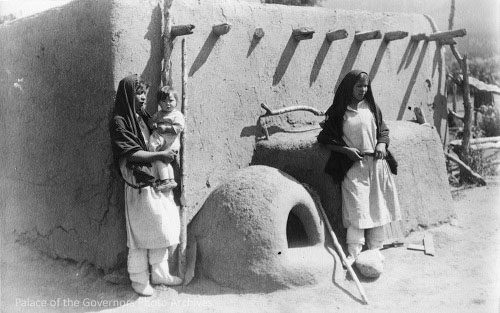
A: You are correct. It is an adobe brick, or just plain mud baking oven. It is called an horno in Spanish. In the Tewa language it is called a pan-te. In Taos, however, they speak Tiwa which is similar but there are enough differences that it is not easy for the Tiwa to communicate with the Tewa speakers. Or the Towa speakers, or Keres. As far as I know the horno was introduced by the Spanish who learned about it from the North Africans who came into the Iberian Peninsula.
There was a program on public television perhaps fifteen years ago called the "Three-Thousand Mile Garden" in which a person in Britain exchanged gardening tips, recipes and experiences with a person in New England. One of them, I think the Brit, had a mud oven which instead of a dome was a vault. It was fired with wood at one end and the smoke escaped from a chimney at the other end. It was cleverly covered by a roof that keep the rain from eating it up. I don't know if the fire is maintained while baking. In an horno, the dome is fired for several hours to build up heat. Then the ashes and wood fragments are swept out and the floor of the dome is mopped (quickly). The little oven in the photo would hold about nine loaves of bread inserted with a wood tool similar to what is used in a pizza oven. The door is closed with wood (wrapped in wet burlap or denim to avoid its burning) a steel plate or door, or it is simply bricked up quickly with adobe bricks and mud mortar. Bread is done in about 20 minutes. Then there will be enough heat for cookies and pies and after that there is still enough heat to slowly roast a goat or leg of venison or elk. The horno interior will still be around 300 degrees F the next morning, Feast Day
And yes indeed, the house behind the horno would be a cool refuge from the summer sun of New Mexico.
Q: I am making Compressed Stabilized Earth Bricks and Blocks and need a water proofing compound for external applications. Please note that we are going to build in India some 50 Million Rural Homes from Earth Bricks and need this product on a large scale but at an affordable pricing.
A: I applaud your plan to build with earthen materials on such a large scale in India. I have tried every available compound for waterproofing earthen walls by external application. My viewpoint is that there is to date no reliable, predictable chemical that works in the long haul. Whatever you might use, it needs to have significant moisture vapor permeability so that any water that does get into the wall can leave as water vapor. Otherwise, moisture in the wall is held against the inner face of the treated wall and the build-up of moisture causes the treated surface to fall off in large sections. So the magic chemical needs to be liquid water impermeable but water vapor permeable. I know that the chemical industry in India is well developed and sophisticated. There must be a chemical engineer somewhere in India who would take an interest in your situation.
Q: I am buying house with adobe walls, built in 1989. I have 2 questions: 1) How do I repair these nail holes, so that I can paint over them? 2) What is the correct way to hang a picture on an adobe wall? Looks like putting a nail in isn't such a good idea!
A: One joy of adobe walls is that you never have to search for a stud as in frame construction. You can put a nail or screw anywhere you want. It should be inclined downward a bit so that gravity forces are not trying to pull it out. 8d or 16d nails can hang all sorts of things. Course thread drywall or deck screws almost always get a terrific bite in adobe. They should be three-inches in length or longer. A pilot hole with a small masonry bit may be helpful for both nails and screws although some screws now come with a self-drilling point. I have hung kitchen cabinets and even attached a stair railing to adobe walls. In a pinch one can find 5-1/2" screws. In any decent adobe wall you can feel the drill motor slowing down just as if you were going into wood. If you don't get that feel, then you have hit a bad adobe or the mortar joint or an air pocket. The solution is a longer screw. For the faint of heart, there are Adobe Anchors which are three wood wedges that go into a square hole made with a steel square pipe. A mounting screw goes into the center wedge.
Now for the repair of nail and screw holes: If it's raw adobe, damp terry cloth rubbed over the wall closes small openings. If it's plastered, I use a cheap caulk and hopefully it's labeled painter's caulk. Once you learn the cure time of the caulk, it can be gone over with that wet terry cloth or even a paper towel to match the texture of the surrounding plaster.
Q: I am trying to find something that will mount on my adobe exterior wall so I can hang my Sun shade from it. Any suggestions of what type of bolt or mount that could work for this application?
A: We can mount all sorts of things on adobe walls with nothing more than long deck screws. If this is a fabric sun shade, however, they are subject to all sorts of forces when the wind blows. I have four of these around my house. My solution is to drill all the way through the adobe wall and use 5/16" or 3/8" all-thread rod with 4" square washers inside and out made with 3/4" CDX plywood followed by steel washers and a nut. It takes some looking around but one can find rings with a threaded base that will screw onto the threaded rod outside to take the ropes from the sun shades. As an alternative, a piece of treated or cedar 2 x 4 wood can be bolted to the wall with several threaded rods and then a standard ring with a threaded screw end can be screwed to the board. Then there is the job of covering the plywood, washers, nut and rod end inside the house.
This is a major operation and if you are not up to all that you might just try very long deck screws which can be found in 4"- and 6"-lengths and they will drive right into the adobe through a pilot hole in the stucco if there is stucco to deal with. Don't try anything that attaches just to the stucco. The worst thing that can happen with deck screws into the adobe is that one might pull out in a high wind. Then you have a hole in the wall and can insert a lag bolt that is slightly longer and slightly larger in diameter. Or just start the process with an 8"- or 10"-lag bolt. The big trick with deck screws and lags is to pre-drill a pilot hole that is slightly less diameter than the fastener itself. The big trick is to find a well-stocked hardware store such as Ace or True Value that comes equipped with an older person who has been in the business for twenty or more years and knows the inventory.
Q: We’ve started remodeling an adobe home I purchased that was built in 1900 and when we removed the kitchen cabinets I noticed that the hardwood kitchen floorboards had moisture damage. We pulled up the entire floor joists and all and found that the kitchen does not have a concrete or stone footing. They’re placed directly on the ground. I suspect that initially the kitchen was the main house because no concrete was used. The other three rooms do have some sort of rock/cement footing so perhaps they were additions when concrete was more readily available. I’m guessing here. Here’s where it gets scary. The leak was under the dishwasher and it has saturated the base of the wall. I have a dehumidifier and heater in the room drying the soil. A relative of mine told me I should just pour a concrete floor as it would be more “water proof” but somehow that does not seem like the best solution to me. The walls have been covered with cement based plaster both inside and out and I don’t know how any moisture that may have moved up the wall would evaporate if I cement it in. I’m thinking that perhaps once the wall and surrounding ground dries I can mix up some adobe with straw and in a cob fashion fill in the cavities. Then perhaps I can apply the gravel, sand, brick flooring so that the wall can breathe through the floor and moisture has somewhere to go. I don’t like to work twice so I’m trying to ascertain the best way to approach this problem. Your insight will be greatly appreciated as my anxiety level is climbing by the hour.
A: In a word, relax. Just imagine that you are in a beauty salon in the main train station in Lisbon and they have just offered you the choice between coffee and wine. Choose the wine. What you have written is the basic text for dealing with moisture in existing adobe walls. You are absolutely on the right track and all you need is time for the wall or walls to dry thoroughly along with the moisture in the dirt below the floor – which does not appear to be too bad, as in muddy. The wall does not look too bad. Some plaster seems to have fallen off at the bottom but there are no big bubbles where large areas of plaster have detached from the wall. You are in no danger of wall collapse or of any further damage. In El Paso, with its low humidity, the time to dry might be three to four weeks. Perhaps a bit longer since it is El Paso's best effort at winter right now. Besides, or in place of the dehumidifier and heater, you could run a big fan in the kitchen. Before you put things back together three days of running an ozone generator from a rental company would kill off spores, mold and other biological undesirables. I would also suggest that you drill half-inch holes every six inches with a masonry bit horizontally and vertically in the plaster that was behind the cabinets and dishwasher to increase the opportunity for wall moisture to get out. I faced essentially the same view in my own kitchen three months ago. Dishwashers and their plumbing connections are nothing but trouble. I just shrugged and let the wood and plaster dry out. Also, I have rooms in my home that show no evidence of a recognizable foundation.
Q: I recently purchased a 1950’s remodeled adobe home in Santa Fe. The seller had recently plastered the walls in one room and 3 of the walls showed signs of moisture where the wall meets the floor. The seller claimed that this was just the plaster drying as he had put it to market too soon after finishing. However, I’ve been in the home for 2 weeks now and the moisture pushing out of the walls has gotten worse. Photos of the room prior to the remodel show that the wall in these areas had been damaged. I’m wondering if he tried to incorrectly patch the adobe and then plastered over it too soon, locking moisture in which is now seeping through. In the worst area chunks of plaster have fallen off the wall. Any help would be greatly appreciated!
A: Cement/lime/sand plasters cure mostly in a week and completely in four weeks. In any case they rarely release moisture. Gypsum based plasters are about the same. Earth based, adobe plasters can take longer to fully dry out in the winter. None of these plasters will lock moisture in - they all have some moisture permeability. Cement gets better with time and moisture, gypsum will loose strength over time with moisture and adobe goes back to mud and falls off the wall. So it appears that there was some source of moisture under the plaster: A leaky pipe nearby is one of the most common problems and that's usually around a bathroom or kitchen. A roof leak can send water into walls and travel some distance from the point at which it enters the structure. Cracks in exterior stucco on vertical walls, around doors and windows, on the horizontal part of the parapet can let rain into the walls. Water in and on the ground can result from roof run-off or where snow builds up on the north. If you have an adjacent neighbor the area between houses can accumulate higher than normal moisture. A nearby irrigation ditch can raise the water table. The ground surrounding the house may not have good downward slope away from the house out a minimum of six feet.
Q: I have new windows being installed in a 1978 adobe home covered by plaster/stucco. The installer did not seal it before stucco and the windows have leaked, the adobe is soaked. Mud came in in sheets. I feel the windows are not sealed and stucco should not be applied until the windows are sealed. Am I correct? Does the adobe need to dry out before stucco?
A: First of all the adobe needs to be thoroughly dry before stucco is applied or else you will have moisture sealed inside the wall. Putting new windows into an older home can be tricky and especially when the wall is adobe. When you say sealed, I am assuming that you refer to the strips of waterproof fabric or tape or metallic material that often has an adhesive on one side. Most of these are made for frame walls and assume that the window is set into an opening that is surrounded by plywood or oriented strand board or sometimes even exterior sheetrock. With an adobe wall there may not be a surface to which the sealing membranes can attach. These modern adhesives are not made for adobe.
Ideally - and it should be the case for a 1978 adobe home - the original windows would have been set into a rough buck which is a wood frame in the adobe wall that was installed as the wall was built. The interior dimensions of the rough buck would be the dimensions of the rough opening called out by the window manufacturer. If rough bucks are in place and your new windows fit into them then they will be sealed by a membrane that spans across the window frame and onto and an inch or so beyond the rough buck. The assembly would then be ready for stucco. Modern builders are often not acquainted with the simple methods of adobe but if they have experience with brick, concrete block or other masonry materials they often follow the same methods.
Gaps between the window frame and the rough buck or the adobe itself where there is no rough buck can usually be accomplished with one-part insulation foam that comes in cans. The formulation made specifically for windows and doors should be used since it will expand less and put less pressure on the window frame. This stuff is urethane or polyurethane and is the same chemical used in the original Gorilla Glue. The foam is one of the few things that will stick to adobe.
Q: Researching adobes on the California Ranchos of the early to mid 1800s. With a condition that a home be built within a year and a half to be granted title, I was wondering if you knew how long it actually took to build a small adobe structure back then?
A: Back then there were no worries about code compliance, nor any of the things modern Californians have to put up with to get a home built. A person could just get to work with minimal plans and not much official oversight. A modern adobe home of modest size around 1600 square feet can be built with about 4000 man/woman hours of labor. In the 1880's a house would have been simpler with little electrical, minimal plumbing and no insulation or air conditioning to cut back on the hours. Let's say 3500 hours which is about a full year, no weekends of 10-hour days by one person. A crew of three could work 8-hour, 5-day weeks for thirty weeks to accomplish the task.
A really simple house such as we find all around Northern New Mexico could be built by three people in: Three weeks to make adobe bricks, one week to build the adobe walls, one week to attach vigas or beams for the roof structure, one week to build a roof deck, one week to put in doors and windows, one week to cast adobe floors, one week to plaster the outside, one week to plaster the inside, one week for rudimentary plumbing.That's twelve weeks. A home under a thousand square feet would serve the owners well and could most likely be built in eight weeks.
Q: How much would a three bedroom/3 bathroom adobe house cost? My husband and his brother are making the adobe bricks themselves and we would like a two story if possible.
A: Well if you make and lay the adobe bricks yourself and participate in the rest of the construction, an adobe home can be built for around $80 per square foot. If built by a contractor, it will cost between $140 to $240 per square foot. Those are USA prices and at present it is not easy to find contractors who want to do adobe.