Education related to Adobe Building
 Quentin
Wilson and
Associates, specializes in solar adobe design and construction. He grew
up in the South Valley of Albuquerque, New Mexico where he watched adobe
bricks being made. In the fifth grade, he made miniature adobes on cookie
sheets in his mother’s oven in order to construct house models for
a class assignment. By age thirteen he made full-sized adobes in the back
yard and ruined the grass. Later, he traveled a bit, went through the
Army, and graduated eventually from the University of New Mexico with
a major in physics, minors in math, chemistry, and education in 1970.
After teaching high school two years and community college math for three
more, Quentin moved into professional solar adobe construction in 1976
as the Project Manager and Instructor for the Sundwellings Demonstration
Project at Ghost Ranch, Abiquiu, NM. He became a licensed general contractor
in the State of New Mexico in 1982. He has been building homes and teaching
seminars and workshops ever since. In the fall of 1995 he established
and taught the full-time Adobe Construction Program at Northern New Mexico
Community College. His website, quentinwilson.com, lists the course schedule and many other resources related to working with adobe.
Quentin
Wilson and
Associates, specializes in solar adobe design and construction. He grew
up in the South Valley of Albuquerque, New Mexico where he watched adobe
bricks being made. In the fifth grade, he made miniature adobes on cookie
sheets in his mother’s oven in order to construct house models for
a class assignment. By age thirteen he made full-sized adobes in the back
yard and ruined the grass. Later, he traveled a bit, went through the
Army, and graduated eventually from the University of New Mexico with
a major in physics, minors in math, chemistry, and education in 1970.
After teaching high school two years and community college math for three
more, Quentin moved into professional solar adobe construction in 1976
as the Project Manager and Instructor for the Sundwellings Demonstration
Project at Ghost Ranch, Abiquiu, NM. He became a licensed general contractor
in the State of New Mexico in 1982. He has been building homes and teaching
seminars and workshops ever since. In the fall of 1995 he established
and taught the full-time Adobe Construction Program at Northern New Mexico
Community College. His website, quentinwilson.com, lists the course schedule and many other resources related to working with adobe.
Q: I'm building an adobe art gallery, 20'x18'. The bricks are stabilized 7adobe dirt/1sand/1/2cement, and they are very durable bricks. My location is a beautiful tract of land near Big Bend Nat'l Park, with a great view of the park. I've put up one course of adobes, and was thinking about putting on a workshop for putting up walls. How do I go about promoting this project?
A: Simone Swan hosts a workshop at her home in Presidio to demonstrate mud plastering. She has a talent for gathering people from great distances. I lack that talent. I do lots of classes on adobe construction but we usually just tackle a short wall and corner or intersection. We mostly spend our time demonstrating the several ways of putting up masonry walls and the fastest methods we know. Then I turn students loose to pursue their own projects. If they are nearby we go visit them as they progress and offer suggestions when appropriate. To get a building built that you own, you begin with students who have a slight if unspoken reserve that they are contributing to someone else's ultimate new worth. If you are 80 years old, widowed, blind or in a wheelchair they are less inclined to think like that. It also helps if there is some expertise to be shared with participants. That expertise usually comes somewhere around the third structure. There are some folks at Blue Rock Station in Ohio who seem unintimidated by their short term experience and have opened their first project to hundreds of children and thousands of adults to demonstrate alternative building systems. Their website might offer insight into how they attract the multitudes.
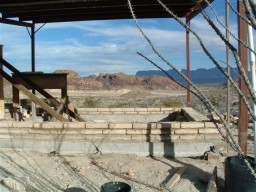 R: Thank you for your suggestion. I do know Simone's buildings. I've had some experience in adobe building, as you may see my work in the picture. A group is good, because its easier with multiple people, and they don't have to work so hard, and can learn so much. The fact that my building is an art gallery, they also will be able to revisit it, and show their friends something they worked on. I followed your web site recommendation to use cement as a mortar between the stabilized blocks. Here you see that I am attempting to get an old adobe look. And I do not plan to plaster over them.
A: After reviewing my response with my class, it was suggested that a good old-fashioned barn raising like the Amish, Presbyterians, Spanish, Farmers, Mennonites, Homesteaders, Baptists, Sinners, Seventh Day Adventists, Neighborhood Associations used to do. Actually, the Seventh Day Adventists still do it and people gather from all around to put up a new church. Perhaps Terlinguans would gather around a project for the sake of seeing a neighbor get a structure up.
Q: I'm a student at university in Turkey and searching a PhD thesis subject. Could you advise me about an original study area?
A: My wife and I were lucky to attend Kerpic05 at the Istanbul Technical University in July 2005. We were honored to tour in Cappadocia, Konya and some of the mountain villages that have earthen villages in the several styles found in Turkey. We also got to see Catal Huyuk which is the remains of the oldest earthen settlement that I have heard of. You live in a fabulous country.
Several topics come to mind: Given that earthen buildings last as long as people maintain them, why do they seem to have lost favor in most modern cultures? Are earthen structures more prone to earthquake damage than other materials or do poor building techniques contribute to the poor image? Recent findings in Cappadocia indicate that structures made of tuff (lightweight stone or pumice) contribute to the high incidence of lung disease found in the area. Would earthen structures be more healthy? American movie stars and wealthy people in New Mexico build trophy homes of adobe. Could this be a message for other cultures? A study of the feasibility of mechanized adobe production and distribution in Anatolya. A study of the feasibility of small-scale mostly human powered adobe production and local distribution in Anatolya. Economic modeling and comparison of mechanized versus small-scale production of adobe. A qualitative comparison of rammed earth and sun-cured adobe brick and mortar construction systems in the cooler, upland regions of Turkey. A proposed building code for earthen materials that would provide greater resistance to earthquakes utilizing good foundations, ring beams at the top of walls, good connections of roof systems to walls, and simply good masonry practices honoring aspect ratios, column sizing, door and window opening sizing developed millennia ago in the region. Development of regional guidelines for solar heating and passive cooling of earthen structures in the climatic zones of Turkey. Cataloging of past and present techniques for underground and partial underground dwellings and structures in Anatolya
Q: Here's the odd question of the year...I plan on building a 1/2 to 1/3 scale model of the Alamo. Where in Gods name do I start? It's going to be used for recreational purposes. It will not be lived in but will see some moderately severe use. Can you point me in a direction for training, advice, help (psychiatric and otherwise), support?
A: We do have an adobe information and support group at adobe-subscribeATyahoogroups.com. That gets you in touch with a lot of people with opinions, few of whom are actually building anything at the moment. You could become the poster child for Ambitious Projects. And then we have a full-time foundation to roof construction program here in El Rito, NM at Northern New Mexico College. The program is two semesters but we fit in the odd person with the odd project for a week or two and adopt them and help them however we can with dreams and projects.
Q: How much does the college course you teach cost and how many semesters to finish?
A: Two semesters. Tuition is around $350 for New Mexico residents and around $800 for non-residents. We have dorms and some married student housing at reasonable rates. Our classes are on the block system so some people come just during the two- to five-weeks duration of a class that particularly interests them if they don't have the time or interest to pursue a certificate. We can be seen at www.nnmc.edu under the link to El Rito Programs.
Q: I am very interested in natural building methods, especially adobe. I was wondering if you could recommend any internship programs were I might be able to get some hands on experience with supervision. The few I found searching google were a little above my price range at the moment.
A: We have suffered a slow period in new home construction around the Northern New Mexico College circle of students. The last student project under construction was completed in March by Tracy McB. We are discussing a major project around Santa Fe but that is still in the planning stages by a group of people who hope that with an owner group they can build homes more economically that what is now seen in the Santa Fe area.
Meantime, we have ongoing adobe construction classes here and we do as much hands-on as possible. From time to time, there are contractors in the area who will take on an apprentice. I will keep my ear open.
Q: Allow me to introduce myself: I'm a biologist from Nicaragua, a small poor country from Central America. I'm very interested in green home building techniques, because there's a huge housing deficit in Nicaragua, and nobody in my government really cares about this problem. I'm planning to create an NGO to provide cheap, decent home for the poorest, but I need help. Would you please help me to find out about organizations/experts that could grant me with some sort of training or expertise in order to achieve my purpose? I think that adobe or rammed earth would be good options...any help or information will be very useful.
A: Adobe is as green as it gets and it is at your feet wherever you are. It is the planet's most autochthonous material. I can talk you through any questions you might have via the Internet. If you want to come to our college in Northern New Mexico, a small, poor state in North America, we will cover your tuition and find someone to pay for your food and living costs in the dormitory. With even more work we can find someone to pay your travel costs. Our full program, foundation to roof is two semesters but for the energetic student one semester will suffice. Semesters start in mid January and mid August.
R: I'll be glad to learn from your team the ecological housing techniques, I'm sure something positive can come out of this experience (besides practicing my rusty English), -just kidding-. I really appreciate your kind help and yes, I certainly would like to go to your college, there's no better way to learn something than get your hands on practice. In Nicaragua adobe is almost an extinct art. The few persons that mastered this technique are pretty old to teach or most of them are gone, it is ironic because there's a lot of houses built with it, as an historic architectural heritage from Spanish colonization. Please let me thank you in the name of my people and of course, from me.
Q: I've just learnt about your mud project and I'm amazed. I recently visited my folk's town in West Africa. The ancient palace, built with straw and mud, (as were the pyramids), have been crumbling for decades now. The local's response is to tear down and rebuild using hideous cement bricks and replace the beautiful handcrafted pillars, most of them having been looted anyway, with ugly cement pillars or plain wood. I'm in a position to stop this process, and I've voiced my criticism. But in actuality, I have no resource or know-how. Can you help me in any way? I can give you more details and show you some photos if you're interested. I would appreciate any advice or help that you can render.
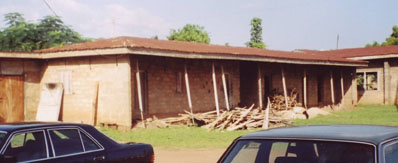
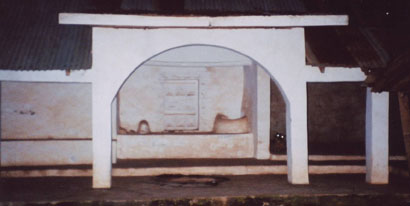
A: It is too bad that people do not value earthen construction. Here in the United States there are a number of large format books that people display on their coffee tables that record the earthen architecture in all parts of Africa. Spectacular Vernacular and African Canvas are just two that I can think of. Probably many of the people in the photographs that give us so much inspiration have never seen themselves in these books. Furthermore, they probably are not aware that in New Mexico, Arizona and other parts of the Southwest United States, adobe is considered the premium building material. Movie stars and rich people want adobe homes and we can see them on the websites of the expensive real estate companies: Sotheby's and Century 21 and Coldwell Bankers.
I am at Northern New Mexico College. We teach earthen construction here and have some of our courses available on the Internet. Soon we will have most of our courses on the Internet. We have a discussion group dedicated to building with sun-cured adobe bricks. We can give you lots of free advice and encouragement. We only want to see everyone, worldwide, living in earthen homes.
Q: Please could you give me advice any online courses offered for Adobe construction? I am an enthusiast from Pakistan, living in Houston, currently working in Nigeria and planning to built something in mountains in Ziarat, Pakistan (very similar terrain to NM or AZ). Traditionally the houses in the area are Mud Houses (adobe) but sadly the traditional builders have passed on and the trade has died down over the last many years - hence I need to educate myself and hopefully then I could direct the local craft to get the job done.
A: We have almost our entire adobe construction curriculum now available on the Internet. You can see our offerings at www.adobecollege.com
Q: I live in southern Baja California, Mexico, near the town of San Jose del Cabo. Do you know of any adobe/cob workshop taking place, now or in the future, in southern Baja California?
A: I wish I did but I do not. Jim Hallock has been active in Compressed Earth Block on one side of the water or the other in that area but I don't think that is going on at present. Website is www.tierraycal.com Meantime, we have Internet delivered classes on adobe here at Northern NM College dealing with all aspects of construction from foundation to roof. www.adobecollege.com
Strangely, my opinion is that students who take our online classes get a better hands-on experience than students who take the live classes, strange as it may seem, hard as it is to believe at first glance. That opinion is unbiased insofar as I only teach the live classes while Kurt Gardella and others teach the online classes. What happens is that in a group of ten students in a live class, 6 can be standing around with their hands in their pockets watching four work. In the online class every participant has to find dirt, shovel, wheelbarrow, water and make his/her own forms and adobes. Or vigas, latillas, nails, screws, etc. No excuses.
Misc. comments by Quentin about adobe construction:
In places I know of such as New Mexico, Colorado, Texas, Arizona, Alberta, Manitoba, Korea, Germany, Saudi Arabia, Morocco, Austria and perhaps parts of Colombia, Mexico, Chile and Argentina, rich people choose to build with mud/adobe to build or preserve premium homes. I myself cannot imagine living in anything without adobe walls. Poor people who have not been brainwashed by television and the Internet can build or maintain sturdy homes of earth for themselves at very little cost other than their own labor (which can be formidable.) However, labor is not the enemy that we might think. In some cultures, the harder one works at something, the more value it has for that person. Bricks can be made with local soil in simple wood forms or just patted into shape where wood is really scarce. Brick after brick can be placed to build the wall with no more than twenty minutes of classroom instruction or twelve minutes of on-the-job instruction or zero minutes instruction for the person embedded in an earth building culture. Television reports almost always add "hut" to mud homes so they are viewed as "mud huts" when in truth, they are very often ornate, comfortable, weatherproof, bulletproof, vermin proof, sound proof, fire proof, easily added to and easily torn down with no trace on the planet other than a pile of dirt which is ready for the next builder to utilize.
Properly built, meaning a good foundation with wall heights no more than ten times the width of the wall, adobe/mud/rammed earth/compressed earth block walls are among the most substantial walls on the planet. These walls are incredibly rigid. We raised three children in our home. We did not hear the loud music in the back of the house. When a teenager slammed a door it just slammed and the walls in the house did not shudder and reverberate and flex as in a frame house. When I taught high school an irate student simply punched a hole in the sheetrock in the hall. Can't do that to mud walls.
The best way to build with earth was developed at least six thousand years ago. Hands full of mud were placed on the ground and patted into shape with more mud on top of that once it was dry enough to support more until a structure emerged. Actually the really best system four thousand years ago was to use baskets full of mud so one person could carry more to the wall and turn the basket upside down with perhaps a bit of an impact to make it all stick together better as long as the drying rate was not exceeded . But really the best system three thousand years ago was to make bricks near a source of mud in wood forms and then let them dry in the sun. These bricks could then be mortared together with more mud at a rapid rate since only the mortar had to dry and not the entire wall. The only way to determine the best system for earth construction is to watch millions of people use it over at least five-hundred years and then we will know it is best.
Q: I'm very interested in building an earth home on my property in Arizona, but want to attend a building course. Since these homes are perfectly fitted for the southern Arizona area I thought I would be able to find training coarses near by. Do you know of any?
A: Adobe in Action has adobe construction classes spring and fall. Most are online and there will be one or more classes done in the field. www.adobeinaction.org. Joe Tibbets does three- to six-day classes through his Southwest Solaradobe School. www.adobebuilder.com should get you started on their website. Some of his classes are in Arizona. Santa Fe Community College has an adobe curriculum in place but I am not sure of where they are in getting it implemented. www.sfcc.edu
Q: I am a teacher in New York and we are learning about the regions. The use of adobe bricks are part of our current chapter. I was thinking of having them make adobe bricks using clay and hay in class. Is it possible to bake the bricks in the oven after they make them, as it is fall here and cold already. Any advice on this project idea of mine is much appreciated!
A: You can make little adobe bricks and bake them in the oven. Actually they should only be warm enough to evaporate the water in them so somewhere around 180 degrees Fahrenheit. I did this when I was in the fifth grade. Full size adobe bricks are 10x14x4 or 8x16x4 with lots of variations. A nice size mini brick is 1"x2". The best bricks are 30% clay and 70% sand. Put some dirt in a glass jar about half full then fill with water, seal it up and shake. Sand comes down first, then silt then clay. You can eyeball the layers or have students measure them and figure the percentage. Most soils are too high in clay and that results in the bricks cracking when they dry. Just fool with it and make test bricks. I use a heavy duty cookie sheet to make the bricks. spread out the mud and cut it with a pizza cutter while it is damp. Then the bricks will separate when dry.